Praxis 5331 Speech-Language Pathology Exam Preparation
About This Course
Praxis 5331 Speech-Language Pathology Exam Preparation
About This Course
Prepare confidently for the Praxis 5331 Speech-Language Pathology exam with a comprehensive, structured preparation course from AIProctoredExams. This course is designed to help speech-language pathology graduate students, recent graduates, certification candidates, and professionals strengthen the knowledge and clinical reasoning skills assessed on the Praxis Speech-Language Pathology examination.
The Praxis 5331 is an important professional examination for many candidates pursuing speech-language pathology certification or licensure. The examination evaluates knowledge across foundational concepts, professional practice, assessment and diagnosis, intervention planning, treatment, and evaluation.
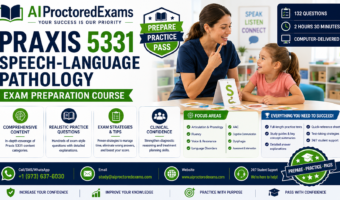
According to ETS, the current Praxis Speech-Language Pathology 5331 exam contains 132 selected-response questions and allows 150 minutes for completion. It is computer delivered and assesses knowledge relevant to independent speech-language pathology practice across settings such as schools, clinics, hospitals, and private practice.
This AIProctoredExams course combines focused content review, Praxis-style practice questions, detailed answer explanations, clinical scenarios, key terminology, assessment concepts, treatment principles, and test-taking strategies to help you prepare systematically rather than relying on memorization alone.
Candidates preparing for other Praxis examinations can also explore the complete Praxis Exam Preparation Courses available through AIProctoredExams.
Praxis 5331 Exam at a Glance
Before beginning your preparation, it is important to understand the structure of the examination.
Test: Praxis Speech-Language Pathology
Test Code: 5331
Test Length: 150 minutes
Number of Questions: 132
Question Format: Selected-response questions
Delivery: Computer delivered
ETS explains that the examination evaluates foundational knowledge, professional practice, assessment, treatment planning, intervention, and treatment evaluation across the major areas encountered in speech-language pathology practice.
For candidates pursuing the ASHA Certificate of Clinical Competence in Speech-Language Pathology, ASHA currently identifies 162 on the 100–200 scale as the passing score for certification purposes. Candidates should always verify requirements with their own state licensing board, employer, university, or certification authority because requirements can vary.
What the Praxis 5331 Course Covers
The course follows the major knowledge and practice areas associated with the Praxis Speech-Language Pathology examination while helping candidates connect theoretical concepts with real clinical decision-making.
Foundations and Professional Practice
Build a strong understanding of the scientific, professional, ethical, and clinical foundations required for speech-language pathology practice.
Topics include:
-
Typical speech, language, communication, and swallowing development
-
Anatomy and physiology of speech and hearing mechanisms
-
Neurological foundations of communication
-
Acoustic and perceptual principles
-
Language development across the lifespan
-
Cultural and linguistic diversity
-
Evidence-based practice
-
Research principles and interpretation
-
Professional ethics
-
Scope of practice
-
Documentation and clinical records
-
Interprofessional collaboration
-
Counseling and client education
-
Prevention and advocacy
-
Infection control and safety
-
Professional responsibilities
-
Relevant laws, regulations, and clinical standards
The goal is to strengthen both your foundational knowledge and your ability to apply professional principles to realistic clinical situations.
Screening, Assessment, Evaluation, and Diagnosis
A major component of speech-language pathology practice involves identifying communication and swallowing disorders accurately and determining their nature and severity.
This section helps candidates review:
-
Screening procedures
-
Case history collection
-
Client interviews
-
Standardized assessments
-
Nonstandardized assessments
-
Dynamic assessment
-
Observational assessment
-
Diagnostic reasoning
-
Differential diagnosis
-
Interpretation of test results
-
Reliability and validity
-
Sensitivity and specificity
-
Norm-referenced assessment
-
Criterion-referenced assessment
-
Cultural and linguistic considerations
-
Referral decisions
-
Interdisciplinary assessment
-
Clinical documentation
-
Communicating assessment results
You will also practice interpreting clinical scenarios in which several findings must be analyzed before selecting the most appropriate diagnostic or referral decision.
Planning, Implementation, and Evaluation of Treatment
Successful intervention requires more than knowing the characteristics of a disorder. Speech-language pathologists must select appropriate treatment goals, intervention approaches, data-collection methods, and outcome measures.
The course reviews:
-
Developing measurable treatment goals
-
Prioritizing treatment needs
-
Selecting evidence-based interventions
-
Establishing treatment frequency and intensity
-
Monitoring client progress
-
Modifying treatment plans
-
Generalization and maintenance
-
Client and caregiver education
-
Interprofessional collaboration
-
Progress documentation
-
Treatment outcome measurement
-
Discharge considerations
-
Follow-up recommendations
-
Ethical treatment decisions
Candidates will practice applying these concepts to both pediatric and adult clinical situations.
Major Speech-Language Pathology Content Areas
ETS indicates that Praxis 5331 questions apply knowledge across the major areas of speech-language pathology practice.
Speech Sound Production
Review the development, assessment, and treatment of speech sound disorders.
Topics include:
-
Articulation
-
Phonology
-
Typical speech development
-
Phonological processes
-
Childhood speech sound disorders
-
Differential diagnosis
-
Assessment procedures
-
Intervention approaches
-
Generalization and maintenance
Fluency
Understand the characteristics, assessment, and treatment of fluency disorders.
Review areas such as:
-
Developmental stuttering
-
Cluttering
-
Fluency assessment
-
Secondary behaviors
-
Counseling
-
Environmental factors
-
Fluency-shaping approaches
-
Stuttering-modification approaches
-
Treatment across age groups
Voice, Resonance, and Motor Speech
Strengthen your understanding of disorders affecting voice production, resonance, and speech motor control.
Topics may include:
-
Vocal anatomy and physiology
-
Voice disorders
-
Vocal quality
-
Resonance disorders
-
Cleft palate considerations
-
Velopharyngeal dysfunction
-
Dysarthria
-
Apraxia of speech
-
Childhood apraxia of speech
-
Assessment techniques
-
Treatment planning
Receptive and Expressive Language
Review language development and disorders across children and adults.
Topics include:
-
Morphology
-
Syntax
-
Semantics
-
Language comprehension
-
Expressive language
-
Developmental language disorders
-
Aphasia
-
Language assessment
-
Intervention strategies
-
Literacy-related language skills
Social Aspects of Communication and Pragmatics
Develop your ability to recognize and address difficulties involving the social use of language.
Review:
-
Pragmatic development
-
Conversational skills
-
Nonverbal communication
-
Topic maintenance
-
Turn taking
-
Social inference
-
Contextual language
-
Social communication disorders
-
Assessment and intervention strategies
Cognitive-Communication Disorders
Review communication difficulties related to cognitive impairment.
Topics include:
-
Attention
-
Memory
-
Executive functioning
-
Problem solving
-
Traumatic brain injury
-
Dementia
-
Right-hemisphere disorders
-
Cognitive rehabilitation
-
Functional communication
-
Compensatory strategies
Augmentative and Alternative Communication
Understand principles related to AAC assessment, selection, implementation, and treatment.
Topics include:
-
Unaided communication
-
Aided communication
-
Low-tech AAC
-
High-tech AAC
-
Symbol selection
-
Access methods
-
Feature matching
-
Communication partner training
-
AAC across the lifespan
Hearing and Aural Rehabilitation
Review how hearing loss can affect speech, language, and communication.
Topics include:
-
Types of hearing loss
-
Basic audiological concepts
-
Hearing screening
-
Hearing aids
-
Cochlear implants
-
Communication strategies
-
Auditory training
-
Aural rehabilitation
-
Collaborative practice with audiologists
Feeding and Swallowing
Develop your understanding of swallowing physiology, dysphagia assessment, and intervention.
Topics include:
-
Normal swallowing physiology
-
Oral preparatory phase
-
Oral phase
-
Pharyngeal phase
-
Esophageal considerations
-
Pediatric feeding disorders
-
Adult dysphagia
-
Clinical swallowing evaluation
-
Instrumental assessment
-
Aspiration risk
-
Compensatory strategies
-
Diet modifications
-
Rehabilitation approaches
-
Patient safety
Clinical Application and Praxis-Style Questions
Knowing definitions is only one part of preparing for Praxis 5331. Many questions require candidates to determine what should happen next, identify the most appropriate assessment or intervention, interpret clinical findings, or distinguish between similar disorders.
This course therefore emphasizes application through realistic Praxis-style scenarios.
You will practice questions involving:
-
Identifying likely disorders from clinical findings
-
Selecting appropriate assessments
-
Determining the next step in evaluation
-
Interpreting assessment information
-
Selecting evidence-based interventions
-
Prioritizing treatment goals
-
Making referral decisions
-
Applying ethical principles
-
Evaluating treatment effectiveness
-
Distinguishing between plausible answer choices
Detailed explanations help you understand why an answer is correct and why competing choices may be less appropriate.
Practice Questions and Detailed Answer Explanations
Practice is a central part of this Praxis 5331 preparation course.
Rather than simply memorizing an answer key, learners are encouraged to understand the reasoning behind each response.
Practice materials are designed to help you:
-
Identify weak content areas
-
Recognize frequently tested concepts
-
Improve clinical reasoning
-
Become comfortable with selected-response questions
-
Interpret complex question stems
-
Eliminate distractors
-
Recognize important clinical clues
-
Apply knowledge to unfamiliar cases
-
Improve pacing
-
Track progress during preparation
For additional practice resources and exam-preparation materials, visit the AIProctoredExams Study Guides and Exam Preparation Resources.
Praxis 5331 Test-Taking Strategies
Strong content knowledge should be combined with an effective examination strategy.
Read the Clinical Scenario Carefully
Identify important information such as:
-
Client age
-
Medical history
-
Developmental history
-
Symptoms
-
Assessment findings
-
Treatment history
-
Context of communication difficulty
Avoid selecting an answer based on one isolated detail when the question provides multiple clinical clues.
Determine What the Question Is Asking
Praxis questions may ask for the:
-
Most likely diagnosis
-
Best assessment
-
Most appropriate treatment
-
First action
-
Next step
-
Most important consideration
-
Best interpretation of findings
Identifying the exact task can prevent unnecessary mistakes.
Eliminate Clearly Incorrect Choices
When several responses appear reasonable, eliminate choices that conflict with:
-
Client safety
-
Scope of practice
-
Assessment principles
-
Evidence-based practice
-
Ethical responsibilities
-
The clinical information provided
Then compare the strongest remaining options.
Manage Your Time
Because ETS currently allows 150 minutes for 132 selected-response questions, effective pacing is important.
Avoid spending excessive time on one difficult question. Make the strongest evidence-based choice you can, continue through the test, and review questions later when the testing interface and remaining time permit.
Who Should Take This Praxis 5331 Course?
This course is suitable for:
-
Speech-language pathology graduate students
-
Master’s-level SLP candidates
-
Recent speech-language pathology graduates
-
Candidates preparing for ASHA certification requirements
-
Candidates pursuing state SLP licensure
-
School-based speech-language pathology candidates
-
First-time Praxis 5331 test takers
-
Candidates retaking the Praxis Speech-Language Pathology examination
-
Professionals returning to the field who need a structured content review
ASHA identifies the Speech-Language Pathology Praxis examination as an integral component of its certification process.
What You Will Learn
By completing this course, you should be able to:
-
Understand the structure and major content areas of the Praxis 5331 examination.
-
Review foundational principles of speech-language pathology practice.
-
Apply professional ethics and evidence-based practice principles.
-
Recognize typical and atypical speech and language development.
-
Identify characteristics of major communication disorders.
-
Select appropriate screening and assessment procedures.
-
Interpret common assessment findings.
-
Apply diagnostic and differential-diagnosis principles.
-
Develop appropriate intervention goals and treatment plans.
-
Evaluate treatment progress and clinical outcomes.
-
Review speech sound, fluency, voice, resonance, and motor speech disorders.
-
Strengthen knowledge of receptive and expressive language disorders.
-
Review pragmatic and social communication disorders.
-
Understand cognitive-communication disorders.
-
Apply AAC principles across different clinical populations.
-
Review hearing and aural rehabilitation concepts.
-
Understand feeding and swallowing assessment and treatment principles.
-
Analyze realistic clinical scenarios.
-
Apply effective question-elimination strategies.
-
Improve pacing and time management.
-
Identify weak areas through practice questions and detailed explanations.
-
Approach the Praxis 5331 examination with greater preparation and confidence.
Related Praxis Preparation Courses
If you are preparing for additional Praxis examinations, explore the complete AIProctoredExams Praxis Course Collection.
Other available preparation courses include:
-
Praxis 5001 Elementary Education: Multiple Subjects Exam Preparation
-
Praxis 5355 Special Education: Foundational Knowledge Exam Preparation
-
Praxis 5511 Fundamental Subjects: Content Knowledge Exam Prep Course
You can also review How AIProctoredExams Works to learn more about using the platform’s study materials, practice resources, and exam-preparation courses.
Official Praxis 5331 Resources
Candidates should combine preparation materials with current information from the organizations responsible for the examination and certification requirements.
Visit the official ETS Praxis 5331 Speech-Language Pathology page for current information about test structure, registration, test delivery, fees, and official Praxis preparation resources.
Candidates pursuing ASHA certification should also review the ASHA Speech-Language Pathology Praxis Exam information for certification-specific requirements and passing-score information.
Because licensing and certification requirements may change or differ by jurisdiction, always confirm your requirements directly with ETS, ASHA, your university, and the relevant state licensing authority before registering for the examination.
Start Preparing for Praxis 5331
Preparing for the Praxis Speech-Language Pathology examination requires broad content knowledge, clinical reasoning, consistent practice, and an effective test-taking strategy.
The Praxis 5331 Speech-Language Pathology Exam Preparation Course from AIProctoredExams brings these areas together in one structured preparation pathway. Review important concepts, practice applying your knowledge to exam-style scenarios, study detailed answer explanations, identify weaker areas, and strengthen your readiness before test day.
Prepare. Practice. Succeed.
Explore more online Praxis exam preparation courses at AIProctoredExams and continue building your exam readiness.
Disclaimer: AIProctoredExams is an independent test-preparation provider and is not affiliated with, endorsed by, or sponsored by ETS or ASHA. Praxis is a trademark of ETS. Course materials are intended for educational and exam-preparation purposes and do not replace official ETS, ASHA, university, state licensing board, or certification requirements.
Learning Objectives
Material Includes
- Complete Praxis 5331 Speech-Language Pathology Digital Study Pack
- Comprehensive Content Review Across All Major Exam Domains
- Speech, Language, Voice, Fluency & Motor Speech Review
- Assessment, Evaluation & Differential Diagnosis Resources
- Dysphagia, AAC & Cognitive-Communication Review
- Realistic Praxis 5331 Practice Questions
- Detailed Answer Explanations & Clinical Rationales
- Topic-Based Quizzes & Full-Length Practice Tests
- Exam Strategies, Time-Management Tips & Quick-Reference Notes
- Flexible Self-Paced Study Resources with 24/7 Student Support
Curriculum
Praxis 5331 Practice Quiz
Material Includes
- Complete Praxis 5331 Speech-Language Pathology Digital Study Pack
- Comprehensive Content Review Across All Major Exam Domains
- Speech, Language, Voice, Fluency & Motor Speech Review
- Assessment, Evaluation & Differential Diagnosis Resources
- Dysphagia, AAC & Cognitive-Communication Review
- Realistic Praxis 5331 Practice Questions
- Detailed Answer Explanations & Clinical Rationales
- Topic-Based Quizzes & Full-Length Practice Tests
- Exam Strategies, Time-Management Tips & Quick-Reference Notes
- Flexible Self-Paced Study Resources with 24/7 Student Support