
Most popular

Free
GED Social Studies
What you'll learn
Understand the structure and functions of the United States government.
Explain the roles of the legislative, executive, and judicial branches.
Understand the U.S. Constitution, Bill of Rights, and key amendments.
Identify important rights and responsibilities of American citizens.
Analyze major events and developments in U.S. history.
Understand important historical documents and their significance.
Interpret primary and secondary historical sources.
Evaluate arguments, claims, evidence, and different viewpoints.
Recognize cause-and-effect relationships in historical events.
Interpret maps, timelines, political cartoons, graphs, charts, and tables.
Understand basic economic principles, markets, supply, and demand.
Explain the role of government in the economy.
Understand geography, migration, population, and natural resources.
Identify bias, fact, opinion, and persuasive language.
Apply critical-thinking skills to GED-style Social Studies questions.
Improve reading comprehension and time-management skills.
Build confidence for the GED Social Studies exam.

Free
GED Maths
What you'll learn
Perform calculations involving whole numbers, integers, fractions, decimals, and percentages.
Apply the correct order of operations when simplifying mathematical expressions.
Work confidently with ratios, proportions, rates, and unit rates.
Solve practical problems involving distance, speed, time, costs, wages, budgets, and everyday measurements.
Calculate percentage increases, decreases, discounts, markups, and other percent-based quantities.
Work with powers, exponents, square roots, cube roots, and scientific notation.
Compare, order, and interpret different types of numbers.
Find mean, median, mode, range, and probability and interpret statistical information.
Read and analyze tables, charts, histograms, scatter plots, and graphs.
Calculate perimeter, area, circumference, surface area, and volume.
Apply geometry formulas to triangles, circles, rectangles, prisms, pyramids, cylinders, spheres, and other figures.
Convert between different units of measurement and use scale factors appropriately.
Apply the Pythagorean theorem to solve geometric and real-world problems.
Translate written situations into mathematical expressions and equations.

Free
Ged Science
What you'll learn
Understand important Life Science concepts, including cells, genetics, ecosystems, evolution, and human body systems.
Explain Physical Science concepts involving matter, chemical reactions, forces, motion, energy, electricity, and waves.
Understand Earth and Space Science topics, including weather, climate, plate tectonics, natural resources, and the solar system.
Interpret scientific graphs, tables, charts, maps, diagrams, and models.
Identify independent variables, dependent variables, constants, and control groups.
Analyze scientific experiments and evaluate whether conclusions are supported by evidence.
Apply the scientific method to GED-style questions and real-world situations.
Compare scientific claims, hypotheses, evidence, results, and conclusions.
Use basic scientific formulas and calculations correctly.
Recognize cause-and-effect relationships in scientific information.
Improve time management and question-answering strategies.
Build confidence for the GED Science exam.
Free
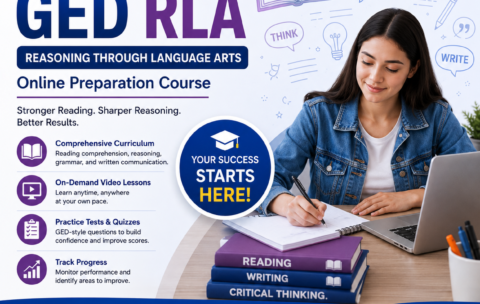
GED Reading Through Language Arts
What you'll learn
Identify main ideas and supporting details in reading passages.
Analyze literary and informational texts.
Determine an author’s purpose, tone, and point of view.
Make logical inferences using evidence from a passage.
Compare ideas, arguments, and viewpoints across multiple texts.
Evaluate claims, reasoning, and supporting evidence.
Distinguish between fact, opinion, bias, and persuasive language.
Understand vocabulary using context clues.
Recognize themes, characters, settings, and plot development.
Apply correct grammar, punctuation, spelling, and word usage.
Identify and correct sentence fragments and run-on sentences.
Improve sentence structure and paragraph organization.
Develop clear thesis statements and topic sentences.
Organize ideas into a logical written response.
Use evidence from passages to support written arguments.
Write clear, focused, and well-supported extended responses.
Revise and edit written work for clarity and accuracy.
Apply effective reading and writing test-taking strategies.
Improve time management during the GED RLA exam.
Build confidence for the Reasoning Through Language Arts test.
Trending
Free
GED Social Studies
What you'll learn
Understand the structure and functions of the United States government.
Explain the roles of the legislative, executive, and judicial branches.
Understand the U.S. Constitution, Bill of Rights, and key amendments.
Identify important rights and responsibilities of American citizens.
Analyze major events and developments in U.S. history.
Understand important historical documents and their significance.
Interpret primary and secondary historical sources.
Evaluate arguments, claims, evidence, and different viewpoints.
Recognize cause-and-effect relationships in historical events.
Interpret maps, timelines, political cartoons, graphs, charts, and tables.
Understand basic economic principles, markets, supply, and demand.
Explain the role of government in the economy.
Understand geography, migration, population, and natural resources.
Identify bias, fact, opinion, and persuasive language.
Apply critical-thinking skills to GED-style Social Studies questions.
Improve reading comprehension and time-management skills.
Build confidence for the GED Social Studies exam.
Free
GED Maths
What you'll learn
Perform calculations involving whole numbers, integers, fractions, decimals, and percentages.
Apply the correct order of operations when simplifying mathematical expressions.
Work confidently with ratios, proportions, rates, and unit rates.
Solve practical problems involving distance, speed, time, costs, wages, budgets, and everyday measurements.
Calculate percentage increases, decreases, discounts, markups, and other percent-based quantities.
Work with powers, exponents, square roots, cube roots, and scientific notation.
Compare, order, and interpret different types of numbers.
Find mean, median, mode, range, and probability and interpret statistical information.
Read and analyze tables, charts, histograms, scatter plots, and graphs.
Calculate perimeter, area, circumference, surface area, and volume.
Apply geometry formulas to triangles, circles, rectangles, prisms, pyramids, cylinders, spheres, and other figures.
Convert between different units of measurement and use scale factors appropriately.
Apply the Pythagorean theorem to solve geometric and real-world problems.
Translate written situations into mathematical expressions and equations.
Free
Ged Science
What you'll learn
Understand important Life Science concepts, including cells, genetics, ecosystems, evolution, and human body systems.
Explain Physical Science concepts involving matter, chemical reactions, forces, motion, energy, electricity, and waves.
Understand Earth and Space Science topics, including weather, climate, plate tectonics, natural resources, and the solar system.
Interpret scientific graphs, tables, charts, maps, diagrams, and models.
Identify independent variables, dependent variables, constants, and control groups.
Analyze scientific experiments and evaluate whether conclusions are supported by evidence.
Apply the scientific method to GED-style questions and real-world situations.
Compare scientific claims, hypotheses, evidence, results, and conclusions.
Use basic scientific formulas and calculations correctly.
Recognize cause-and-effect relationships in scientific information.
Improve time management and question-answering strategies.
Build confidence for the GED Science exam.
Free
GED Reading Through Language Arts
What you'll learn
Identify main ideas and supporting details in reading passages.
Analyze literary and informational texts.
Determine an author’s purpose, tone, and point of view.
Make logical inferences using evidence from a passage.
Compare ideas, arguments, and viewpoints across multiple texts.
Evaluate claims, reasoning, and supporting evidence.
Distinguish between fact, opinion, bias, and persuasive language.
Understand vocabulary using context clues.
Recognize themes, characters, settings, and plot development.
Apply correct grammar, punctuation, spelling, and word usage.
Identify and correct sentence fragments and run-on sentences.
Improve sentence structure and paragraph organization.
Develop clear thesis statements and topic sentences.
Organize ideas into a logical written response.
Use evidence from passages to support written arguments.
Write clear, focused, and well-supported extended responses.
Revise and edit written work for clarity and accuracy.
Apply effective reading and writing test-taking strategies.
Improve time management during the GED RLA exam.
Build confidence for the Reasoning Through Language Arts test.
Popular Instructors

All HIGH SCHOOL Courses
Free
What you'll learn
Perform calculations involving whole numbers, integers, fractions, decimals, and percentages.
Apply the correct order of operations when simplifying mathematical expressions.
Work confidently with ratios, proportions, rates, and unit rates.
Solve practical problems involving distance, speed, time, costs, wages, budgets, and everyday measurements.
Calculate percentage increases, decreases, discounts, markups, and other percent-based quantities.
Work with powers, exponents, square roots, cube roots, and scientific notation.
Compare, order, and interpret different types of numbers.
Find mean, median, mode, range, and probability and interpret statistical information.
Read and analyze tables, charts, histograms, scatter plots, and graphs.
Calculate perimeter, area, circumference, surface area, and volume.
Apply geometry formulas to triangles, circles, rectangles, prisms, pyramids, cylinders, spheres, and other figures.
Convert between different units of measurement and use scale factors appropriately.
Apply the Pythagorean theorem to solve geometric and real-world problems.
Translate written situations into mathematical expressions and equations.
Free
What you'll learn
Understand the structure and functions of the United States government.
Explain the roles of the legislative, executive, and judicial branches.
Understand the U.S. Constitution, Bill of Rights, and key amendments.
Identify important rights and responsibilities of American citizens.
Analyze major events and developments in U.S. history.
Understand important historical documents and their significance.
Interpret primary and secondary historical sources.
Evaluate arguments, claims, evidence, and different viewpoints.
Recognize cause-and-effect relationships in historical events.
Interpret maps, timelines, political cartoons, graphs, charts, and tables.
Understand basic economic principles, markets, supply, and demand.
Explain the role of government in the economy.
Understand geography, migration, population, and natural resources.
Identify bias, fact, opinion, and persuasive language.
Apply critical-thinking skills to GED-style Social Studies questions.
Improve reading comprehension and time-management skills.
Build confidence for the GED Social Studies exam.
Free
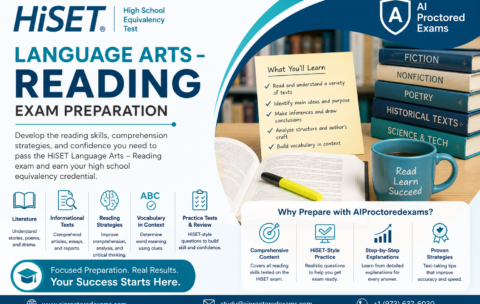
Language Arts – Reading
HiSET Language Arts – Reading Exam Preparation Prepare confidently for …
Free
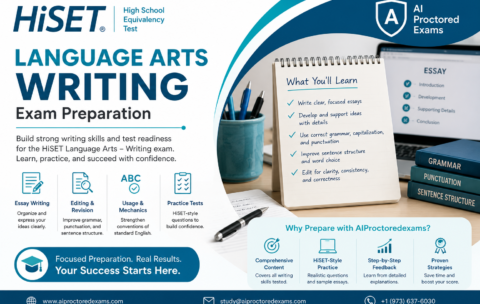
HiSET Language Arts
HiSET Language Arts – Writing Exam Preparation Prepare confidently for …
Free
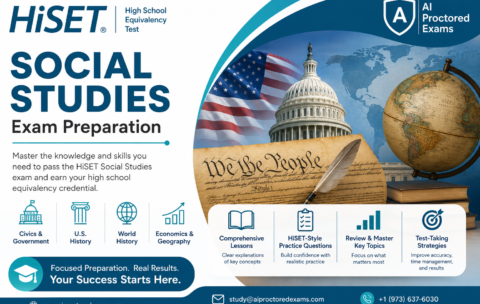
Hiset Social Studies
HiSET Social Studies Exam Preparation Prepare confidently for the HiSET …
Free
Hiset Science
HiSET Science Exam Preparation Prepare confidently for the HiSET Science …
Free
Hiset Mathematics
HiSET Mathematics Exam Preparation Prepare confidently for the HiSET Mathematics …
Free
GED Reading Through Language Arts
GED Reasoning Through Language Arts (RLA) Online Preparation Course Prepare …
What you'll learn
Identify main ideas and supporting details in reading passages.
Analyze literary and informational texts.
Determine an author’s purpose, tone, and point of view.
Make logical inferences using evidence from a passage.
Compare ideas, arguments, and viewpoints across multiple texts.
Evaluate claims, reasoning, and supporting evidence.
Distinguish between fact, opinion, bias, and persuasive language.
Understand vocabulary using context clues.
Recognize themes, characters, settings, and plot development.
Apply correct grammar, punctuation, spelling, and word usage.
Identify and correct sentence fragments and run-on sentences.
Improve sentence structure and paragraph organization.
Develop clear thesis statements and topic sentences.
Organize ideas into a logical written response.
Use evidence from passages to support written arguments.
Write clear, focused, and well-supported extended responses.
Revise and edit written work for clarity and accuracy.
Apply effective reading and writing test-taking strategies.
Improve time management during the GED RLA exam.
Build confidence for the Reasoning Through Language Arts test.
- 1
- 2