Praxis 5312 School Librarian Exam Preparation Course
About This Course
Prepare for the Praxis 5312 School Librarian Exam
The Praxis 5312 School Librarian Exam Preparation Course provides comprehensive online preparation for aspiring school librarians, library media specialists, teacher-education students, classroom teachers transitioning into library roles, alternative-certification candidates, and educators seeking an additional school-library endorsement.
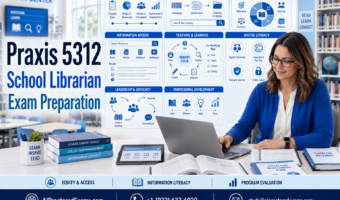
This course develops the knowledge and professional judgment needed to administer a safe, inclusive, accessible, and instructionally effective school library or media program. Structured lessons cover program administration, organization and access, collection development, information resources, inquiry, digital literacy, teaching and learning, professional development, leadership, advocacy, and program evaluation.
Candidates learn how to connect library-management responsibilities with student learning. Praxis-style scenarios require learners to evaluate collections, respond to intellectual-freedom concerns, plan instruction, support research, use program data, collaborate with teachers, and advocate for equitable access to information.
Explore additional Praxis exam preparation courses for other teacher-certification and educational-support assessments.
What Is the Praxis 5312 School Librarian Exam?
Praxis 5312 measures the knowledge and competencies considered important for safe and effective beginning practice as a school librarian.
According to the official ETS Praxis 5312 School Librarian page, the computer-delivered examination allows two hours and contains 120 questions.
The test uses several question formats. Candidates may need to select one answer, choose more than one answer, enter an answer into a text box, or complete another type of computer-delivered question.
The six official content areas are:
-
Program Administration
-
Organization and Access
-
Collection Development
-
Information Access in the Learning Environment
-
Teaching and Learning
-
Professional Development, Leadership, and Advocacy
The assessment focuses on administering a school-level library or media program within an elementary or secondary school. It does not emphasize district-level programs or systems with differentiated library staffing.
The test reflects knowledge and skills identified in the ALA/AASL/CAEP National School Librarian Standards and the AASL National School Library Standards.
School Library Program Administration
Effective school librarians manage programs that support curriculum, student achievement, reading, research, technology use, and the broader educational mission of the school.
This module reviews:
-
Developing a school-library mission and vision
-
Aligning library goals with school priorities
-
Strategic and operational planning
-
Establishing program objectives
-
Budget development and management
-
Resource allocation
-
Scheduling
-
Staffing and volunteer coordination
-
Policy and procedure development
-
Facility planning
-
Safety and accessibility
-
Technology planning
-
Recordkeeping
-
Program communication
-
Continuous improvement
Candidates learn to prioritize competing program needs while considering available resources, student demographics, instructional goals, accessibility, and ethical responsibilities.
Praxis-style scenarios require candidates to select appropriate policies, recommend resource allocations, respond to safety concerns, and evaluate whether program decisions support student learning.
Organization and Access
School librarians organize resources so students and educators can locate and use information efficiently.
Course preparation includes:
-
Descriptive cataloging
-
Subject analysis
-
Classification systems
-
Call numbers
-
Metadata
-
Catalog records
-
Authority control
-
Shelving and arrangement
-
Signage and wayfinding
-
Indexing
-
Database organization
-
Integrated library systems
-
Circulation procedures
-
Inventory and resource tracking
-
Accessibility of print and digital materials
Candidates practice determining how materials should be described, classified, arranged, and retrieved. Lessons also address the importance of user-friendly catalogs, accessible search tools, accurate metadata, and consistent organizational procedures.
The course emphasizes organization as a means of improving access rather than as an isolated technical process.
Collection Development and Management
Collection development requires school librarians to build and maintain resources that are current, accurate, diverse, age-appropriate, accessible, and aligned with curriculum and student interests.
This module covers:
-
Conducting collection assessments
-
Identifying resource gaps
-
Reviewing curriculum needs
-
Evaluating professional reviews
-
Selecting print and digital resources
-
Developing selection criteria
-
Supporting different reading levels
-
Representing diverse perspectives
-
Balancing formats and subjects
-
Managing licenses and subscriptions
-
Processing and maintaining resources
-
Weeding outdated or damaged materials
-
Reconsideration procedures
-
Intellectual freedom
-
Preservation and replacement decisions
Candidates learn to evaluate the authority, accuracy, relevance, currency, developmental appropriateness, accessibility, cost, format, and potential instructional value of resources.
Scenarios also address challenges to library materials. Candidates review fair and consistent reconsideration procedures, professional ethics, confidentiality, intellectual freedom, and the responsibility to provide access to diverse viewpoints.
Information Access in the Learning Environment
School librarians help learners identify information needs, locate appropriate sources, evaluate evidence, and use information effectively.
Course topics include:
-
Search strategies
-
Keywords and subject headings
-
Boolean searching
-
Database selection
-
Reference interviewing
-
Reference sources
-
Primary and secondary sources
-
Print and digital resources
-
Multimedia information
-
Open educational resources
-
Accessibility tools
-
Assistive technologies
-
Source evaluation
-
Misinformation and disinformation
-
Bias and perspective
-
Information ethics
Candidates learn to match resources with the student’s age, task, reading ability, language needs, accessibility requirements, and research purpose.
The course also addresses equitable access to library resources, including support for students with disabilities, multilingual learners, students without reliable home internet, and learners requiring alternative formats.
Information Literacy and Inquiry
Information literacy is central to the school librarian’s instructional role.
Candidates study the complete inquiry process:
-
Defining a research problem
-
Developing meaningful questions
-
Activating prior knowledge
-
Selecting search tools
-
Planning a search strategy
-
Locating information
-
Evaluating authority and credibility
-
Comparing perspectives
-
Organizing evidence
-
Synthesizing information
-
Drawing conclusions
-
Creating and communicating new knowledge
-
Reflecting on the research process
Lessons help candidates distinguish research instruction from simply providing information. Candidates learn how to scaffold inquiry, model effective searching, teach source evaluation, support note-taking, and guide students as they communicate findings.
Teaching and Learning
School librarians are instructional partners who support curriculum, inquiry, reading, media literacy, technology, and independent learning.
This module examines:
-
Standards-aligned instructional planning
-
Writing measurable learning objectives
-
Activating prior knowledge
-
Direct instruction
-
Guided practice
-
Inquiry-based learning
-
Differentiation
-
Formative and summative assessment
-
Selecting instructional resources
-
Integrating educational technology
-
Supporting reading engagement
-
Teaching research strategies
-
Developing critical thinking
-
Assessing student learning
-
Providing meaningful feedback
Candidates learn to plan instruction for individual students, small groups, classes, and collaborative projects.
Course scenarios require candidates to identify student needs, choose appropriate resources, select effective instructional strategies, assess learning, and modify instruction using performance evidence.
Collaboration and Co-Teaching
School librarians collaborate with classroom teachers, administrators, technology staff, counselors, special educators, families, and community partners.
Preparation covers:
-
Collaborative curriculum planning
-
Identifying shared learning outcomes
-
Co-planning lessons
-
Co-teaching
-
Selecting resources
-
Designing research assignments
-
Integrating information literacy
-
Supporting disciplinary literacy
-
Developing assessments
-
Reflecting on student performance
-
Communicating professionally
-
Resolving instructional disagreements
Candidates learn how to contribute library and information expertise while respecting the responsibilities and knowledge of other educators.
Reading Promotion and Learner Engagement
School librarians support reading as both an academic skill and a lifelong practice.
The course reviews strategies for:
-
Matching readers with appropriate books
-
Conducting readers’ advisory
-
Supporting different reading interests
-
Promoting diverse authors and perspectives
-
Developing reading programs
-
Creating engaging displays
-
Supporting classroom literacy
-
Organizing book discussions
-
Encouraging student choice
-
Using digital and audio formats
-
Collaborating with families
-
Evaluating reading-promotion activities
Candidates learn to recommend resources without imposing personal preferences and to create inclusive opportunities for students with different reading levels, languages, interests, and abilities.
Digital Literacy, Citizenship, and Technology
School librarians help students use technology safely, ethically, critically, and creatively.
Course preparation includes:
-
Digital citizenship
-
Online safety
-
Privacy and data protection
-
Cyberbullying awareness
-
Password and account security
-
Evaluating online information
-
Recognizing misinformation
-
Ethical technology use
-
Copyright
-
Fair use
-
Licensing
-
Creative Commons
-
Plagiarism prevention
-
Citation
-
Responsible use of artificial intelligence
-
Accessible digital content
Candidates examine appropriate technology-selection criteria, including instructional purpose, privacy, accessibility, usability, cost, compatibility, and student-data protection.
Copyright, Fair Use, and Intellectual Property
School librarians frequently provide guidance on the legal and ethical use of information.
Candidates review:
-
Copyright protection
-
Public-domain resources
-
Fair-use analysis
-
Educational use
-
Licensing agreements
-
Database terms of use
-
Creative Commons licenses
-
Attribution
-
Plagiarism
-
Student-created work
-
Streaming and multimedia
-
Reproduction of materials
-
Ethical information use
Praxis-style scenarios help candidates distinguish legal requirements, school policies, licensing restrictions, ethical responsibilities, and appropriate educational practices.
Professional Development, Leadership, and Advocacy
School librarians contribute to professional learning and advocate for effective library programs.
This module addresses:
-
Identifying staff-development needs
-
Planning professional learning
-
Modeling instructional technology
-
Sharing research resources
-
Supporting information-literacy instruction
-
Participating in professional organizations
-
Reflective practice
-
Continuing education
-
Building collaborative relationships
-
Communicating program value
-
Developing stakeholder partnerships
-
Advocating for students and equitable access
-
Leading school-improvement initiatives
Candidates learn how to communicate the relationship among library services, curriculum, student engagement, information literacy, and academic outcomes.
Advocacy preparation emphasizes using evidence, program data, student needs, stakeholder feedback, and professional standards rather than relying only on general claims about the importance of libraries.
Program Evaluation and Data-Informed Improvement
School librarians need to evaluate whether programs, services, resources, and instructional activities are meeting established goals.
Course preparation covers:
-
Establishing measurable objectives
-
Collecting quantitative and qualitative data
-
Analyzing circulation patterns
-
Reviewing collection use
-
Evaluating database use
-
Assessing instructional outcomes
-
Gathering stakeholder feedback
-
Identifying underserved groups
-
Reviewing budget effectiveness
-
Evaluating program accessibility
-
Communicating findings
-
Developing improvement plans
Candidates learn to select evidence that matches the program question being investigated. They also practice distinguishing activity measures, such as circulation counts, from evidence demonstrating changes in student learning or access.
Praxis 5312 Practice and Exam Strategy
The course includes structured lessons, topic quizzes, realistic Praxis-style questions, program-management scenarios, collection-development exercises, cataloging practice, instructional situations, detailed answer explanations, and full-length simulated tests.
Timed activities help candidates maintain an appropriate pace across the two-hour examination. Diagnostic results identify areas requiring additional study, including program administration, organization, collections, information access, instruction, copyright, digital citizenship, leadership, advocacy, or program evaluation.
Additional preparation resources are available through the AIProctoredExams study guides and How It Works pages.
Candidates can also review the professional framework available through the American Association of School Librarians standards website.
Praxis requirements and qualifying scores differ among states and licensing authorities. Confirm that your jurisdiction requires or accepts School Librarian test 5312 through the official Praxis state requirements directory.
Begin the Praxis 5312 School Librarian Exam Preparation Course to strengthen your knowledge of school-library administration, resource organization, collection development, information literacy, instruction, collaboration, leadership, advocacy, and program evaluation.
This independent preparation course is not affiliated with or endorsed by ETS. Candidates should verify current testing policies and licensing requirements through official sources.
Learning Objectives
Material Includes
- * Complete digital Praxis 5312 School Librarian study pack
- * Structured lessons covering all six official content areas
- * Program administration, budgeting, policy, scheduling, and facilities review
- * Cataloging, classification, metadata, organization, and information-access module
- * Collection development, intellectual freedom, copyright, and digital-citizenship review
- * Teaching, inquiry, collaboration, reading promotion, leadership, and advocacy module
- * Realistic Praxis 5312 selected-response and text-entry practice questions
- * Detailed explanations for correct and incorrect answer choices
- * Full-length 120-question Praxis 5312 simulated practice tests
- * Three-week study schedule, diagnostic review, exam strategy, and progress tracker
Material Includes
- * Complete digital Praxis 5312 School Librarian study pack
- * Structured lessons covering all six official content areas
- * Program administration, budgeting, policy, scheduling, and facilities review
- * Cataloging, classification, metadata, organization, and information-access module
- * Collection development, intellectual freedom, copyright, and digital-citizenship review
- * Teaching, inquiry, collaboration, reading promotion, leadership, and advocacy module
- * Realistic Praxis 5312 selected-response and text-entry practice questions
- * Detailed explanations for correct and incorrect answer choices
- * Full-length 120-question Praxis 5312 simulated practice tests
- * Three-week study schedule, diagnostic review, exam strategy, and progress tracker