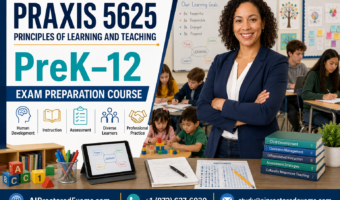
Praxis 5625 Principles of Learning and Teaching: PreK–12 Exam Preparation Course
About This Course
Prepare for the Praxis 5625 Principles of Learning and Teaching Exam
The Praxis 5625 Principles of Learning and Teaching: PreK–12 Exam Preparation Course provides structured preparation for aspiring teachers who need to demonstrate their knowledge of teaching, learning, assessment, development, diversity, and professional practice across the complete PreK–12 grade range.
This course is suitable for teacher-education students, alternative-certification candidates, career changers, and educators returning to the examination after an earlier attempt. It transforms broad educational theories and professional principles into clear lessons, classroom scenarios, and exam-style questions.
Praxis 5625 Test Structure
According to the official Praxis 5625 test page, the computer-delivered examination contains 100 selected-response questions and allows 120 minutes for completion. Questions may require candidates to select one or more correct answers.
The examination assesses human development, learning processes, instructional processes, diverse learners, educational psychology, assessment, and professional issues. Some questions apply to specific grade levels, while others address principles that are relevant throughout PreK–12 education.
Effective Praxis 5625 Principles of Learning and Teaching exam preparation requires more than memorizing educational vocabulary. Candidates must analyze classroom situations, recognize student needs, select appropriate instructional responses, and apply professional principles across different developmental stages.
Human Development Across PreK–12
The human-development module examines physical, cognitive, linguistic, social, emotional, and moral development from early childhood through adolescence. You will explore typical developmental patterns while recognizing that students develop at different rates.
Lessons examine how development influences readiness, attention, motivation, communication, social interaction, and academic performance. Candidates also review the effects of family, culture, peers, community, prior experiences, and learning environments.
The Praxis 5625 Principles of Learning and Teaching exam preparation course helps you select developmentally appropriate strategies for preschool learners, elementary students, middle school learners, and high school students.
Candidates preparing to teach younger learners may also benefit from the Praxis 5025 Early Childhood Education course or the Praxis 5001 Elementary Education course.
Learning Processes and Educational Psychology
This section reviews major theories of learning, cognition, motivation, memory, and behavior. You will examine how learners acquire, organize, retain, retrieve, and apply knowledge.
Topics include prior knowledge, cognitive development, social learning, information processing, metacognition, reinforcement, self-efficacy, attribution, intrinsic motivation, extrinsic motivation, and goal orientation.
Lessons connect theory to classroom practice. For example, you will determine when modeling, guided practice, independent practice, feedback, scaffolding, repetition, collaboration, or student choice is most appropriate.
Rather than selecting a teaching strategy because it sounds positive, you will learn to evaluate whether it matches the learner, objective, developmental level, and classroom context.
Instructional Planning and Teaching Strategies
Instructional planning begins with clear, measurable, and developmentally appropriate objectives. The course explains how to align objectives with learning activities, instructional resources, assessment methods, and student needs.
The Praxis 5625 Principles of Learning and Teaching exam preparation reviews direct instruction, inquiry, discussion, cooperative learning, experiential learning, problem-based learning, independent study, interdisciplinary instruction, and technology-supported learning.
You will practice choosing suitable strategies for different subjects, age groups, learning goals, and classroom circumstances. Lessons also address activating prior knowledge, modeling new skills, checking understanding, providing guided practice, promoting transfer, and closing a lesson effectively.
Candidates who need stronger foundational academic skills can review the Praxis Core preparation course.
Assessment and Data-Informed Instruction
Assessment lessons cover diagnostic, formative, interim, and summative evaluation. You will review selected-response tests, constructed tasks, performance assessments, portfolios, observations, checklists, rating scales, projects, and student self-assessment.
The course explains validity, reliability, fairness, scoring, feedback, bias, and appropriate assessment use. Candidates also learn how to interpret classroom data, identify patterns, monitor progress, adjust instruction, and communicate results.
Effective assessment should align with instructional objectives and provide useful evidence about learning. Therefore, the course emphasizes selecting the most suitable assessment method instead of automatically choosing a traditional test.
Diverse Learners and Differentiated Instruction
Today’s PreK–12 classrooms include students with different abilities, languages, cultures, backgrounds, interests, experiences, and learning needs. This module examines differentiation, accommodations, modifications, accessibility, culturally responsive teaching, and equitable participation.
You will practice adjusting content, process, products, materials, grouping, pacing, and levels of support. Scenarios address students with disabilities, multilingual learners, advanced learners, students experiencing academic difficulty, and learners needing social or emotional support.
The Praxis 5625 Principles of Learning and Teaching exam preparation course helps candidates identify responses that maintain high expectations while providing appropriate access and assistance.
Additional preparation for inclusive education is available through the Praxis 5355 Special Education course.
Classroom Environment and Behavior Support
A safe and productive classroom depends on clear expectations, consistent procedures, respectful relationships, active engagement, and effective use of instructional time.
Classroom-management lessons cover preventive approaches, routines, transitions, reinforcement, redirection, conflict resolution, student responsibility, and responses to challenging behavior. You will examine how classroom arrangement, lesson design, communication, and teacher behavior can influence student conduct.
The course emphasizes identifying the cause and context of behavior before selecting an intervention. Appropriate responses should protect learning, preserve student dignity, and support long-term behavioral improvement.
Communication, Motivation and Student Engagement
Teachers communicate through explanations, questions, feedback, modeling, listening, written directions, nonverbal behavior, and digital tools. This section helps you evaluate whether communication is clear, respectful, age-appropriate, and responsive to student needs.
Motivation topics include relevance, autonomy, attainable challenge, feedback, classroom relationships, student interests, and opportunities for success. You will also review questioning techniques that encourage recall, interpretation, analysis, evaluation, and creative thinking.
Strong Praxis 5625 Principles of Learning and Teaching exam preparation connects motivation and communication with development, instruction, classroom management, and assessment.
Professional Responsibilities and Ethical Practice
Professional-practice lessons examine ethical conduct, confidentiality, collaboration, reflective practice, continuing development, record keeping, and communication with families.
You will review the appropriate roles of teachers, administrators, specialists, counselors, support staff, families, and community partners. Scenarios require you to identify when collaboration, documentation, referral, professional consultation, or direct instructional action is most appropriate.
The course also discusses student safety, privacy, fairness, professional boundaries, mandated responsibilities, and the importance of following school and legal procedures.
Candidates exploring related student-support responsibilities can review the Praxis 5422 School Counselor course and the AI Proctored Exams teacher-certification course catalog.
Classroom Scenarios and Decision-Making
Many Praxis 5625 questions present realistic classroom situations. Several answer choices may appear reasonable, but the strongest response usually addresses the immediate need while supporting development, instruction, fairness, safety, or professional procedure.
The Praxis 5625 Principles of Learning and Teaching exam preparation course teaches you to identify the central problem, consider the learner’s developmental level, examine available evidence, eliminate weak options, and select the response most consistent with effective educational practice.
Detailed answer explanations clarify why one response is stronger than the alternatives. This process helps you develop professional judgment instead of relying on memorized phrases.
Who Should Enroll?
This course is designed for:
Teacher-education students approaching program completion
Prospective educators seeking PreK–12 certification
Alternative-certification and career-change candidates
Substitute or provisional teachers completing licensure requirements
Candidates preparing to retake Praxis 5625
Educators who need a broad review of teaching principles across grade levels
Additional planning resources are available through the AI Proctored Exams study guides and How It Works pages.
Build Your Praxis 5625 Study Plan
Begin your Praxis 5625 Principles of Learning and Teaching exam preparation with a diagnostic assessment. Use the results to identify whether you need greater support with development, learning theory, instruction, assessment, diversity, management, or professional responsibilities.
Combine topic review with scenario-based and timed practice. The 120-minute limit provides slightly more than one minute per question, so efficient reading and decision-making are essential.
Candidates can supplement this course with the official Praxis 5625 practice test. Because qualifying scores vary among states and agencies, confirm your requirement through the official Praxis passing-score tool.
Start your Praxis 5625 Principles of Learning and Teaching exam preparation today and build the knowledge, judgment, pacing, and confidence needed for the PreK–12 examination.
Disclaimer: This independent preparation course is not affiliated with or endorsed by ETS. Praxis is a registered trademark of ETS. Candidates should verify current examination policies, fees, testing options, and licensing requirements through official sources.
Learning Objectives
Material Includes
- Complete digital Praxis 5625 study and exam-preparation pack
- Human development and PreK–12 developmental-stages review module
- Learning theories, educational psychology, cognition, memory, and motivation module
- Instructional planning, teaching methods, questioning, scaffolding, and technology-integration module
- Assessment types, data interpretation, feedback, validity, reliability, and scoring module
- Diverse learners, differentiation, accommodations, accessibility, and culturally responsive teaching module
- Classroom management, behavior support, communication, and student-engagement guide
- Professional ethics, legal responsibilities, family partnerships, collaboration, and reflective-practice resources
- Topic-based and classroom-scenario practice questions with detailed answer explanations
- Full-length practice examinations modeled on the 100-question format with a study schedule and progress tracker
Material Includes
- Complete digital Praxis 5625 study and exam-preparation pack
- Human development and PreK–12 developmental-stages review module
- Learning theories, educational psychology, cognition, memory, and motivation module
- Instructional planning, teaching methods, questioning, scaffolding, and technology-integration module
- Assessment types, data interpretation, feedback, validity, reliability, and scoring module
- Diverse learners, differentiation, accommodations, accessibility, and culturally responsive teaching module
- Classroom management, behavior support, communication, and student-engagement guide
- Professional ethics, legal responsibilities, family partnerships, collaboration, and reflective-practice resources
- Topic-based and classroom-scenario practice questions with detailed answer explanations
- Full-length practice examinations modeled on the 100-question format with a study schedule and progress tracker