About This Course
About the Praxis 5626 Professional Teaching Knowledge Exam Preparation Course
Prepare for the Praxis 5626 Professional Teaching Knowledge Exam with comprehensive teaching knowledge study guides, educational psychology reviews, instructional planning resources, classroom management strategies, and practice questions from AIProctoredExams.com.
The Praxis 5626 Professional Teaching Knowledge Exam Preparation Course is designed for aspiring teachers, teacher education students, alternative certification candidates, and individuals preparing to demonstrate their understanding of professional teaching practices.
This course provides structured coverage of essential educational principles, including student development, learning processes, instructional design, classroom management, assessment, differentiated instruction, professional ethics, and collaboration.
Candidates develop their ability to analyze classroom situations, select appropriate instructional strategies, evaluate student learning, and make informed professional decisions.
The Praxis 5626 Professional Teaching Knowledge Exam Preparation Course emphasizes the application of educational theory to practical classroom situations.
Through subject reviews, scenario-based questions, instructional examples, and structured revision activities, candidates can strengthen their knowledge and identify areas requiring additional preparation.
Praxis 5626 Professional Teaching Knowledge Exam Overview
The Praxis 5626 Professional Teaching Knowledge Exam evaluates professional teaching competencies relevant to effective classroom instruction and educational practice.
Candidates should prepare to demonstrate knowledge of how students learn, how teachers plan instruction, how learning is assessed, and how educators fulfill their professional responsibilities.
Praxis 5626 Exam Preparation Topics
The course covers:
-
Human growth and development.
-
Educational psychology.
-
Learning theories.
-
Student motivation.
-
Diverse learners.
-
Instructional planning.
-
Teaching strategies.
-
Classroom management.
-
Student assessment.
-
Professional ethics.
-
Family and community engagement.
-
Professional development.
Candidates should confirm the current examination structure and official content specifications through ETS Praxis.
Praxis 5626 Students as Learners Study Guide
Understanding students as learners is fundamental to effective teaching.
Teachers must recognize how developmental, cognitive, emotional, social, and environmental factors influence student learning.
Human Growth and Development
Candidates review:
-
Physical development.
-
Cognitive development.
-
Social development.
-
Emotional development.
-
Language development.
-
Developmental milestones.
-
Individual developmental differences.
-
Environmental influences on development.
-
Developmentally appropriate instruction.
Major Theories of Human Development
Candidates study:
-
Jean Piaget’s cognitive development theory.
-
Lev Vygotsky’s sociocultural theory.
-
Erik Erikson’s psychosocial development theory.
-
Lawrence Kohlberg’s moral development theory.
-
Albert Bandura’s social learning theory.
-
Urie Bronfenbrenner’s ecological systems theory.
Cognitive Development and Learning
Topics include:
-
Attention.
-
Perception.
-
Memory.
-
Information processing.
-
Working memory.
-
Long-term memory.
-
Metacognition.
-
Problem-solving.
-
Critical thinking.
-
Transfer of learning.
Learning Theories and Educational Psychology
Candidates review:
-
Behaviorism.
-
Classical conditioning.
-
Operant conditioning.
-
Social cognitive theory.
-
Constructivism.
-
Cognitive learning theories.
-
Observational learning.
-
Reinforcement.
-
Scaffolding.
-
Experiential learning.
Student Motivation and Engagement
Topics include:
-
Intrinsic motivation.
-
Extrinsic motivation.
-
Self-efficacy.
-
Goal-setting.
-
Student autonomy.
-
Attribution theory.
-
Growth mindset.
-
Engagement strategies.
-
Positive reinforcement.
-
Supportive classroom environments.
The Praxis 5626 Professional Teaching Knowledge Exam Preparation Course helps candidates connect learning theories with classroom decisions.
Praxis 5626 Diverse Learners and Inclusive Education
Teachers must understand individual differences and create learning environments that support students with varied educational needs.
Individual Learning Differences
Candidates study:
-
Prior knowledge.
-
Academic readiness.
-
Language proficiency.
-
Learning strengths.
-
Student interests.
-
Cultural experiences.
-
Developmental differences.
-
Learning barriers.
-
Student engagement.
Special Education and Student Support
Topics include:
-
Individuals with Disabilities Education Act.
-
Individualized Education Programs.
-
Section 504 accommodations.
-
Least restrictive environment.
-
Inclusive classroom practices.
-
Instructional accommodations.
-
Instructional modifications.
-
Collaboration with specialists.
-
Progress monitoring.
-
Student support services.
English Language Learners
Candidates review:
-
Language acquisition.
-
Academic language development.
-
Vocabulary instruction.
-
Visual supports.
-
Scaffolding.
-
Language-sensitive assessment.
-
Culturally responsive instruction.
-
Collaborative learning.
-
Communication supports.
Differentiated Instruction
Candidates study:
-
Differentiating content.
-
Differentiating process.
-
Differentiating products.
-
Flexible grouping.
-
Readiness-based instruction.
-
Student choice.
-
Formative assessment.
-
Accessible instructional materials.
Universal Design for Learning
Topics include:
-
Multiple means of engagement.
-
Multiple means of representation.
-
Multiple means of action and expression.
-
Reducing barriers to learning.
-
Flexible instructional methods.
-
Accessible assessments.
Additional resources are available through CAST Universal Design for Learning.
Praxis 5626 Instructional Planning and Curriculum Development
Effective teaching requires purposeful planning, clear learning objectives, and instructional strategies aligned with student needs.
Instructional Objectives and Learning Outcomes
Candidates review:
-
Measurable learning objectives.
-
Standards alignment.
-
Bloom’s taxonomy.
-
Cognitive learning outcomes.
-
Skill development.
-
Performance expectations.
-
Instructional priorities.
-
Student learning targets.
Curriculum Planning
Topics include:
-
Curriculum standards.
-
Scope and sequence.
-
Unit planning.
-
Lesson planning.
-
Curriculum mapping.
-
Prerequisite knowledge.
-
Interdisciplinary connections.
-
Learning progressions.
-
Instructional resources.
Backward Design
Candidates study:
-
Identifying desired learning results.
-
Determining acceptable evidence.
-
Planning learning experiences.
-
Aligning instruction and assessment.
-
Evaluating instructional effectiveness.
Lesson Planning
Candidates review:
-
Lesson introductions.
-
Activating prior knowledge.
-
Direct instruction.
-
Modeling.
-
Guided practice.
-
Independent practice.
-
Checking understanding.
-
Closure activities.
-
Lesson reflection.
Instructional Alignment
Candidates examine how learning objectives, classroom activities, teaching materials, and assessments should support the same educational outcomes.
Praxis 5626 Effective Teaching Strategies
The Praxis 5626 Professional Teaching Knowledge Exam Preparation Course emphasizes evidence-informed instructional approaches.
Direct Instruction
Candidates study:
-
Explicit explanations.
-
Teacher modeling.
-
Guided practice.
-
Frequent checks for understanding.
-
Corrective feedback.
-
Independent practice.
Inquiry-Based Learning
Topics include:
-
Student questioning.
-
Investigation.
-
Exploration.
-
Evidence gathering.
-
Hypothesis development.
-
Critical thinking.
-
Reflection.
Cooperative and Collaborative Learning
Candidates review:
-
Group roles.
-
Peer interaction.
-
Shared responsibility.
-
Collaborative problem-solving.
-
Group accountability.
-
Cooperative learning structures.
-
Peer feedback.
Problem-Based and Project-Based Learning
Topics include:
-
Authentic problems.
-
Real-world applications.
-
Student inquiry.
-
Research.
-
Collaborative projects.
-
Problem-solving.
-
Performance assessment.
Scaffolding and Guided Learning
Candidates study:
-
Modeling.
-
Prompting.
-
Worked examples.
-
Guided questioning.
-
Gradual release of responsibility.
-
Instructional supports.
-
Removing supports as students progress.
Instructional Technology
Topics include:
-
Digital learning resources.
-
Interactive presentations.
-
Learning management systems.
-
Online assessments.
-
Assistive technology.
-
Digital citizenship.
-
Responsible technology use.
-
Technology accessibility.
Praxis 5626 Classroom Management Study Guide
Effective classroom management supports student engagement, positive behavior, and productive learning.
Establishing Classroom Expectations
Candidates review:
-
Classroom rules.
-
Classroom routines.
-
Clear expectations.
-
Consistent procedures.
-
Positive classroom culture.
-
Student responsibility.
-
Predictable transitions.
Positive Behavior Support
Topics include:
-
Reinforcement.
-
Preventive classroom management.
-
Positive feedback.
-
Behavior expectations.
-
Relationship building.
-
Restorative approaches.
-
Behavior intervention strategies.
Managing Classroom Behavior
Candidates study:
-
Identifying behavior triggers.
-
De-escalation.
-
Conflict resolution.
-
Classroom redirection.
-
Appropriate consequences.
-
Student self-regulation.
-
Behavior monitoring.
-
Family communication.
Classroom Organization and Learning Environment
Topics include:
-
Classroom layout.
-
Student seating.
-
Materials management.
-
Instructional transitions.
-
Time management.
-
Accessibility.
-
Safe learning environments.
-
Student participation.
Building Positive Teacher-Student Relationships
Candidates examine:
-
Trust.
-
Respect.
-
Empathy.
-
Communication.
-
Fairness.
-
Cultural responsiveness.
-
Student belonging.
-
Supportive feedback.
Praxis 5626 Assessment and Evaluation
Assessment helps teachers identify student strengths, monitor progress, and improve instruction.
Types of Student Assessment
Candidates review:
-
Diagnostic assessment.
-
Formative assessment.
-
Summative assessment.
-
Performance assessment.
-
Authentic assessment.
-
Criterion-referenced assessment.
-
Norm-referenced assessment.
Formative Assessment Strategies
Topics include:
-
Exit tickets.
-
Classroom questioning.
-
Observation.
-
Quick quizzes.
-
Student responses.
-
Peer assessment.
-
Self-assessment.
-
Feedback conferences.
Summative Assessment Methods
Candidates study:
-
Unit examinations.
-
Final examinations.
-
Projects.
-
Presentations.
-
Portfolios.
-
Performance tasks.
-
Standardized assessments.
Assessment Validity and Reliability
Candidates review:
-
Validity.
-
Reliability.
-
Fairness.
-
Assessment bias.
-
Scoring consistency.
-
Appropriate interpretation.
-
Alignment with learning objectives.
Rubrics and Performance Assessment
Topics include:
-
Analytic rubrics.
-
Holistic rubrics.
-
Performance criteria.
-
Scoring guides.
-
Student work evaluation.
-
Feedback.
-
Consistent grading.
Data-Driven Instruction
Candidates study:
-
Interpreting assessment results.
-
Identifying learning gaps.
-
Monitoring student progress.
-
Adjusting instruction.
-
Grouping students.
-
Selecting interventions.
-
Evaluating instructional effectiveness.
Effective Feedback
Candidates review:
-
Timely feedback.
-
Specific feedback.
-
Actionable feedback.
-
Student reflection.
-
Feedback conferences.
-
Goal-setting.
-
Supporting improvement.
Praxis 5626 Educational Psychology and Classroom Scenarios
Professional teaching knowledge examinations frequently require candidates to apply educational concepts to classroom situations.
Applying Learning Theories
Candidates practice identifying instructional strategies that reflect behaviorist, cognitive, social, and constructivist approaches.
Responding to Student Learning Needs
Practice scenarios include:
-
Students experiencing academic difficulties.
-
Students requiring additional challenges.
-
Students with disabilities.
-
English language learners.
-
Students with low motivation.
-
Students struggling with classroom expectations.
Selecting Appropriate Instructional Strategies
Candidates analyze:
-
Student readiness.
-
Learning objectives.
-
Prior knowledge.
-
Classroom context.
-
Available resources.
-
Assessment evidence.
-
Instructional alternatives.
Classroom Decision-Making
Candidates practice selecting responses that support student learning, safety, fairness, and professional responsibilities.
Praxis 5626 Professional Development and Teacher Responsibilities
Professional teaching involves ethical conduct, continuous learning, collaboration, and accountability.
Professional Ethics
Candidates review:
-
Professional integrity.
-
Confidentiality.
-
Student privacy.
-
Appropriate professional boundaries.
-
Equitable treatment.
-
Ethical decision-making.
-
Professional accountability.
-
Responsible communication.
Teacher Legal Responsibilities
Topics include:
-
Student rights.
-
Educational access.
-
Disability accommodations.
-
Student records.
-
Mandatory reporting.
-
School policies.
-
Safe learning environments.
-
Professional responsibilities.
Collaboration With Families
Candidates study:
-
Parent-teacher communication.
-
Family engagement.
-
Progress reporting.
-
Collaborative problem-solving.
-
Respectful communication.
-
Family-school partnerships.
Professional Collaboration
Topics include:
-
Professional learning communities.
-
Team teaching.
-
Collaboration with specialists.
-
Peer observation.
-
Shared instructional planning.
-
Mentoring.
-
School improvement.
Professional Growth and Reflection
Candidates review:
-
Reflective teaching.
-
Professional development plans.
-
Instructional self-assessment.
-
Continuing education.
-
Evidence-based improvement.
-
Professional learning.
-
Teaching effectiveness.
Teacher Leadership
Topics include:
-
Instructional leadership.
-
Professional collaboration.
-
School improvement initiatives.
-
Mentoring.
-
Advocacy for student learning.
-
Community engagement.
Praxis 5626 Culturally Responsive Teaching
Effective teachers recognize student diversity and create respectful, inclusive learning environments.
Cultural Awareness and Responsiveness
Candidates study:
-
Cultural identity.
-
Student backgrounds.
-
Inclusive instructional practices.
-
Cultural perspectives.
-
Respectful communication.
-
Equity in education.
-
Student belonging.
Equity and Educational Access
Topics include:
-
Identifying barriers to learning.
-
Providing appropriate supports.
-
Equitable classroom participation.
-
Fair assessment practices.
-
Accessible learning materials.
-
Inclusive classroom environments.
Family and Community Contexts
Candidates examine how family experiences, community resources, socioeconomic circumstances, and cultural environments influence student learning.
Praxis 5626 Practice Questions and Examination Strategies
The Praxis 5626 Professional Teaching Knowledge Exam Preparation Course helps candidates strengthen their ability to apply educational principles.
Students as Learners Practice Questions
Candidates review developmental theories, motivation, cognitive processes, and individual learning differences.
Instructional Planning Practice Questions
Practice includes lesson objectives, curriculum alignment, teaching strategies, differentiation, and instructional decision-making.
Classroom Management Questions
Candidates analyze classroom routines, positive behavior supports, conflict resolution, and student engagement.
Assessment Practice Questions
Candidates review formative assessment, summative assessment, rubrics, assessment quality, and data interpretation.
Professional Responsibilities Questions
Practice covers ethics, student confidentiality, legal responsibilities, professional development, and family collaboration.
Scenario-Based Teaching Questions
Candidates practice evaluating classroom situations and identifying educationally appropriate responses.
Effective Examination Strategies
Candidates should:
-
Read questions carefully.
-
Identify relevant educational principles.
-
Consider student developmental needs.
-
Evaluate instructional effectiveness.
-
Eliminate clearly inappropriate answers.
-
Apply professional ethical standards.
-
Review challenging topics.
-
Practice under timed conditions.
Praxis 5626 Study Plan and Revision Strategies
Effective preparation requires consistent study and regular self-assessment.
Step 1: Review Professional Teaching Foundations
Begin with educational psychology, learning theories, student development, and motivation.
Step 2: Strengthen Instructional Knowledge
Review lesson planning, teaching methods, differentiation, curriculum alignment, and instructional technology.
Step 3: Study Assessment and Classroom Management
Practice identifying effective assessment methods and appropriate classroom management strategies.
Step 4: Review Professional Responsibilities
Study teacher ethics, legal obligations, family engagement, and professional collaboration.
Step 5: Complete Practice Activities
Use topic-based questions and classroom scenarios to evaluate understanding.
Step 6: Review Weak Areas
Identify frequently missed topics and revisit relevant study materials.
Why Choose AIProctoredExams for Praxis 5626?
AIProctoredExams.com provides independent examination preparation resources for aspiring teachers and education professionals.
Comprehensive Professional Teaching Review
The course covers student development, educational psychology, instruction, assessment, classroom management, and professional responsibilities.
Practical Classroom Applications
Scenario-based learning helps candidates connect educational theories with realistic classroom decisions.
Structured Learning Resources
Candidates can organize preparation around essential professional teaching knowledge.
Flexible Online Study
Learners can review materials at their own pace and revisit challenging topics.
Additional Teacher Certification Resources
Explore the AIProctoredExams Teachers Course Category and the AIProctoredExams Course Catalog.
For additional professional teaching standards, review the Council of Chief State School Officers and U.S. Department of Education.
Praxis 5626 Professional Teaching Knowledge Exam FAQs
What Is the Praxis 5626 Professional Teaching Knowledge Exam?
Praxis 5626 is an examination listed by ETS under the title Professional Teaching Knowledge Exam.
What Subjects Should I Study for Praxis 5626?
Important preparation topics include student development, educational psychology, instructional planning, classroom management, assessment, and professional responsibilities.
Does Praxis 5626 Include Learning Theories?
Learning theories are an important part of professional teaching knowledge preparation, including cognitive, behavioral, and sociocultural approaches.
Does Praxis 5626 Include Classroom Management?
Classroom management is a relevant professional teaching competency involving student behavior, learning environments, and classroom procedures.
Does Praxis 5626 Include Assessment?
Assessment is a major teaching competency, including formative assessment, summative assessment, evaluation, and instructional decision-making.
Does Praxis 5626 Cover Special Education?
Candidates should understand inclusive education, instructional accommodations, differentiation, and appropriate student support.
Is Praxis 5626 the Same as Praxis 5625?
No. Praxis 5625 is officially titled Principles of Learning and Teaching: PreK–12, while Praxis 5626 is listed separately as Professional Teaching Knowledge Exam.
How Many Questions Are on Praxis 5626?
Candidates should consult the current ETS Praxis 5626 Study Companion for the exact question count and examination format.
What Is the Passing Score for Praxis 5626?
Passing requirements depend on the state or certifying authority. Verify the applicable score through the official ETS Praxis website.
How Can I Prepare for Praxis 5626?
Review the official examination specifications, study professional teaching principles, practice classroom scenarios, and complete structured revision activities.
Start Your Praxis 5626 Professional Teaching Knowledge Exam Preparation Today
Strengthen your understanding of student learning, instructional planning, classroom management, assessment, and professional teaching responsibilities with the Praxis 5626 Professional Teaching Knowledge Exam Preparation Course at AIProctoredExams.com.
Develop practical educational knowledge and prepare through structured study resources, classroom scenarios, and targeted review.
Begin your Praxis 5626 Professional Teaching Knowledge Exam preparation today.
Visit AIProctoredExams.com to explore additional teacher certification examination resources.
AIProctoredExams.com is an independent examination preparation provider and is not affiliated with, sponsored by, or endorsed by ETS.
Learning Objectives
Material Includes
- Comprehensive Praxis 5626 Professional Teaching Knowledge study guide covering essential educational principles and classroom applications.
- Human growth and development review materials covering cognitive, social, emotional, and physical development.
- Educational psychology and learning theory reference sheets covering Piaget, Vygotsky, Erikson, Bandura, behaviorism, and constructivism.
- Diverse learners and inclusive education resources covering differentiated instruction, accommodations, special education, and English language learners.
- Instructional planning and curriculum development study guides covering learning objectives, lesson planning, standards alignment, and teaching methods.
- Classroom management learning materials covering positive behavior support, student engagement, classroom routines, and conflict resolution.
- Student assessment resources covering formative and summative assessment, rubrics, validity, reliability, and data-driven instruction.
- Professional ethics and teacher responsibilities study materials covering confidentiality, educational law, family communication, and professional collaboration.
- Classroom scenario-based practice questions with answer explanations and instructional decision-making exercises.
- Exam revision checklists, self-assessment activities, study planning templates, teaching strategy summaries, and practice question resources.
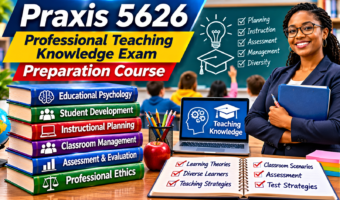
Material Includes
- Comprehensive Praxis 5626 Professional Teaching Knowledge study guide covering essential educational principles and classroom applications.
- Human growth and development review materials covering cognitive, social, emotional, and physical development.
- Educational psychology and learning theory reference sheets covering Piaget, Vygotsky, Erikson, Bandura, behaviorism, and constructivism.
- Diverse learners and inclusive education resources covering differentiated instruction, accommodations, special education, and English language learners.
- Instructional planning and curriculum development study guides covering learning objectives, lesson planning, standards alignment, and teaching methods.
- Classroom management learning materials covering positive behavior support, student engagement, classroom routines, and conflict resolution.
- Student assessment resources covering formative and summative assessment, rubrics, validity, reliability, and data-driven instruction.
- Professional ethics and teacher responsibilities study materials covering confidentiality, educational law, family communication, and professional collaboration.
- Classroom scenario-based practice questions with answer explanations and instructional decision-making exercises.
- Exam revision checklists, self-assessment activities, study planning templates, teaching strategy summaries, and practice question resources.
Praxis Core Combined 5752 Exam Preparation Course
$100.00$150.00