Praxis 7002 Elementary Education: Teaching Reading Exam Preparation Course
About This Course
Prepare confidently for the Praxis 7002 Elementary Education: Teaching Reading exam with a focused online preparation course from AIProctoredExams. This course is designed for aspiring elementary educators, teacher-preparation students, career changers, first-time candidates, and test-takers preparing to retake the assessment.
According to the official Praxis 7002 test page, the computer-delivered exam contains 80 questions and has a testing time of 110 minutes. It measures the knowledge and skills beginning teachers need to support reading and writing development among students in kindergarten through sixth grade.
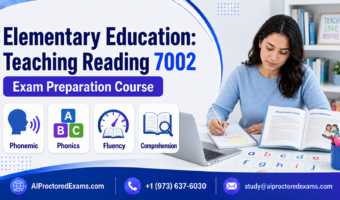
The assessment is grounded in the science of reading and emphasizes five essential components of effective reading instruction: phonemic awareness, phonics, vocabulary, fluency, and comprehension. Assessment principles and connections between reading and written expression are integrated throughout the test.
Praxis 7002 is also the Teaching Reading component of the Praxis 7001 Elementary Education: Multiple Subjects Exam Preparation Course. Candidates may take this subtest independently or as part of the combined Praxis 7001 assessment.
Phonological and Phonemic Awareness
The course explains how spoken language is organized into sentences, words, syllables, onset-rime units, and individual phonemes. Candidates learn to distinguish phonological awareness from phonemic awareness and phonics.
Lessons cover rhyming, blending, segmenting, deleting, adding, substituting, and manipulating sounds. Learners also review emergent literacy, concepts of print, alphabet knowledge, oral-language development, and the progression of early reading skills.
Phonics and Decoding
Candidates examine systematic and explicit phonics instruction, sound-symbol relationships, letter patterns, syllable types, decoding strategies, spelling patterns, and automatic word recognition.
The course covers consonants, short and long vowels, digraphs, blends, diphthongs, inflectional endings, prefixes, suffixes, roots, and multisyllabic word analysis. Practice scenarios help learners select suitable instructional strategies for students experiencing difficulty with decoding and word recognition.
Vocabulary and Fluency
Vocabulary lessons address oral and written vocabulary, direct and indirect instruction, context clues, morphology, semantic relationships, and strategies for teaching unfamiliar words.
Fluency preparation covers accuracy, automaticity, reading rate, phrasing, expression, and prosody. Candidates learn how repeated reading, modeled reading, guided oral reading, and appropriate text selection can strengthen fluency without sacrificing comprehension.
Reading Comprehension
The comprehension section covers literary and informational texts, central ideas, themes, supporting details, inference, text structure, point of view, author purpose, evidence, and relationships among ideas.
Learners examine strategies for activating background knowledge, questioning, predicting, summarizing, monitoring understanding, and using graphic organizers. The course also explains how vocabulary, fluency, text complexity, and knowledge building influence comprehension.
Written Expression
Candidates review the connection between reading and writing development. Lessons address handwriting, spelling, sentence construction, text organization, writing conventions, revision, editing, and the characteristics of narrative, informational, and argumentative writing.
The course explains how reading models, vocabulary knowledge, oral language, and explicit writing instruction support students’ ability to communicate ideas effectively.
Literacy Assessment and Instruction
Assessment concepts are integrated throughout the Praxis 7002 preparation course. Candidates review screening, diagnostic, formative, summative, formal, and informal assessments.
Learners practice interpreting reading data, identifying skill gaps, selecting appropriate instruction, monitoring progress, and determining when additional intervention is required. Classroom scenarios include students with dyslexia, language differences, and varied literacy-learning needs.
Practice and Exam Strategy
The course includes Praxis-style questions, literacy scenarios, passage-based exercises, assessment-data activities, topic quizzes, and timed practice tests. Detailed explanations clarify why each answer is correct and how alternative choices may conflict with evidence-based reading instruction.
Candidates also develop strategies for managing the 110-minute testing period, analyzing classroom scenarios, distinguishing related literacy terms, eliminating distractors, and selecting instruction that targets a student’s identified need.
Additional support is available through the AIProctoredExams Study Guides and How It Works pages. Candidates can also explore the complete collection of Praxis exam-preparation courses.
Because certification requirements and qualifying scores vary among states and licensing agencies, candidates should check the official Praxis score requirements before registering.
AIProctoredExams is an independent exam-preparation provider and is not affiliated with or endorsed by ETS. Praxis is a registered trademark of ETS.
Learning Objectives
Material Includes
- * Complete Praxis 7002 digital study pack
- * Exam blueprint and three-week study schedule
- * Phonological and phonemic-awareness practice activities
- * Phonics, decoding, spelling, and word-analysis guide
- * Vocabulary and reading-fluency study resources
- * Literary and informational comprehension practice passages
- * Written-expression and language-conventions workbook
- * Literacy-assessment and instructional-intervention scenarios
- * Praxis-style questions with detailed answer explanations
- * Timed 80-question practice exams and progress tracker
Material Includes
- * Complete Praxis 7002 digital study pack
- * Exam blueprint and three-week study schedule
- * Phonological and phonemic-awareness practice activities
- * Phonics, decoding, spelling, and word-analysis guide
- * Vocabulary and reading-fluency study resources
- * Literary and informational comprehension practice passages
- * Written-expression and language-conventions workbook
- * Literacy-assessment and instructional-intervention scenarios
- * Praxis-style questions with detailed answer explanations
- * Timed 80-question practice exams and progress tracker