
Most popular
Free
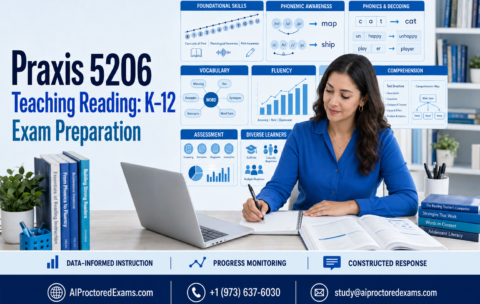
Praxis 5206 Teaching Reading: K–12 Exam Preparation Course
What you'll learn
* Explain the science of reading and the development of literacy from kindergarten through Grade 12.
* Distinguish phonological awareness, phonemic awareness, phonics, decoding, spelling, and automatic word recognition.
* Apply evidence-based strategies for teaching foundational reading skills and decoding multisyllabic words.
* Develop vocabulary and academic-language instruction for literary, informational, and content-area texts.
* Evaluate reading fluency using accuracy, automaticity, rate, phrasing, expression, and comprehension evidence.
* Teach comprehension through text structures, questioning, inference, summarization, synthesis, and textual evidence.
* Connect reading instruction with spelling, sentence development, research, and evidence-based writing.
* Select and interpret screening, diagnostic, formative, summative, and progress-monitoring assessments.
* Differentiate literacy instruction for English learners, students with dyslexia, struggling readers, and advanced learners.
* Apply effective strategies to Praxis 5206 selected-response questions and all three constructed-response tasks.
Free
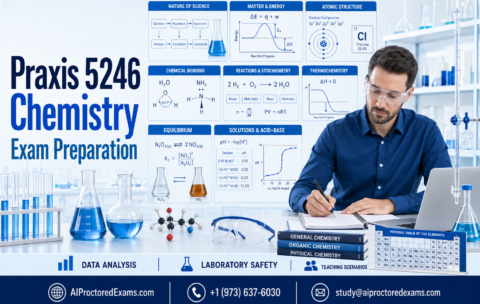
Praxis 5246 Chemistry Exam Preparation Course
What you'll learn
* Understand the Praxis 5246 test structure, question formats, timing, official content areas, and teaching-scenario emphasis.
* Apply scientific inquiry, engineering practices, experimental design, measurement, evidence evaluation, and laboratory-safety principles.
* Explain the properties, classification, particle behavior, phases, and energy relationships of matter.
* Analyze atomic structure, electron configurations, isotopes, electromagnetic radiation, and periodic trends.
* Predict chemical bonding, molecular geometry, polarity, intermolecular forces, and structure-property relationships.
* Balance chemical equations and solve mole, formula, limiting-reactant, yield, gas, and solution stoichiometry problems.
* Interpret thermochemical processes, calorimetry, enthalpy, entropy, Gibbs free energy, reaction rates, and energy diagrams.
* Apply equilibrium, solubility, acid-base, buffer, pH, titration, and electrochemical principles.
* Analyze laboratory investigations, molecular models, graphs, tables, chemical equations, experimental data, and teaching scenarios.
* Use pacing, estimation, dimensional analysis, answer elimination, and error-checking strategies during the Praxis 5246 exam.
Trending
Free
Praxis 5206 Teaching Reading: K–12 Exam Preparation Course
What you'll learn
* Explain the science of reading and the development of literacy from kindergarten through Grade 12.
* Distinguish phonological awareness, phonemic awareness, phonics, decoding, spelling, and automatic word recognition.
* Apply evidence-based strategies for teaching foundational reading skills and decoding multisyllabic words.
* Develop vocabulary and academic-language instruction for literary, informational, and content-area texts.
* Evaluate reading fluency using accuracy, automaticity, rate, phrasing, expression, and comprehension evidence.
* Teach comprehension through text structures, questioning, inference, summarization, synthesis, and textual evidence.
* Connect reading instruction with spelling, sentence development, research, and evidence-based writing.
* Select and interpret screening, diagnostic, formative, summative, and progress-monitoring assessments.
* Differentiate literacy instruction for English learners, students with dyslexia, struggling readers, and advanced learners.
* Apply effective strategies to Praxis 5206 selected-response questions and all three constructed-response tasks.
Free
Praxis 5246 Chemistry Exam Preparation Course
What you'll learn
* Understand the Praxis 5246 test structure, question formats, timing, official content areas, and teaching-scenario emphasis.
* Apply scientific inquiry, engineering practices, experimental design, measurement, evidence evaluation, and laboratory-safety principles.
* Explain the properties, classification, particle behavior, phases, and energy relationships of matter.
* Analyze atomic structure, electron configurations, isotopes, electromagnetic radiation, and periodic trends.
* Predict chemical bonding, molecular geometry, polarity, intermolecular forces, and structure-property relationships.
* Balance chemical equations and solve mole, formula, limiting-reactant, yield, gas, and solution stoichiometry problems.
* Interpret thermochemical processes, calorimetry, enthalpy, entropy, Gibbs free energy, reaction rates, and energy diagrams.
* Apply equilibrium, solubility, acid-base, buffer, pH, titration, and electrochemical principles.
* Analyze laboratory investigations, molecular models, graphs, tables, chemical equations, experimental data, and teaching scenarios.
* Use pacing, estimation, dimensional analysis, answer elimination, and error-checking strategies during the Praxis 5246 exam.
Popular Instructors

All Praxis 5246 Courses
Free
Praxis 5246 Chemistry Exam Preparation Course
Prepare for the Praxis 5246 Chemistry Exam The Praxis 5246 …
What you'll learn
* Understand the Praxis 5246 test structure, question formats, timing, official content areas, and teaching-scenario emphasis.
* Apply scientific inquiry, engineering practices, experimental design, measurement, evidence evaluation, and laboratory-safety principles.
* Explain the properties, classification, particle behavior, phases, and energy relationships of matter.
* Analyze atomic structure, electron configurations, isotopes, electromagnetic radiation, and periodic trends.
* Predict chemical bonding, molecular geometry, polarity, intermolecular forces, and structure-property relationships.
* Balance chemical equations and solve mole, formula, limiting-reactant, yield, gas, and solution stoichiometry problems.
* Interpret thermochemical processes, calorimetry, enthalpy, entropy, Gibbs free energy, reaction rates, and energy diagrams.
* Apply equilibrium, solubility, acid-base, buffer, pH, titration, and electrochemical principles.
* Analyze laboratory investigations, molecular models, graphs, tables, chemical equations, experimental data, and teaching scenarios.
* Use pacing, estimation, dimensional analysis, answer elimination, and error-checking strategies during the Praxis 5246 exam.
Free
Praxis 5206 Teaching Reading: K–12 Exam Preparation Course
Praxis 5206 Teaching Reading: K–12 Exam Preparation Course Prepare for …
What you'll learn
* Explain the science of reading and the development of literacy from kindergarten through Grade 12.
* Distinguish phonological awareness, phonemic awareness, phonics, decoding, spelling, and automatic word recognition.
* Apply evidence-based strategies for teaching foundational reading skills and decoding multisyllabic words.
* Develop vocabulary and academic-language instruction for literary, informational, and content-area texts.
* Evaluate reading fluency using accuracy, automaticity, rate, phrasing, expression, and comprehension evidence.
* Teach comprehension through text structures, questioning, inference, summarization, synthesis, and textual evidence.
* Connect reading instruction with spelling, sentence development, research, and evidence-based writing.
* Select and interpret screening, diagnostic, formative, summative, and progress-monitoring assessments.
* Differentiate literacy instruction for English learners, students with dyslexia, struggling readers, and advanced learners.
* Apply effective strategies to Praxis 5206 selected-response questions and all three constructed-response tasks.