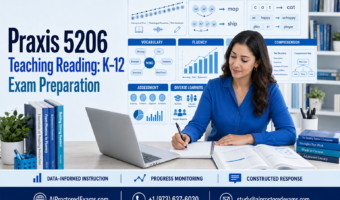
Praxis 5206 Teaching Reading: K–12 Exam Preparation Course
About This Course
Praxis 5206 Teaching Reading: K–12 Exam Preparation Course
Prepare for the Praxis 5206 Teaching Reading: K–12 exam with comprehensive online preparation from AIProctoredExams. This course is designed for aspiring reading teachers, literacy specialists, teacher-education students, licensure candidates, classroom educators, first-time test-takers, and candidates preparing to retake the Praxis Teaching Reading: K–12 examination.
The course provides structured preparation in evidence-based reading instruction, the science of reading, foundational literacy development, vocabulary, fluency, comprehension, writing, assessment, differentiation, and instructional decision-making across the full K–12 grade range.
Rather than relying on isolated definitions, candidates learn how reading skills develop, how literacy difficulties can be identified, and how assessment evidence should guide instruction and intervention. Praxis-style questions and classroom scenarios help learners apply reading research to the instructional decisions expected of effective literacy educators.
Candidates preparing for additional certification tests can also explore the complete collection of Praxis exam preparation courses and the related Praxis 5205 Teaching Reading: Elementary Exam Preparation Course.
What Is the Praxis 5206 Teaching Reading: K–12 Exam?
Praxis 5206 measures the knowledge and instructional skills beginning educators need to support reading and writing development in elementary, middle, and secondary school students.
According to the official ETS Praxis 5206 examination page, the computer-delivered test allows 150 minutes and contains 90 selected-response questions and three constructed-response questions.
The examination emphasizes research-based reading instruction and the science of teaching reading. Candidates must demonstrate an understanding of language, foundational reading skills, vocabulary, fluency, comprehension, writing, assessment, and appropriate instruction for students with diverse academic, linguistic, cultural, and developmental needs.
The test includes instructional situations involving individual students and entire classes from kindergarten through Grade 12. Candidates may need to analyze print, digital, literary, informational, and image-based texts before selecting or explaining an appropriate instructional response.
Science of Reading and Literacy Development
The Praxis 5206 preparation course examines reading as a complex process involving several connected language and literacy systems.
Candidates study how students progress from oral-language development and phonological awareness to decoding, automatic word recognition, fluent reading, vocabulary growth, and increasingly sophisticated text comprehension. Lessons emphasize the importance of explicit, systematic, cumulative, and responsive instruction while helping candidates determine when particular approaches are appropriate for different students.
Course content also examines the relationship among listening, speaking, reading, spelling, and writing. This foundation helps candidates understand why difficulty in one area may influence a student’s performance in another.
Phonological and Phonemic Awareness
Candidates review the hierarchy of phonological awareness, including words, syllables, onset-rime, and individual phonemes.
Preparation covers:
-
Phoneme isolation and identification
-
Blending and segmenting
-
Phoneme addition, deletion, and substitution
-
Rhyming and sound matching
-
Relationships between oral language and written language
-
Selecting activities for particular stages of literacy development
-
Recognizing patterns in student errors
-
Supporting students who need intensive foundational instruction
Praxis-style scenarios help candidates distinguish between broad phonological-awareness activities and tasks that specifically develop phonemic awareness.
Phonics, Decoding, Spelling, and Word Recognition
This section reviews how learners connect speech sounds with written symbols and use those relationships to read and spell words.
Candidates study the alphabetic principle, grapheme-phoneme correspondences, consonant and vowel patterns, digraphs, blends, syllable types, irregular words, and strategies for decoding multisyllabic words.
Instruction also addresses structural and morphological analysis, including prefixes, suffixes, roots, base words, and meaningful word parts. These concepts are considered across grade levels so candidates can support beginning readers as well as older students experiencing persistent decoding or word-recognition difficulties.
Practice activities require candidates to analyze reading and spelling errors, identify the likely source of difficulty, and select an appropriate instructional response.
Vocabulary and Academic Language
Vocabulary instruction is essential throughout the K–12 curriculum. Candidates learn how vocabulary grows through reading, conversation, content-area learning, and intentional instruction.
The course reviews:
-
Direct and indirect vocabulary instruction
-
Academic and domain-specific language
-
Context clues
-
Morphological analysis
-
Multiple-meaning words
-
Synonyms, antonyms, and semantic relationships
-
Selecting words for explicit instruction
-
Student-friendly explanations
-
Word consciousness
-
Strategies for English learners
-
Vocabulary instruction in science, mathematics, social studies, and literature
Candidates practice choosing vocabulary strategies that match the student, text, subject, and instructional objective presented in each scenario.
Reading Fluency
Fluent reading involves accuracy, automaticity, appropriate rate, phrasing, expression, and attention to meaning.
The course examines teacher modeling, guided oral reading, repeated reading, partner reading, phrase-cued reading, corrective feedback, and fluency progress monitoring. Candidates learn how to interpret fluency information and determine whether a student primarily needs support with decoding, automatic word recognition, prosody, comprehension, or another underlying skill.
Reading Comprehension
Praxis 5206 candidates must understand how readers construct meaning from increasingly complex literary and informational texts.
Course preparation addresses:
-
Activating and building background knowledge
-
Identifying main ideas and supporting details
-
Making inferences and drawing conclusions
-
Summarizing and synthesizing information
-
Monitoring comprehension
-
Asking and answering questions
-
Analyzing text structure
-
Identifying an author’s purpose and point of view
-
Evaluating arguments and evidence
-
Comparing ideas across multiple texts
-
Using textual evidence
-
Interpreting digital and image-based information
-
Understanding figurative language and author’s craft
Candidates also examine disciplinary literacy and the different ways students approach texts in English language arts, science, social studies, mathematics, and technical subjects.
Writing in Support of Reading
Reading and writing are closely connected. The course reviews how writing can strengthen vocabulary, comprehension, analysis, and knowledge development.
Candidates learn how to support students as they plan, draft, revise, edit, and publish writing. Additional topics include sentence construction, spelling, grammar, organization, written responses to texts, research, evidence-based writing, and the use of writing to demonstrate comprehension.
Instructional scenarios help candidates select writing activities that reinforce specific reading objectives and address identified student needs.
Literacy Assessment and Diagnostic Instruction
Assessment concepts are integrated throughout Praxis 5206. Candidates learn how to select, administer, interpret, and use literacy assessments appropriately.
Preparation includes screening, diagnostic assessment, progress monitoring, formative assessment, summative assessment, observation, reading inventories, oral-reading records, decoding measures, fluency data, comprehension evidence, and student writing samples.
The course emphasizes data-informed decision-making. Candidates practice identifying patterns in student performance, determining instructional priorities, forming flexible groups, monitoring progress, and deciding when an intervention should be continued, adjusted, or intensified.
Differentiating Instruction for Diverse Learners
The Praxis 5206 examination includes classroom situations involving students with different backgrounds, strengths, and learning needs.
The course prepares candidates to differentiate literacy instruction for:
-
English learners and multilingual students
-
Students with dyslexia or characteristics associated with dyslexia
-
Students with reading disabilities
-
Students requiring intervention
-
Advanced and gifted readers
-
Students with limited background knowledge
-
Learners from different cultural and linguistic backgrounds
-
Students using accommodations or assistive technology
-
Older students with unfinished foundational reading development
Candidates learn to use assessment evidence, explicit instruction, scaffolding, multimodal resources, culturally responsive materials, flexible grouping, and progress monitoring to make defensible instructional decisions.
Selected-Response and Constructed-Response Preparation
The course includes targeted preparation for both question formats used on Praxis 5206.
Selected-response practice helps candidates recognize important details, compare instructional strategies, interpret assessment information, eliminate weak alternatives, and select the most appropriate evidence-based response.
The three constructed-response questions assess the candidate’s ability to address developing emergent literacy learners, support independent literacy learners, and respond to diverse learners. Candidates practice analyzing student evidence, identifying instructional needs, recommending strategies and materials, and justifying their decisions with relevant literacy knowledge.
Response frameworks help learners organize complete answers while managing the examination’s time limit.
Prepare with a Structured Study Plan
AIProctoredExams combines focused content review with topic quizzes, realistic Praxis-style questions, constructed-response exercises, detailed explanations, progress checks, and full-length practice.
Candidates can use the AIProctoredExams study guides to reinforce important concepts and review how the online preparation process works before beginning.
Praxis requirements and qualifying scores vary by jurisdiction. Before registering, candidates should confirm that their licensing authority requires or accepts test 5206 using the official Praxis state requirements directory.
Enroll in the Praxis 5206 Teaching Reading: K–12 Exam Preparation Course to strengthen your literacy knowledge, practice applying evidence-based instruction, and approach selected-response and constructed-response questions with a clear preparation strategy.
Learning Objectives
Material Includes
- * Complete Praxis 5206 digital study pack
- * Structured K–12 reading-instruction lessons
- * Science of reading and foundational literacy review
- * Praxis-style selected-response practice questions
- * Detailed explanations for practice-question answers
- * Constructed-response frameworks and model responses
- * Student assessment and instructional-decision scenarios
- * Full-length Praxis 5206 simulated practice tests
- * Quick-reference literacy terminology and strategy sheets
- * Structured study schedule and progress tracker
Material Includes
- * Complete Praxis 5206 digital study pack
- * Structured K–12 reading-instruction lessons
- * Science of reading and foundational literacy review
- * Praxis-style selected-response practice questions
- * Detailed explanations for practice-question answers
- * Constructed-response frameworks and model responses
- * Student assessment and instructional-decision scenarios
- * Full-length Praxis 5206 simulated practice tests
- * Quick-reference literacy terminology and strategy sheets
- * Structured study schedule and progress tracker