
Free
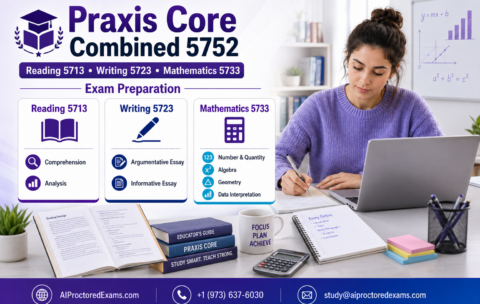
Praxis Core Combined 5752 Exam Preparation Course
Prepare for the Praxis Core Combined 5752 Exam Prepare confidently …
What you'll learn
* Understand the complete Praxis Core Combined 5752 structure, timing and requirements for subtests 5713, 5723 and 5733.
* Analyze reading passages for central ideas, supporting evidence, inferences, purpose, tone and point of view.
* Compare paired passages and interpret information presented in graphs, diagrams, maps, tables and other visual formats.
* Apply standard English grammar, usage, mechanics, sentence structure, word choice and revision principles.
* Evaluate research strategies, source credibility, citation elements and the relevance of supporting information.
* Plan and write organized argumentative essays supported by clear reasons and appropriate examples.
* Develop informative and explanatory essays that accurately synthesize information from two provided sources.
* Solve mathematics problems involving numbers, fractions, decimals, ratios, percentages, algebra and geometry.
* Apply measurement, statistics, probability and data-interpretation concepts to realistic mathematical problems.
* Use effective answer elimination, essay planning, calculator use, pacing, concentration and combined-test time-management strategies.
Free
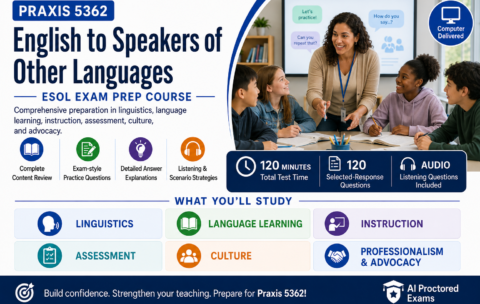
Praxis 5362 English to Speakers of Other Languages Exam Preparation Course
Prepare for the Praxis 5362 ESOL Exam Develop the linguistic …
What you'll learn
* Understand the structure, timing, audio component, and six content areas of the Praxis 5362 exam.
* Analyze English phonetics, phonology, morphology, syntax, semantics, pragmatics, and discourse.
* Explain major first- and second-language acquisition theories and developmental processes.
* Recognize how first-language literacy, motivation, age, culture, and prior education affect English learning.
* Plan standards-aligned lessons that integrate listening, speaking, reading, writing, and academic content.
* Differentiate ESOL instruction for varied proficiency levels, backgrounds, abilities, and learning needs.
* Select and interpret formal, informal, formative, summative, and language-proficiency assessments.
* Create culturally responsive classrooms that value multilingual learners’ identities and experiences.
* Apply professional ethics, education law, family collaboration, advocacy, and referral responsibilities.
* Use listening, pacing, scenario analysis, and answer-elimination strategies during the examination.