
Praxis 5362 English to Speakers of Other Languages Exam Preparation Course
About This Course
Prepare for the Praxis 5362 ESOL Exam
Develop the linguistic knowledge, instructional skills, cultural awareness, and professional judgment assessed on the Praxis 5362 English to Speakers of Other Languages exam. This comprehensive course is designed for aspiring ESOL teachers, current educators seeking an ESL endorsement, education majors, first-time candidates, and test takers preparing to retake the assessment.
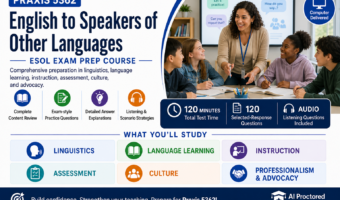
According to the official ETS Praxis 5362 examination page, the computer-delivered test contains 120 selected-response questions and allows 120 minutes for completion. The examination may include audio-based listening questions embedded throughout the test.
The Praxis 5362 assessment measures the knowledge and skills expected of beginning K–12 ESOL teachers across six content categories:
-
Foundations of Linguistics
-
Foundations of Language Learning
-
Planning and Implementing Instruction
-
Assessment and Evaluation
-
Culture
-
Professionalism and Advocacy
Foundations of Linguistics
The Foundations of Linguistics section of the Praxis 5362 English to Speakers of Other Languages course examines how the English language is structured and used.
Topics include phonetics, phonology, morphology, syntax, semantics, pragmatics, discourse, vocabulary, language variation, dialects, and communicative competence.
You will learn how individual speech sounds are produced, how words are formed, how sentences are organized, and how context influences meaning. Practice questions also address English spelling patterns, grammatical structures, social language, academic language, and features that may be challenging for multilingual learners.
Foundations of Language Learning
Review the theories and processes involved in first- and second-language acquisition. This section explains how age, motivation, personality, prior education, first-language literacy, culture, anxiety, and opportunities for interaction can influence English-language development.
You will examine concepts such as comprehensible input, interaction, scaffolding, language transfer, interlanguage, developmental errors, social language, academic language, and the relationship between language acquisition and literacy.
The course emphasizes selecting appropriate instructional responses based on a learner’s proficiency level, educational background, and individual needs.
Planning and Implementing Instruction
The Planning and Implementing Instruction module of the Praxis 5362 English to Speakers of Other Languages course focuses on effective K–12 ESOL teaching.
You will learn how to create measurable language objectives, connect language development with academic content, organize instruction, activate prior knowledge, differentiate lessons, and select appropriate materials.
Preparation covers listening, speaking, reading, and writing instruction. It also examines sheltered instruction, cooperative learning, explicit language teaching, content-based instruction, technology integration, vocabulary development, literacy instruction, and strategies for supporting newcomers.
Candidates practice adapting lessons for different proficiency levels and supporting English learners who may also receive gifted, special education, or intervention services.
Assessment and Evaluation
Learn how to select, administer, interpret, and use assessments for multilingual learners. Topics include formal and informal assessment, formative and summative assessment, diagnostic testing, language-proficiency assessment, classroom observation, portfolios, rubrics, and performance-based tasks.
The Praxis 5362 English to Speakers of Other Languages exam may ask you to identify appropriate accommodations, recognize potential cultural or linguistic bias, interpret assessment data, and use results to plan instruction.
You will also review validity, reliability, norm-referenced and criterion-referenced testing, progress monitoring, placement decisions, and communicating results to students, families, and colleagues.
Culture
Culture influences communication, learning, classroom participation, identity, and relationships. This module develops the cultural understanding needed to create welcoming and responsive learning environments.
Topics include cultural identity, cross-cultural communication, acculturation, assimilation, stereotypes, bias, family expectations, educational traditions, and the relationship between language and culture.
Practice scenarios help you recognize culturally influenced behavior without making assumptions or treating cultural groups as uniform.
Professionalism and Advocacy
The Professionalism and Advocacy section reviews the ethical, legal, and collaborative responsibilities of ESOL educators.
You will examine professional standards, English learners’ educational rights, confidentiality, family communication, collaboration with content-area teachers, referrals, community resources, and advocacy for equitable educational access.
The course also covers professional development, reflective teaching, cooperation with administrators and specialists, and distinguishing language-development differences from possible learning disabilities.
The examination aligns with professional expectations described in the TESOL Standards for Initial Pre-K–12 Teacher Preparation Programs. Candidates may also consult the WIDA English Language Development Standards Framework for additional guidance on integrating language and academic-content instruction.
Listening and Scenario-Based Questions
Audio questions on the Praxis 5362 English to Speakers of Other Languages exam may require you to analyze pronunciation, oral language, classroom interactions, or instructional situations.
Listening practice helps you identify relevant linguistic features while managing the overall test clock. Scenario-based questions strengthen your ability to select responses that are developmentally appropriate, culturally responsive, evidence-based, and supportive of language development.
Complete Praxis 5362 Preparation
The course includes focused lessons, realistic practice questions, listening activities, classroom scenarios, and detailed explanations. Full-length practice tests help you develop the pacing needed to answer 120 questions in 120 minutes.
Related preparation is available through the Praxis 5624 Principles of Learning and Teaching: Grades 7–12 course, Praxis 5623 Principles of Learning and Teaching: Grades 5–9 course, and Praxis 5205 Teaching Reading: Elementary course.
Candidates can also explore the complete Praxis course catalog, access additional study guides, and review how the preparation process works.
Confirm Your State Requirements
Qualifying scores and endorsement requirements vary by state or licensing agency. Confirm your requirements using the official ETS state requirements directory before registering.
Prepare with structured content review, listening practice, realistic classroom scenarios, and full-length assessments for the Praxis 5362 English to Speakers of Other Languages exam.
Learning Objectives
Material Includes
- * Complete digital Praxis 5362 ESOL study pack.
- * Foundations of Linguistics content-review module.
- * Foundations of Language Learning and acquisition-theory module.
- * Planning and Implementing Instruction preparation module.
- * Assessment and Evaluation content-review module.
- * Culture, identity, and culturally responsive teaching module.
- * Professionalism, education law, collaboration, and advocacy module.
- * Audio-based listening practice and realistic classroom scenarios.
- * Full-length 120-question practice assessments with detailed answer explanations.
- * Three-week study schedule, progress tracker, quick-reference sheets, and test-taking strategies.
Material Includes
- * Complete digital Praxis 5362 ESOL study pack.
- * Foundations of Linguistics content-review module.
- * Foundations of Language Learning and acquisition-theory module.
- * Planning and Implementing Instruction preparation module.
- * Assessment and Evaluation content-review module.
- * Culture, identity, and culturally responsive teaching module.
- * Professionalism, education law, collaboration, and advocacy module.
- * Audio-based listening practice and realistic classroom scenarios.
- * Full-length 120-question practice assessments with detailed answer explanations.
- * Three-week study schedule, progress tracker, quick-reference sheets, and test-taking strategies.