
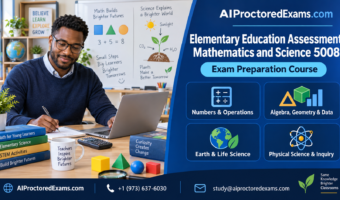
Praxis 5008 Elementary Education Assessment: Mathematics and Science Exam Preparation Course
About This Course
About This Praxis 5008 Course
Prepare confidently for the Praxis 5008 Elementary Education Assessment: Mathematics and Science exam with a comprehensive online course covering elementary mathematics, Earth and space science, life science, physical science, scientific inquiry, and classroom-based teaching applications.
The course combines focused content review with guided problem-solving, original practice questions, detailed answer explanations, calculator exercises, and effective test-taking strategies. It is designed for prospective teachers working with children from the primary through upper elementary grades.
Praxis 5008 Exam Overview
According to the official Praxis 5008 test page, the computer-delivered examination contains 85 questions and allows 120 minutes for completion.
The approximate content distribution is:
-
Mathematics: 60%, or approximately 51 questions
-
Science: 40%, or approximately 34 questions
The assessment includes selected-response questions in which candidates may choose one or more answers, together with other computer-delivered question formats. Some questions may be included for research purposes and may not contribute to the final score.
Relationship Between Praxis 5008 and Praxis 5006
Praxis 5008 is the Mathematics and Science component of the Praxis 5006 Elementary Education Assessment. The other component is Reading and Language Arts & Social Studies 5007.
Depending on state requirements, candidates may take Praxis 5008 separately or complete it as part of the combined 5006 assessment. This course focuses exclusively on preparing candidates for the Mathematics and Science 5008 subtest.
Praxis 5008 Mathematics Content
The mathematics section reflects elementary content and teaching practices associated with the National Council of Teachers of Mathematics. Questions assess mathematical understanding, reasoning, representations, problem-solving, and the ability to interpret students’ mathematical thinking.
Numbers and Operations
Review place value, whole-number operations, factors, multiples, prime and composite numbers, fractions, decimals, ratios, percentages, and proportional reasoning.
Learn to compare quantities, estimate results, select appropriate operations, and use visual models such as number lines, arrays, area models, and base-ten representations.
Fractions, Decimals, and Ratios
Strengthen your ability to compare, order, add, subtract, multiply, and divide fractions and decimals. Practice converting among fractions, decimals, and percentages while applying these concepts to realistic word problems.
Lessons also address equivalent fractions, unit rates, ratios, proportional relationships, and common student misconceptions.
Algebraic Thinking
Study patterns, sequences, properties of operations, equations, expressions, variables, functions, and relationships between quantities.
Practice translating among verbal descriptions, tables, diagrams, and symbolic representations. Learn to analyze different student strategies and determine whether mathematical reasoning is valid.
Geometry and Spatial Reasoning
Review points, lines, angles, polygons, circles, symmetry, coordinate systems, transformations, and two-dimensional and three-dimensional figures.
Learn to classify shapes using their properties, compose and decompose figures, visualize spatial relationships, and solve problems involving geometric reasoning.
Measurement
Study customary and metric units, length, mass, weight, capacity, temperature, time, perimeter, area, surface area, and volume.
Practice selecting appropriate measuring tools, converting units, estimating measurements, and applying formulas within elementary-level problems.
Data, Statistics, and Probability
Learn to organize, display, interpret, and compare data using tables, bar graphs, line plots, picture graphs, circle graphs, and other visual representations.
Review measures of center, data variability, basic probability, possible outcomes, and the interpretation of conclusions drawn from data.
Praxis 5008 Science Content
The science section reflects standards and practices associated with the National Science Teaching Association and the Next Generation Science Standards.
Questions assess scientific knowledge together with the ability to analyze investigations, interpret evidence, and apply scientific principles to elementary classroom situations.
Earth and Space Science
Review rocks, minerals, soil, fossils, weathering, erosion, landforms, plate tectonics, natural resources, weather, climate, and the water cycle.
Lessons also examine the solar system, Earth’s rotation and revolution, day and night, seasons, moon phases, gravity, and observable patterns in the sky.
Life Science
Study cells, organisms, plant and animal structures, life cycles, body systems, heredity, variation, adaptation, classification, and biological diversity.
Practice analyzing ecosystems, habitats, populations, communities, food chains, food webs, and the movement of matter and energy through living systems.
Physical Science
Review matter, states of matter, physical and chemical properties, mixtures, solutions, forces, motion, gravity, friction, and simple machines.
The course also covers heat, light, sound, electricity, magnetism, energy transfer, and the transformation of energy from one form to another.
Scientific Inquiry
Develop your ability to identify testable questions, form predictions, recognize variables and controls, select appropriate tools, interpret evidence, and evaluate conclusions.
Practice analyzing tables, graphs, diagrams, experimental descriptions, measurement results, and potential sources of error.
Engineering and Technology
Review the elementary engineering-design process, including defining problems, developing possible solutions, building models, testing designs, evaluating results, and making improvements.
Learn how scientific knowledge, mathematics, technology, and evidence can be combined to address practical problems.
Tasks of Teaching
Many Praxis 5008 questions present realistic classroom situations. Candidates may need to identify a student misconception, select an appropriate mathematical model, evaluate a science investigation, interpret student work, or determine the next instructional step.
Course exercises help you connect content knowledge with developmentally appropriate instruction, assessment, questioning, and classroom decision-making.
Praxis 5008 Calculator Use
An on-screen four-function calculator is provided during the examination. However, many questions can be answered more efficiently through estimation, reasoning, or mental computation.
The course includes calculator-based practice to help you decide when calculator use is appropriate, estimate answers before calculating, and identify unreasonable results. Review the official Praxis calculator-use guidelines before your examination.
Praxis 5008 Practice and Test Strategies
Timed practice helps you build an effective pace for answering 85 questions in 120 minutes. Learn to identify relevant information, translate word problems, estimate before calculating, eliminate unsupported answers, and interpret unfamiliar graphs or scientific scenarios.
Original practice questions include explanations showing why the correct response is supported and why the alternatives are less appropriate. This method strengthens understanding and helps you apply concepts when a question is presented differently.
Flexible Online Praxis Preparation
Study at your preferred pace and revisit challenging mathematics or science topics whenever necessary. Explore additional Praxis exam-preparation courses, consult the available study guides, or visit How It Works for information about accessing the online learning platform.
Praxis 5008 Passing-Score Information
Qualifying scores and testing requirements differ among states and licensing agencies. Before registering, consult the official Praxis state requirements to confirm whether Praxis 5008 is accepted and determine the score required for your certification pathway.
Independent Test-Preparation Disclaimer
AIProctoredExams is an independent test-preparation provider and is not affiliated with, endorsed by, or sponsored by ETS. Praxis is a registered trademark of ETS. Course lessons and practice questions are independently developed for educational purposes and do not contain live examination questions.
Learning Objectives
Material Includes
- * Complete digital Praxis 5008 Mathematics and Science preparation course.
- * Praxis 5008 exam overview and three-week study schedule.
- * Numbers, operations, fractions, decimals, ratios, and percentages workbook.
- * Algebraic thinking, patterns, equations, and mathematical-reasoning guide.
- * Geometry, measurement, statistics, probability, and data-analysis materials.
- * Earth materials, weather, climate, water cycle, and space science study guide.
- * Cells, organisms, heredity, adaptation, ecosystems, and biodiversity workbook.
- * Matter, forces, motion, energy, light, sound, electricity, and magnetism guide.
- * Scientific inquiry, engineering design, student-misconception, and calculator exercises.
- * Original exam-style questions, detailed answer explanations, timed practice tests, and progress-tracking tools.
Material Includes
- * Complete digital Praxis 5008 Mathematics and Science preparation course.
- * Praxis 5008 exam overview and three-week study schedule.
- * Numbers, operations, fractions, decimals, ratios, and percentages workbook.
- * Algebraic thinking, patterns, equations, and mathematical-reasoning guide.
- * Geometry, measurement, statistics, probability, and data-analysis materials.
- * Earth materials, weather, climate, water cycle, and space science study guide.
- * Cells, organisms, heredity, adaptation, ecosystems, and biodiversity workbook.
- * Matter, forces, motion, energy, light, sound, electricity, and magnetism guide.
- * Scientific inquiry, engineering design, student-misconception, and calculator exercises.
- * Original exam-style questions, detailed answer explanations, timed practice tests, and progress-tracking tools.