Praxis 5024 Education of Young Children Exam Preparation Course
About This Course
About This Praxis 5024 Course
Prepare confidently for the Praxis 5024 Education of Young Children exam with a comprehensive online course covering child development, assessment, developmentally appropriate teaching, family engagement, professional responsibilities, content pedagogy, and constructed-response writing.
The Praxis 5024 exam is intended primarily for prospective teachers of children from birth through age eight. This course connects early childhood theory with realistic educational situations so you can apply what you learn to classroom scenarios and exam-style questions.
Praxis 5024 Exam Overview
According to the official Praxis 5024 test page, the computer-delivered examination contains 120 selected-response questions and three constructed-response questions. Candidates receive 150 minutes to complete the assessment.
The official Praxis 5024 Study Companion recommends allocating approximately 120 minutes to the selected-response questions and 30 minutes to the constructed responses. However, the two portions are not independently timed.
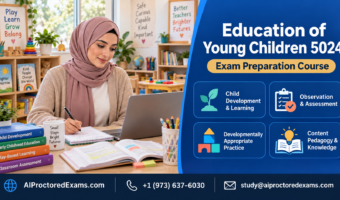
The approximate content distribution is:
-
Childhood Development and Learning: 25 selected-response questions, or 17%
-
Observation, Documentation, and Assessment: 19 selected-response questions, or 13%
-
Developmentally Appropriate Practices: 19 selected-response questions, or 13%
-
Professionalism, Family, and Community: 19 selected-response questions, or 13%
-
Content Pedagogy and Knowledge: 38 selected-response questions, or 24%
-
Knowledge of Teaching: three constructed responses, or 20%
Childhood Development and Learning
Physical, Cognitive, Social, and Emotional Development
Review the interconnected areas of physical, cognitive, social, emotional, and language development from birth through age eight.
Learn how developmental knowledge guides decisions about learning activities, classroom expectations, communication, behavior support, and relationships. Course exercises help you distinguish developmentally appropriate expectations from practices that may not match a child’s current abilities.
Influences on Development
Examine how culture, language, family structure, community, health, nutrition, socioeconomic conditions, disabilities, and life experiences influence children’s development and learning.
The course also addresses risk and protective factors, motivation, resilience, individual differences, and the interaction between inherited characteristics and environmental experiences.
Typical and Atypical Development
Review commonly expected developmental patterns while recognizing that children develop at different rates. Learn to identify possible developmental delays, advanced abilities, language differences, disabilities, and circumstances that may require additional observation or referral.
The emphasis is on using appropriate evidence, avoiding unsupported diagnoses, and collaborating with families and qualified professionals.
Observation, Documentation, and Assessment
Purposes and Types of Assessment
Study formal and informal assessment, observation, screening, diagnostic evaluation, formative assessment, summative assessment, portfolios, checklists, rating scales, and work samples.
Learn to select assessment methods that match instructional goals, developmental levels, and the needs of individual children.
Responsible Assessment Practices
Review validity, reliability, fairness, confidentiality, cultural and linguistic responsiveness, and the limitations of different assessment methods.
Practice using multiple sources of information before making instructional decisions. Learn how to communicate assessment results respectfully and clearly to families and other professionals.
Using Evidence to Guide Instruction
Develop your ability to collect, document, analyze, and interpret information about children’s progress.
Course activities help you connect observations and assessment results to curriculum planning, differentiation, intervention, enrichment, referral, and future learning goals.
Developmentally Appropriate Practices
The Praxis 5024 framework reflects principles associated with the National Association for the Education of Young Children and emphasizes active, play-based, child-centered learning.
Play and Active Learning
Understand how play supports physical development, language, creativity, problem-solving, self-regulation, social interaction, and academic learning.
Review teacher-guided and child-initiated experiences that give children opportunities to explore, make choices, ask questions, solve problems, and learn through discovery.
Learning Environments and Classroom Organization
Learn how room arrangement, schedules, routines, learning centers, transitions, materials, and classroom expectations influence children’s participation and behavior.
The course addresses safe, inclusive, respectful, stimulating, and appropriately challenging learning environments.
Differentiated and Inclusive Teaching
Practice adapting instruction, materials, communication, and assessment for children with different abilities, interests, languages, cultures, backgrounds, and learning needs.
Learn to provide appropriate support without unnecessarily limiting independence, choice, exploration, or meaningful participation.
Positive Guidance and Social-Emotional Learning
Review developmentally appropriate approaches to behavior, relationships, emotional regulation, conflict resolution, cooperation, and classroom community.
Learn to identify the purpose a behavior may serve and select positive, preventive, and instructional responses.
Professionalism, Family, and Community
Ethical and Professional Responsibilities
Study professional ethics, confidentiality, reflective practice, continuing professional development, advocacy, record keeping, and collaboration.
Learn to recognize situations requiring communication with administrators, specialists, child-protection personnel, or other qualified professionals.
Family Partnerships
Examine respectful, reciprocal, and culturally responsive approaches to working with families. Practice selecting communication methods that encourage two-way participation and shared decision-making.
The course emphasizes viewing families as important sources of knowledge about their children and including them appropriately in assessment, goal setting, and educational planning.
Community and Professional Collaboration
Learn how teachers collaborate with colleagues, specialists, service providers, and community organizations to support children’s development.
Review referral processes, transition planning, interdisciplinary teamwork, and responsible use of technology when communicating with families and professionals.
Content Pedagogy and Knowledge
Language and Literacy
Review oral-language development, print awareness, phonological and phonemic awareness, phonics, vocabulary, fluency, comprehension, children’s literature, writing, speaking, and listening.
Learn to select developmentally appropriate books, conversations, games, environmental print, storytelling, and writing activities.
Mathematics
Study counting, number relationships, operations, patterns, classification, geometry, measurement, data, and mathematical problem-solving.
Practice using manipulatives, play, questions, routines, and real-world experiences to develop mathematical understanding.
Science and Inquiry
Review life science, physical science, Earth and space science, observation, prediction, experimentation, measurement, and evidence-based conclusions.
Learn how to create safe, hands-on experiences that encourage curiosity and scientific reasoning.
Social Studies, Creative Arts, and Physical Development
Study age-appropriate approaches to family, community, culture, geography, history, citizenship, music, movement, visual art, dramatic play, health, safety, nutrition, and physical development.
The course emphasizes integrating content areas through meaningful projects, play, stories, investigation, and daily classroom experiences.
Praxis 5024 Constructed Responses
The examination includes three constructed-response questions. According to ETS, these prompts may address Developmentally Appropriate Practices; Professionalism, Family, and Community; Observation, Documentation, and Assessment; or Content Pedagogy and Knowledge.
This course teaches you to organize each response around four elements:
-
Identify the relevant need, issue, or instructional goal.
-
Recommend a specific and developmentally appropriate action.
-
Explain why the action is appropriate.
-
Connect the recommendation to the child’s development, evidence, family, or learning outcome.
Timed writing practice helps you produce focused answers without unnecessary introductions or unsupported general statements.
Praxis 5024 Practice and Test Strategies
Course exercises help you identify important details, distinguish developmentally appropriate practices from attractive distractors, apply professional ethics, and connect theory with classroom practice.
Original practice questions include detailed explanations showing why the correct response is supported and why the alternatives are less appropriate. Timed practice builds the pacing needed for both selected-response and written questions.
Flexible Online Praxis Preparation
Study at your preferred pace and revisit difficult topics whenever necessary. Explore additional Praxis exam-preparation courses, consult the available study guides, or visit How It Works for information about accessing the online learning platform.
Praxis 5024 Passing-Score Information
Qualifying scores and examination requirements differ among states and licensing agencies. Before registering, consult the official Praxis state requirements to confirm whether Praxis 5024 is accepted and determine the score required for your certification pathway.
Independent Test-Preparation Disclaimer
AIProctoredExams is an independent test-preparation provider and is not affiliated with, endorsed by, or sponsored by ETS. Praxis is a registered trademark of ETS. Course lessons, constructed-response exercises, and practice questions are independently developed for educational purposes and do not contain live examination questions.
Learning Objectives
Material Includes
- * Complete digital Praxis 5024 Education of Young Children preparation course.
- * Praxis 5024 exam overview and four-week study schedule.
- * Child development, developmental influences, and individual-differences study guide.
- * Observation, documentation, screening, assessment, and referral workbook.
- * Developmentally appropriate practice, play, and learning-environment guide.
- * Positive guidance, inclusion, differentiation, and social-emotional learning activities.
- * Professional ethics, family partnerships, community resources, and collaboration guide.
- * Language, literacy, mathematics, science, social studies, arts, health, and movement materials.
- * Constructed-response planning frameworks, practice prompts, and model-response guidance.
- * Original selected-response questions, detailed explanations, timed practice tests, and progress-tracking tools.
Material Includes
- * Complete digital Praxis 5024 Education of Young Children preparation course.
- * Praxis 5024 exam overview and four-week study schedule.
- * Child development, developmental influences, and individual-differences study guide.
- * Observation, documentation, screening, assessment, and referral workbook.
- * Developmentally appropriate practice, play, and learning-environment guide.
- * Positive guidance, inclusion, differentiation, and social-emotional learning activities.
- * Professional ethics, family partnerships, community resources, and collaboration guide.
- * Language, literacy, mathematics, science, social studies, arts, health, and movement materials.
- * Constructed-response planning frameworks, practice prompts, and model-response guidance.
- * Original selected-response questions, detailed explanations, timed practice tests, and progress-tracking tools.