Praxis 5023 Interdisciplinary Early Childhood Education Exam Preparation Course
About This Course
Prepare for the Praxis 5023 Interdisciplinary Early Childhood Education Exam
Develop the professional knowledge, instructional judgment, and inclusive teaching skills assessed on the Praxis 5023 Interdisciplinary Early Childhood Education test. This structured exam preparation course is designed for prospective educators working with young children from birth through kindergarten, including children with disabilities, developmental delays, and diverse learning needs.
The course integrates child development, early childhood education, special education, curriculum planning, assessment, play-based learning, family collaboration, and professional practice. Lessons emphasize applying educational principles to realistic situations rather than memorizing disconnected definitions.
Candidates looking for related educator assessments can explore our complete collection of Praxis exam preparation courses and additional exam study guides.
About the Praxis 5023 Test
According to the official Praxis 5023 test information, the computer-delivered exam contains approximately 120 selected-response questions and allows two hours for completion. Questions measure subject knowledge and the ability to analyze problems, interpret classroom situations, and apply interdisciplinary early childhood education principles.
The assessment is intended for candidates completing undergraduate or graduate teacher-preparation programs in interdisciplinary early childhood education. It may also be taken by licensed teachers seeking an additional certification, depending on the requirements of their licensing agency.
Passing scores and certification requirements differ among states. Before registering, candidates should consult the Praxis state requirements directory and confirm that test code 5023 is accepted by their state department of education or educator-preparation program.
Praxis 5023 Content Categories
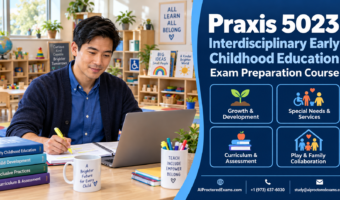
The official Praxis 5023 Study Companion organizes the assessment into six major content categories:
-
Growth and Development of Young Children Across the Spectrum of Development — approximately 20%
-
Educational and Service Requirements for Children with a Range of Abilities and Special Needs — approximately 16%
-
Curriculum, Instruction, and Assessment for Young Children — approximately 22%
-
Play and Learning Environment for Young Children — approximately 20%
-
Collaboration with Families and Colleagues — approximately 12%
-
Professionalism and Growth Through Professional Development — approximately 10%
Growth and Development of Young Children
Review the physical, motor, cognitive, perceptual, linguistic, social, emotional, and adaptive development of infants, toddlers, preschoolers, and kindergarten children. You will examine developmental milestones, foundational theories, individual differences, and the biological, environmental, cultural, and family factors that influence learning.
This section also prepares you to recognize development that may require additional observation, evaluation, or professional support. You will consider how healthy, respectful, supportive, and appropriately challenging environments contribute to development across a wide range of abilities.
Educational and Service Requirements for Children with Special Needs
Strengthen your understanding of inclusive early childhood education and interdisciplinary service delivery. Lessons address developmental delays, disabilities, diverse abilities, early intervention, assistive technology, adaptive resources, and collaboration among teachers, families, therapists, and other professionals.
You will review Individualized Family Service Plans, Individualized Education Programs, Section 504 plans, the Individuals with Disabilities Education Act, inclusion, and the least restrictive environment. The course explains how these requirements influence educational planning and the delivery of services to young children and their families.
Curriculum, Instruction, and Assessment
Learn how to plan comprehensive, developmentally appropriate instruction aligned with learning standards and individual needs. Topics include activity-based learning, child-initiated and teacher-directed experiences, grouping strategies, daily schedules, instructional adaptations, culturally responsive learning opportunities, positive feedback, and the integration of literacy, mathematics, social development, and other early learning goals.
Assessment lessons examine observation, documentation, authentic assessment, progress monitoring, data organization, and communication of results. You will practice using assessment evidence to modify instruction, evaluate programs, plan individualized experiences, and support IFSP and IEP goals.
Play and Learning Environments
Examine how purposeful play supports communication, cognition, creativity, physical development, social competence, self-regulation, and problem-solving. You will study indoor and outdoor learning environments that encourage children to explore, discover, interact, and participate in individual and group activities.
This section also addresses sanitation, nutrition, physical safety, classroom organization, accessibility, positive behavior guidance, adaptive materials, assistive technology, and environmental modifications for children with disabilities. Lessons reflect evidence-based practices promoted through the DEC Recommended Practices.
Collaboration with Families and Colleagues
Prepare to build respectful partnerships with families, assistants, volunteers, administrators, special educators, therapists, and community professionals. The course examines family systems, family priorities, cultural and linguistic differences, team decision-making, interpersonal communication, and community resources.
You will learn how to include families as meaningful partners in assessment, program planning, educational decision-making, and evaluation. These practices support the family-centered and collaborative approach expected of interdisciplinary early childhood educators.
Professionalism and Professional Growth
Review the ethical, legal, and professional responsibilities of early childhood educators. Topics include confidentiality, privacy, mandated reporting, advocacy, professional boundaries, reflective practice, continuing education, and compliance with laws protecting children and families.
The course also reinforces professional standards associated with the NAEYC Professional Standards and Competencies. You will consider how self-evaluation, professional development, research, collaboration, and advocacy can improve instructional practice and outcomes for children.
Build Praxis 5023 Test-Taking Skills
Praxis 5023 questions frequently present classroom situations that require more than factual recall. You may need to identify a developmental concern, choose an inclusive placement, recommend an assessment method, select an instructional adaptation, or determine the most professional response to a family or colleague.
Course practice activities help you identify what each question is testing, evaluate the available evidence, eliminate inappropriate choices, and select the response that best supports children’s development, inclusion, safety, and learning. Visit How It Works to learn more about accessing and completing the online preparation materials.
Begin Your Praxis 5023 Preparation
Prepare at your own pace with organized lessons that connect early childhood education and special education principles. Whether you are working toward initial certification or adding an interdisciplinary early childhood credential, this course provides a focused path through the six official test domains.
AIProctoredExams.com is an independent education provider and is not affiliated with, sponsored by, or endorsed by ETS. Praxis is a registered trademark of ETS. All preparation materials are independently developed and do not contain live or confidential examination questions.
Learning Objectives
Material Includes
- * Blueprint-aligned lessons covering all six Praxis 5023 content categories.
- * Downloadable Praxis 5023 study guide and preparation outline.
- * Infant-through-kindergarten developmental milestone reference charts.
- * Special needs, developmental delays, and inclusive education review materials.
- * IFSP, IEP, Section 504, IDEA, and least restrictive environment reference sheets.
- * Curriculum planning, instructional adaptation, and activity-based learning organizers.
- * Observation, documentation, authentic assessment, and progress-monitoring guides.
- * Play-based learning and accessible classroom environment checklists.
- * Family collaboration, professional ethics, legal responsibilities, and advocacy notes.
- * Topic-based practice questions with answer explanations and an exam-day checklist.
Material Includes
- * Blueprint-aligned lessons covering all six Praxis 5023 content categories.
- * Downloadable Praxis 5023 study guide and preparation outline.
- * Infant-through-kindergarten developmental milestone reference charts.
- * Special needs, developmental delays, and inclusive education review materials.
- * IFSP, IEP, Section 504, IDEA, and least restrictive environment reference sheets.
- * Curriculum planning, instructional adaptation, and activity-based learning organizers.
- * Observation, documentation, authentic assessment, and progress-monitoring guides.
- * Play-based learning and accessible classroom environment checklists.
- * Family collaboration, professional ethics, legal responsibilities, and advocacy notes.
- * Topic-based practice questions with answer explanations and an exam-day checklist.