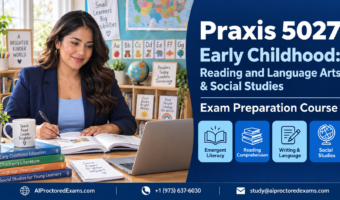
Praxis 5027 Early Childhood: Reading and Language Arts & Social Studies Exam Prep Course
About This Course
Prepare for the Praxis 5027 Early Childhood Exam
Strengthen the literacy and social studies knowledge assessed on the Praxis 5027 Early Childhood: Reading and Language Arts & Social Studies test. This structured preparation course is designed for prospective teachers working with children in prekindergarten and the lower elementary grades.
The lessons combine subject knowledge with practical teaching applications. You will review how children develop early literacy skills, learn to comprehend different texts, progress through the writing process, communicate effectively, understand their communities, interpret history and geography, and participate in civic life.
You can also explore our complete collection of Praxis exam preparation courses and supporting exam study guides as you build your certification study plan.
About the Praxis 5027 Test
According to the official Praxis 5027 test page, the computer-delivered assessment contains approximately 90 selected-response questions and allows two hours for completion. Some questions require one answer, while others may require candidates to select multiple responses or interact with information presented in another format.
Praxis 5027 is one of the two subtests that make up the Praxis 5026 Early Childhood Assessment. The other subtest is Praxis 5028 Mathematics and Science. Candidates should verify whether their licensing agency requires Praxis 5027 individually or as part of the combined assessment.
Testing requirements and qualifying scores are established by individual states. Review the Praxis requirements for your state and confirm the correct test code with your educator-preparation program or licensing authority before registering.
Praxis 5027 Content Distribution
The official Early Childhood Assessment Study Companion divides Praxis 5027 into two principal content categories:
-
Reading and Language Arts — approximately 60 questions or 67% of the test
-
Social Studies — approximately 30 questions or 33% of the test
Because reading and language arts represents approximately two-thirds of the assessment, the course provides detailed coverage of emergent literacy, foundational reading skills, comprehension, writing, speaking, listening, grammar, vocabulary, and language use.
Reading and Language Arts Preparation
Emergent Literacy and Language Acquisition
Review the stages of oral and written language development that occur during early childhood. You will examine print awareness, environmental print, concepts of print, early spelling, and instructional approaches for children with different learning needs.
Lessons address phonological and phonemic awareness, including identifying, blending, segmenting, substituting, and deleting sounds. You will also consider appropriate literacy support for English learners, children with disabilities, and gifted learners.
Phonics, Word Analysis, and Reading Fluency
Develop your understanding of letter-sound relationships, common syllable patterns, decoding, spelling conventions, high-frequency words, roots, and affixes. The course explains how phonics and word-analysis instruction contribute to accurate and independent reading.
Fluency preparation covers accuracy, reading rate, prosody, text selection, modeling, choral reading, and repeated reading. You will practice identifying strategies that improve fluency while supporting reading comprehension.
Literature and Informational Text
Learn how to analyze literary and informational texts using key ideas, supporting details, textual evidence, central ideas, themes, characters, settings, plots, and sequence. You will study how readers make inferences, summarize information, compare viewpoints, and interpret relationships among events, individuals, and ideas.
Lessons also examine literary genres, informational-text structures, digital texts, visual elements, multimedia sources, and text complexity. These topics reflect principles included in the NCTE Standards for the English Language Arts.
Writing and the Authoring Process
Review the developmental stages of early writing, beginning with drawing, scribbling, letter-like forms, invented spelling, and increasingly organized written communication. You will study narrative, informative, explanatory, and persuasive writing and learn to identify the purpose and characteristics of each form.
The course covers brainstorming, planning, drafting, revising, editing, and publishing. Additional lessons address writing for different audiences, evaluating writing samples, strengthening organization and clarity, using digital publishing tools, conducting age-appropriate research, and distinguishing paraphrasing from plagiarism.
Speaking, Listening, Grammar, and Vocabulary
Prepare for questions involving active listening, collaborative discussions, questioning techniques, oral presentations, formal and informal language, and respectful participation. You will examine how teachers can encourage productive classroom conversations and help young learners communicate ideas clearly.
Language lessons cover parts of speech, sentence structures, grammar, usage, mechanics, spelling, context clues, roots, affixes, figurative language, tone, dialects, registers, and academic vocabulary. The course supports the evidence-based literacy principles described by the International Literacy Association.
Social Studies Preparation
Community, Culture, and Identity
Examine how children develop self-concept, self-awareness, self-regulation, and relationships with others. Lessons explore the meaning of community, the influence of social institutions, cultural expression, diversity, interdependence, and the ways cultural perspectives affect individual experiences.
You will also consider teaching practices that help children appreciate different traditions, languages, beliefs, families, and ways of life.
People, Places, and Environments
Build your understanding of geography and spatial thinking, including location, direction, distance, regions, landmarks, maps, charts, graphs, and geographic technology. You will review physical and human-made characteristics of places and examine relationships among people, environments, living things, and economic activity.
Time, Continuity, and Change
Prepare to organize events chronologically and interpret historical information presented through timelines, maps, graphs, tables, primary sources, and secondary sources. The course reviews important themes in United States history, cultural contributions, historical movements, and the ways societies respond to inequality and change.
Civics and Government
Study citizenship, justice, equality, equity, tolerance, voting, rule of law, civic participation, and informed decision-making. Lessons introduce the structure of government, public officials, levels of government, shared and reserved powers, and different forms of governance.
You will practice selecting developmentally appropriate ways to help young students understand classroom rules, community responsibility, democratic participation, multiple perspectives, and the balance between individual and group needs.
Develop Effective Test-Taking Skills
Praxis 5027 questions assess both content knowledge and professional application. Practice activities help you determine what a question is asking, interpret passages and classroom situations, compare plausible answer choices, identify supporting evidence, and select the most instructionally appropriate response.
Review how our online exam preparation works before beginning your course.
Begin Your Praxis 5027 Preparation
Prepare at your own pace with focused lessons covering the official reading, language arts, and social studies categories. The course provides an organized pathway for strengthening content knowledge, reviewing instructional applications, and approaching selected-response questions with greater confidence.
AIProctoredExams.com is an independent education provider and is not affiliated with, sponsored by, or endorsed by ETS. Praxis is a registered trademark of ETS. Course materials are independently developed and do not contain live or confidential examination questions.
Learning Objectives
Material Includes
- * Blueprint-aligned lessons covering both official Praxis 5027 content categories.
- * Downloadable Praxis 5027 study guide and preparation outline.
- * Emergent literacy, print awareness, and language-acquisition reference sheets.
- * Phonological awareness, phonics, decoding, and word-analysis review materials.
- * Reading fluency, comprehension, text structure, and text-complexity guides.
- * Writing development, authoring process, grammar, and vocabulary study notes.
- * Speaking, listening, research, and digital-literacy review materials.
- * Community, culture, identity, geography, history, and civics reference charts.
- * Reading-passage and social studies source-analysis practice activities.
- * Topic-based practice questions with answer explanations and an exam-day checklist.
Material Includes
- * Blueprint-aligned lessons covering both official Praxis 5027 content categories.
- * Downloadable Praxis 5027 study guide and preparation outline.
- * Emergent literacy, print awareness, and language-acquisition reference sheets.
- * Phonological awareness, phonics, decoding, and word-analysis review materials.
- * Reading fluency, comprehension, text structure, and text-complexity guides.
- * Writing development, authoring process, grammar, and vocabulary study notes.
- * Speaking, listening, research, and digital-literacy review materials.
- * Community, culture, identity, geography, history, and civics reference charts.
- * Reading-passage and social studies source-analysis practice activities.
- * Topic-based practice questions with answer explanations and an exam-day checklist.