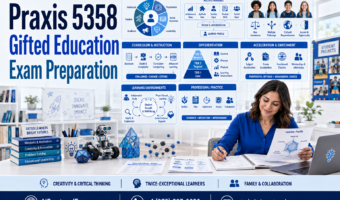
Praxis 5358 Gifted Education Exam Preparation Course
About This Course
Prepare for the Praxis 5358 Gifted Education Exam
The Praxis 5358 Gifted Education Exam Preparation Course provides comprehensive online preparation for aspiring gifted-education teachers, enrichment specialists, advanced-learning coordinators, classroom teachers, teacher-education students, alternative-certification candidates, and educators seeking a gifted-education endorsement.
This course develops the knowledge and instructional judgment needed to identify and support gifted learners from diverse backgrounds. Structured lessons cover learner development, characteristics of giftedness, identification and assessment, curriculum design, differentiation, acceleration, enrichment, learning environments, social-emotional needs, twice-exceptional learners, collaboration, professional practice, and program evaluation.
Candidates learn how to apply gifted-education principles to realistic situations involving student profiles, assessment data, curriculum decisions, instructional planning, family communication, equitable identification, and professional responsibilities.
Explore additional Praxis exam preparation courses for other teacher-certification and educational-support assessments.
What Is the Praxis 5358 Gifted Education Exam?
Praxis 5358 measures the knowledge, skills, and professional abilities considered necessary for safe and effective beginning practice in gifted education.
According to the official ETS Praxis 5358 Gifted Education page, the computer-delivered examination allows two hours and contains 120 selected-response questions.
The test assesses five essential areas of professional practice:
-
Development and Characteristics of Gifted Students
-
Identification and Assessment of Gifted Students
-
Planning and Managing the Learning Environment
-
Curriculum and Instruction of Gifted Students
-
Professionalism Expected of Gifted-Education Teachers
Candidates may encounter questions involving classroom situations, assessment results, student characteristics, instructional resources, curriculum plans, collaboration, and professional decisions.
Development and Characteristics of Gifted Learners
Giftedness can appear through different combinations of academic ability, intellectual potential, creativity, leadership, artistic talent, task commitment, motivation, or performance within a particular domain.
This module examines:
-
Major concepts and definitions of giftedness
-
Intellectual and academic development
-
Creativity and divergent thinking
-
Leadership potential
-
Domain-specific talent
-
Advanced reasoning
-
Rapid acquisition of knowledge
-
Exceptional memory
-
Intense interests
-
Curiosity
-
Problem-solving
-
Asynchronous development
-
Motivation and task commitment
-
Underachievement
-
Individual differences among gifted learners
Candidates learn to avoid assuming that all gifted students demonstrate the same abilities, behaviors, achievement patterns, interests, or educational needs.
The course also addresses how characteristics may change across ages, developmental stages, cultures, languages, environments, and areas of talent.
Cognitive and Academic Characteristics
Gifted learners may demonstrate advanced reasoning, rapid learning, sophisticated vocabulary, unusual insight, complex problem-solving, strong memory, or intense interest in particular subjects.
However, advanced potential does not guarantee consistently high academic performance. Candidates study factors that may influence achievement, including:
-
Insufficient challenge
-
Lack of engagement
-
Perfectionism
-
Fear of failure
-
Executive-function difficulties
-
Learning disabilities
-
Cultural or linguistic differences
-
Limited educational opportunity
-
Inappropriate curriculum
-
Social pressures
-
Motivation
-
School attendance
-
Emotional concerns
Praxis-style scenarios help candidates distinguish a student’s demonstrated performance from the student’s potential and determine what additional information is needed.
Social and Emotional Development
Gifted learners may experience social and emotional needs connected with asynchronous development, perfectionism, sensitivity, intensity, peer relationships, identity, expectations, and educational fit.
Course preparation covers:
-
Self-concept
-
Identity development
-
Motivation
-
Resilience
-
Perfectionism
-
Fear of failure
-
Anxiety
-
Peer relationships
-
Social isolation
-
Multipotentiality
-
Career development
-
Underachievement
-
Self-advocacy
-
Appropriate counseling referrals
-
Supportive classroom relationships
Candidates learn to recognize when a concern can be addressed through instructional planning and when collaboration with counselors, psychologists, families, or other professionals may be appropriate.
Identification and Assessment
Effective gifted identification uses multiple sources of information and recognizes that no single assessment captures every form of giftedness.
The course reviews:
-
Universal screening
-
Individual and group ability measures
-
Achievement assessments
-
Aptitude measures
-
Creativity assessments
-
Performance tasks
-
Portfolios
-
Student work samples
-
Behavioral rating scales
-
Teacher observations
-
Parent and family input
-
Student interviews
-
Dynamic assessment
-
Local norms
-
Nonverbal measures
-
Talent-development evidence
Candidates learn to examine reliability, validity, test purpose, administration requirements, standardization, norms, interpretation, and potential sources of bias.
The course emphasizes evaluating assessment evidence as part of a complete learner profile rather than using one score as the sole identification decision.
Equity in Gifted Identification
Students from some populations may be overlooked when identification procedures rely heavily on referrals, narrow definitions, a single test, prior opportunities, or culturally dependent evidence.
Preparation examines identification considerations involving:
-
Students from culturally diverse communities
-
Multilingual learners
-
Students from economically disadvantaged backgrounds
-
Rural students
-
Students with disabilities
-
Twice-exceptional learners
-
Students with limited access to advanced instruction
-
Students whose talents appear outside traditional academic subjects
-
Students demonstrating potential but not high achievement
Candidates study equitable practices such as universal screening, multiple entry pathways, local norms, culturally responsive assessment, nonverbal measures, talent development, ongoing identification, and systematic review of participation data.
Twice-Exceptional Learners
Twice-exceptional students demonstrate gifted potential while also experiencing a disability or another learning need.
The course reviews:
-
Giftedness and learning disabilities
-
Giftedness and attention-related needs
-
Giftedness and autism
-
Giftedness and communication disorders
-
Giftedness and physical or sensory disabilities
-
Masking of strengths
-
Masking of disabilities
-
Uneven achievement
-
Appropriate accommodations
-
Strength-based instruction
-
Collaboration with special educators
-
Individualized education programs
-
Section 504 considerations
Candidates learn that intervention should address a student’s disability-related needs without removing appropriate opportunities for challenge, creativity, acceleration, and advanced learning.
Planning and Managing the Learning Environment
Effective gifted-education environments promote intellectual challenge, creativity, independence, inquiry, responsible risk-taking, collaboration, and social-emotional well-being.
This module covers:
-
Establishing high but appropriate expectations
-
Creating psychologically safe learning environments
-
Supporting productive struggle
-
Encouraging intellectual risk-taking
-
Promoting student choice
-
Flexible grouping
-
Independent learning
-
Inquiry and exploration
-
Project-based learning
-
Mentoring
-
Technology-supported learning
-
Classroom management
-
Time and resource management
-
Inclusive participation
-
Student reflection
Candidates practice selecting environments that respond to individual readiness, interests, strengths, cultural backgrounds, learning profiles, and areas for growth.
Curriculum for Gifted Learners
Gifted education requires more than assigning additional work or moving through the same material at a faster pace.
The course examines curriculum principles involving:
-
Advanced content
-
Depth and complexity
-
Concept-based learning
-
Interdisciplinary connections
-
Authentic problems
-
Real-world applications
-
Inquiry
-
Research
-
Creativity
-
Critical thinking
-
Problem-solving
-
Communication
-
Student choice
-
Products for authentic audiences
-
Alignment with academic standards
Candidates learn how to evaluate whether a curriculum provides meaningful challenge and opportunities to develop expertise.
Differentiated Instruction
Differentiation adjusts content, process, products, learning environment, or pace according to student readiness, interests, and learning profiles.
Preparation covers:
-
Preassessment
-
Flexible grouping
-
Tiered assignments
-
Advanced questioning
-
Learning contracts
-
Choice boards
-
Independent study
-
Problem-based learning
-
Project-based learning
-
Inquiry-based instruction
-
Advanced resources
-
Seminars and discussions
-
Technology integration
-
Product differentiation
-
Authentic assessment
Candidates practice identifying appropriate differentiation rather than simply increasing workload or assigning routine activities after a student finishes early.
Curriculum Compacting
Curriculum compacting allows educators to document prior mastery and replace already-mastered content with appropriately challenging learning opportunities.
Candidates learn how to:
-
Identify essential curriculum objectives
-
Conduct appropriate preassessment
-
Document demonstrated mastery
-
Determine which content can be reduced or eliminated
-
Plan replacement activities
-
Match alternatives with learner needs
-
Monitor student progress
-
Maintain accountability
-
Evaluate outcomes
Replacement activities may include advanced content, independent investigations, creative production, acceleration, mentorships, interdisciplinary study, or authentic problem-solving.
Acceleration
Acceleration matches the level and pace of instruction with a student’s demonstrated readiness.
Course preparation examines:
-
Subject acceleration
-
Grade acceleration
-
Early entrance
-
Advanced placement
-
Dual enrollment
-
Telescoping
-
Curriculum compacting
-
Flexible pacing
-
Cluster grouping
-
Advanced courses
Candidates study the academic, social, emotional, developmental, and logistical information that should inform acceleration decisions.
The course emphasizes individualized decision-making rather than assuming acceleration is suitable or unsuitable for every gifted learner.
Enrichment and Talent Development
Enrichment expands the depth, complexity, breadth, and application of learning.
Candidates review:
-
Enrichment clusters
-
Independent investigations
-
Research projects
-
Mentorships
-
Internships
-
Academic competitions
-
Creative production
-
Service learning
-
Interdisciplinary learning
-
Leadership development
-
Arts and performance opportunities
-
STEM challenges
-
Community partnerships
-
Specialized talent development
Candidates learn to evaluate whether an enrichment activity develops meaningful knowledge and skills rather than functioning only as entertainment or an unrelated reward.
Creativity and Critical Thinking
Gifted-education teachers support both analytical and creative thinking.
The course examines:
-
Divergent and convergent thinking
-
Fluency, flexibility, originality, and elaboration
-
Problem finding
-
Creative problem-solving
-
Evaluating assumptions
-
Identifying bias
-
Analyzing arguments
-
Generating alternatives
-
Making evidence-based decisions
-
Designing original products
-
Encouraging experimentation
-
Reflecting on the creative process
Classroom scenarios help candidates select strategies that encourage thoughtful risk-taking without sacrificing accuracy, evidence, or academic standards.
Assessment of Gifted Learning
Assessment in gifted education should document growth, challenge, mastery, creativity, and the development of advanced skills.
Preparation includes:
-
Preassessment
-
Formative assessment
-
Summative assessment
-
Performance tasks
-
Portfolios
-
Rubrics
-
Self-assessment
-
Peer assessment
-
Growth measures
-
Product evaluation
-
Progress monitoring
-
Curriculum-based assessment
Candidates learn how to use assessment results to adjust pacing, grouping, content, complexity, instructional strategies, and enrichment opportunities.
Family and Professional Collaboration
Gifted-education teachers collaborate with classroom teachers, specialists, counselors, psychologists, administrators, families, and community partners.
The course reviews:
-
Communicating assessment results
-
Explaining gifted services
-
Collaborative instructional planning
-
Co-teaching
-
Sharing differentiation strategies
-
Supporting transitions
-
Resolving disagreements
-
Maintaining confidentiality
-
Respecting cultural perspectives
-
Developing mentorships
-
Building community partnerships
-
Advocating for appropriate services
Candidates learn to communicate strengths and needs clearly without suggesting that gifted learners are more valuable than other students.
Professionalism and Program Evaluation
Professional preparation includes:
-
Ethical decision-making
-
Confidentiality
-
Equitable access
-
Evidence-based practice
-
Reflective teaching
-
Professional learning
-
Advocacy
-
Collaboration
-
Program standards
-
Legal and policy considerations
-
Resource allocation
-
Program evaluation
-
Continuous improvement
Candidates practice evaluating gifted programs using identification data, participation patterns, student-growth evidence, curriculum quality, implementation fidelity, family feedback, and program goals.
Praxis 5358 Practice and Exam Strategy
The course includes structured lessons, topic quizzes, learner-profile scenarios, identification data, curriculum-planning exercises, instructional situations, program-evaluation tasks, detailed answer explanations, and full-length simulated tests.
Timed activities help candidates manage the 120-question examination. Diagnostic results identify areas requiring additional study, such as learner development, identification, twice-exceptionality, curriculum, differentiation, acceleration, enrichment, learning environments, collaboration, or professionalism.
Additional resources are available through the AIProctoredExams study guides and How It Works pages.
Praxis requirements and qualifying scores differ among states and licensing authorities. Confirm that your jurisdiction requires or accepts Gifted Education test 5358 through the official Praxis state requirements directory.
Begin the Praxis 5358 Gifted Education Exam Preparation Course to strengthen your understanding of gifted learners, equitable identification, advanced curriculum, differentiation, social-emotional support, collaboration, and professional practice.
This independent preparation course is not affiliated with or endorsed by ETS.