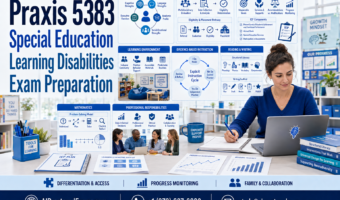
Praxis 5383 Special Education: Teaching Students with Learning Disabilities Exam Preparation Course
About This Course
Prepare for the Praxis 5383 Special Education Exam
The Praxis 5383 Special Education: Teaching Students with Learning Disabilities Exam Preparation Course provides comprehensive online preparation for aspiring special educators, teacher-education students, intervention specialists, alternative-certification candidates, classroom teachers seeking an additional endorsement, and educators preparing to retake the examination.
This course develops the knowledge and professional judgment needed to teach students with learning disabilities effectively. Structured lessons cover learner development, identification and eligibility, individualized education programs, inclusive learning environments, reading and writing instruction, mathematics intervention, assessment, progress monitoring, accommodations, assistive technology, collaboration, transition planning, and professional responsibilities.
Candidates work through realistic scenarios involving student strengths and needs, evaluation information, instructional decisions, measurable goals, progress data, classroom supports, family communication, and multidisciplinary collaboration.
Explore additional Praxis exam preparation courses for other special-education and teacher-certification assessments.
What Is the Praxis 5383 Exam?
Praxis 5383 measures whether entry-level special educators possess the standards-relevant knowledge, skills, and abilities needed to teach students with learning disabilities.
According to the official ETS Praxis 5383 test page, the computer-delivered examination allows two hours and contains 120 questions.
The test uses several question formats. Candidates may need to select one answer, select more than one answer, enter a numeric response, interpret student data, or complete another computer-delivered task.
The five official content areas are:
-
Development and Characteristics of Students with Learning Disabilities
-
Planning and Managing the Learning Environment
-
Instruction
-
Identification, Eligibility, and Placement
-
Foundations and Professional Responsibilities
Successful preparation requires more than recalling terminology. Candidates must determine which instructional, assessment, placement, behavioral, collaborative, or professional response is most appropriate for a particular student and situation.
Development and Characteristics of Students with Learning Disabilities
Students with learning disabilities represent a diverse population. Their strengths, needs, academic performance, communication abilities, executive-function skills, and social-emotional development can vary considerably.
The course reviews:
-
Cognitive development
-
Language development
-
Academic development
-
Social and emotional development
-
Physical and motor development
-
Executive functioning
-
Attention
-
Memory
-
Processing speed
-
Metacognition
-
Motivation
-
Self-concept
-
Self-determination
-
Adaptive skills
-
Individual learner variability
Candidates study how learning disabilities may affect reading, writing, mathematics, organization, communication, classroom participation, and independent learning.
The course uses a strengths-based approach. Candidates learn to identify instructional needs without defining students solely by a disability label or assuming that all learners with the same eligibility category require identical services.
Common Academic Characteristics
Students with learning disabilities may experience difficulty in one or more academic areas.
Reading
Reading-related needs may involve:
-
Phonological awareness
-
Phonemic awareness
-
Phonics
-
Decoding
-
Word recognition
-
Reading fluency
-
Vocabulary
-
Reading comprehension
-
Morphological awareness
-
Multisyllabic-word reading
-
Comprehension monitoring
Written Language
Writing-related needs may involve:
-
Handwriting
-
Spelling
-
Sentence construction
-
Grammar and usage
-
Organization
-
Planning
-
Drafting
-
Revising
-
Editing
-
Written expression
-
Use of evidence
Mathematics
Mathematics-related needs may involve:
-
Number sense
-
Place value
-
Computation
-
Mathematical facts
-
Fractions
-
Algebraic reasoning
-
Geometry
-
Measurement
-
Mathematical vocabulary
-
Problem representation
-
Word-problem solving
-
Selecting appropriate operations
Candidates learn to connect observed errors with possible underlying needs and select appropriate evidence-based instruction.
Identification, Evaluation, and Eligibility
Special educators participate in multidisciplinary evaluation and eligibility processes.
The course reviews:
-
Child-find responsibilities
-
Referral procedures
-
Prereferral interventions
-
Multi-tiered systems of support
-
Response to intervention
-
Comprehensive evaluation
-
Formal and informal assessment
-
Curriculum-based measurement
-
Classroom observations
-
Work samples
-
Interviews
-
Family input
-
Progress-monitoring data
-
Academic achievement measures
-
Cognitive and processing information
-
Adaptive and social-emotional information
-
Linguistic and cultural considerations
Candidates learn that eligibility decisions should be based on multiple sources of relevant information rather than a single test score.
Preparation also addresses the need to distinguish learning disabilities from difficulties primarily associated with inadequate instruction, language acquisition, environmental factors, limited educational opportunity, sensory concerns, intellectual disability, or other conditions.
Specific procedures and eligibility criteria can vary by jurisdiction. Candidates should understand federal principles while consulting applicable state and local requirements.
Individualized Education Programs
Individualized education program development is a central professional responsibility for special educators.
Course preparation includes:
-
Present levels of academic achievement
-
Functional performance
-
Measurable annual goals
-
Short-term objectives when applicable
-
Specially designed instruction
-
Related services
-
Supplementary aids and services
-
Accommodations
-
Modifications
-
Assistive technology
-
Participation in assessments
-
Progress-monitoring procedures
-
Reporting progress
-
Placement considerations
-
Transition services
-
Family participation
-
Student participation
Candidates practice writing goals that describe an observable skill, measurable performance, relevant conditions, and appropriate mastery criteria.
The course also distinguishes accommodations from modifications. Accommodations change how a student accesses instruction or demonstrates learning, while modifications change the expected content or performance level.
FAPE and the Least Restrictive Environment
Candidates review the relationship among individualized student needs, a free appropriate public education, and education in the least restrictive environment.
The official U.S. Department of Education IDEA website provides current federal information and resources concerning special education.
Preparation emphasizes that placement should follow the development of the student’s IEP. The team considers whether the student can be educated successfully in the general education environment with supplementary aids, services, accommodations, and appropriate support.
Candidates examine placement as a continuum rather than assuming that one setting is appropriate for every student with a learning disability.
Planning and Managing the Learning Environment
Effective special educators establish environments that are structured, inclusive, safe, accessible, predictable, and responsive to individual learning needs.
The course reviews:
-
Classroom organization
-
Predictable routines
-
Explicit expectations
-
Physical accessibility
-
Accessible materials
-
Positive behavior support
-
Active engagement
-
Opportunities to respond
-
Reinforcement
-
Corrective feedback
-
Student choice
-
Flexible grouping
-
Peer support
-
Collaborative learning
-
Culturally responsive practice
-
Trauma-sensitive considerations
Candidates learn to identify environmental factors affecting performance and select proactive strategies that support academic engagement and independence.
Behavior Support and Classroom Management
Behavior may communicate academic frustration, avoidance, skill deficits, unmet needs, or difficulty accessing instruction.
Preparation includes:
-
Defining behavior objectively
-
Collecting antecedent-behavior-consequence data
-
Identifying behavioral patterns
-
Understanding possible functions
-
Developing replacement skills
-
Positive reinforcement
-
Self-monitoring
-
Environmental modification
-
Functional behavioral assessment
-
Behavior intervention planning
-
Monitoring intervention effectiveness
-
Maintaining student dignity
Candidates practice selecting preventive, instructional, and supportive responses instead of relying only on punitive consequences.
Evidence-Based Instruction
Praxis 5383 candidates should understand the characteristics of effective instruction for students with learning disabilities.
The course emphasizes:
-
Explicit instruction
-
Systematic instruction
-
Sequential instruction
-
Modeling
-
Think-alouds
-
Guided practice
-
Independent practice
-
Scaffolding
-
Frequent opportunities to respond
-
Immediate feedback
-
Cumulative review
-
Strategy instruction
-
Metacognitive instruction
-
Generalization
-
Maintenance
-
Data-informed adjustment
Candidates learn how to break complex skills into manageable steps and gradually transfer responsibility from the teacher to the student.
Reading Instruction
Reading preparation covers:
-
Phonological and phonemic awareness
-
Sound-symbol relationships
-
Decoding
-
Encoding
-
Syllable patterns
-
Morphology
-
Word recognition
-
Reading fluency
-
Vocabulary
-
Background knowledge
-
Comprehension strategies
-
Text structures
-
Main ideas
-
Inference
-
Summarization
-
Comprehension monitoring
Candidates practice matching an intervention with the student’s specific reading need. For example, repeated reading may support fluency, but it does not replace explicit decoding instruction when inaccurate word recognition is the primary concern.
Written-Language Instruction
The writing module addresses:
-
Handwriting and transcription
-
Spelling
-
Sentence construction
-
Grammar and mechanics
-
Planning
-
Organization
-
Drafting
-
Revising
-
Editing
-
Written responses to text
-
Paragraph and essay development
-
Strategy instruction
-
Graphic organizers
-
Assistive technology
Candidates learn how to model the writing process, provide explicit strategy instruction, use scaffolds appropriately, and gradually support greater independence.
Mathematics Instruction
Mathematics preparation includes:
-
Number sense
-
Place value
-
Computation
-
Fact fluency
-
Fractions
-
Decimals
-
Ratios
-
Algebraic reasoning
-
Geometry
-
Measurement
-
Mathematical vocabulary
-
Word-problem solving
-
Visual representations
-
Concrete-representational-abstract instruction
-
Error analysis
-
Metacognitive problem-solving
Candidates practice analyzing student work to identify misconceptions and determine the next appropriate instructional step.
Content-Area and Study Skills
Students with learning disabilities may need explicit support to access science, social studies, mathematics, literature, and other academic subjects.
The course reviews:
-
Activating background knowledge
-
Previewing text
-
Teaching academic vocabulary
-
Note-taking
-
Summarization
-
Text-structure instruction
-
Graphic organizers
-
Study strategies
-
Test preparation
-
Time management
-
Organization
-
Assignment planning
-
Self-monitoring
-
Use of accessible digital resources
Assessment and Progress Monitoring
Assessment should guide instruction and document student growth.
Preparation covers:
-
Screening
-
Diagnostic assessment
-
Formative assessment
-
Summative assessment
-
Curriculum-based measurement
-
Error analysis
-
Work-sample analysis
-
Observation
-
Goal-based progress monitoring
-
Graphing performance
-
Evaluating rate of improvement
-
Determining instructional response
-
Communicating results
Candidates learn to select measures aligned with the skill being taught and use repeated data to determine whether instruction should be continued, modified, intensified, or replaced.
Differentiation, Accommodations, and Assistive Technology
The course prepares candidates to provide access while maintaining meaningful learning expectations.
Topics include:
-
Differentiating content, process, products, and environment
-
Accessible instructional materials
-
Extended time
-
Reduced-distraction settings
-
Alternative response formats
-
Audio-supported text
-
Text-to-speech
-
Speech-to-text
-
Word prediction
-
Graphic organizers
-
Digital note-taking
-
Calculation supports
-
Organizational applications
-
Universal Design for Learning
Candidates evaluate whether a support addresses the student’s documented need without creating an unrelated advantage or changing the intended skill being assessed.
Transition and Self-Determination
Special educators help students prepare for further education, employment, independent living, and community participation.
Course preparation includes:
-
Age-appropriate transition assessment
-
Postsecondary goals
-
Course-of-study planning
-
Student-led IEP participation
-
Self-awareness
-
Self-advocacy
-
Goal setting
-
Decision-making
-
Problem-solving
-
Organization
-
Workplace skills
-
College and career supports
-
Agency collaboration
Family and Professional Collaboration
Effective special education depends on respectful collaboration among students, families, teachers, administrators, related-service providers, evaluators, counselors, and community agencies.
The course reviews:
-
Family-centered communication
-
Culturally responsive collaboration
-
Confidentiality
-
Shared decision-making
-
Co-planning
-
Co-teaching
-
Consultation
-
Conflict resolution
-
Interpreting assessment results
-
Communicating progress
-
Coordinating services
-
Supporting transitions
Foundations and Professional Responsibilities
Candidates review:
-
History and philosophy of special education
-
Disability legislation and policy
-
Ethical professional practice
-
Procedural safeguards
-
Confidentiality
-
Due process
-
Student advocacy
-
Evidence-based practice
-
Reflective teaching
-
Professional development
-
Collaboration
-
Documentation
-
Appropriate supervision
-
Maintaining professional boundaries
Praxis 5383 Practice and Exam Strategy
The course includes structured lessons, topic quizzes, learner profiles, evaluation scenarios, IEP exercises, instructional cases, progress-monitoring data, detailed answer explanations, and full-length simulated tests.
Timed practice helps candidates manage the 120-question examination. Diagnostic results identify areas requiring additional review, including learner characteristics, identification, eligibility, IEP development, learning environments, literacy, mathematics, assessment, collaboration, or legal and ethical responsibilities.
Additional preparation support is available through the AIProctoredExams study guides and How It Works pages.
Praxis requirements and qualifying scores differ among states and licensing authorities. Confirm that your jurisdiction requires or accepts test 5383 using the official Praxis state requirements directory.
Begin the Praxis 5383 Special Education: Teaching Students with Learning Disabilities Exam Preparation Course to strengthen your instructional knowledge, assessment skills, IEP planning, collaboration, and readiness for the examination.
This independent preparation course is not affiliated with or endorsed by ETS.