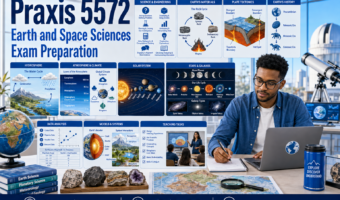
Praxis 5572 Earth and Space Sciences Exam Preparation Course
About This Course
Praxis 5572 Earth and Space Sciences Exam Preparation Course
Prepare for the Praxis 5572 Earth and Space Sciences exam with a comprehensive online course designed for prospective science teachers, teacher-certification candidates, education majors, first-time test-takers, and educators retaking the assessment.
The Praxis 5572 Earth and Space Sciences Exam Preparation Course provides structured review of geology, oceanography, meteorology, astronomy, scientific inquiry, engineering practices, data analysis, and the application of science knowledge to classroom instruction.
Instead of depending entirely on memorization, learners develop the scientific reasoning needed to interpret diagrams, analyze experimental results, evaluate models, identify relationships among Earth systems, and solve unfamiliar Praxis-style questions.
Praxis 5572 Exam Overview
According to the official ETS Praxis Earth and Space Sciences 5572 page, the computer-delivered examination contains 125 selected-response questions and has a testing time of 2 hours and 30 minutes.
Questions may require candidates to select one or more answers, interpret scientific representations, analyze data, evaluate evidence, apply concepts, or solve problems. A calculator is not required. ETS provides access to a periodic table, selected physical constants, and certain SI-unit conversion information within the testing interface.
Half or more of the examination questions integrate content knowledge with one or more science and engineering practices. Approximately one-quarter to one-third apply Earth and space science concepts to teaching scenarios or instructional tasks. Candidates must therefore understand both the scientific content and how that content can be taught, investigated, modeled, and assessed.
The examination is organized into four principal content categories:
-
Nature and Impact of Science and Engineering: approximately 15% of the examination
-
Earth’s Processes and Materials: approximately 45%
-
Earth’s Hydrosphere and Atmosphere: approximately 22%
-
Astronomy: approximately 18%
Nature and Impact of Science and Engineering
This course begins with the principles and practices that support scientific investigation and engineering design.
You will review the nature of scientific knowledge, empirical evidence, testable questions, hypotheses, models, theories, laws, observation, inference, experimentation, and the relationship between evidence and scientific explanations.
Preparation includes designing investigations, identifying independent and dependent variables, controlling variables, selecting suitable measurement tools, recording observations, organizing results, and evaluating whether a scientific procedure can produce valid and reliable evidence.
Candidates also study accuracy, precision, significant figures, uncertainty, systematic and random error, sampling error, mean, percent error, and appropriate use of SI units. Practice activities require you to interpret tables, graphs, maps, diagrams, models, and other scientific representations.
Engineering preparation examines how problems are defined, how criteria and constraints influence possible solutions, and how designs are tested and improved. The course also addresses relationships among science, engineering, technology, society, natural resources, environmental quality, and sustainability.
These topics connect with the Next Generation Science Standards’ Science and Engineering Practices, which emphasize investigation, modeling, evidence-based reasoning, mathematical thinking, explanation, argument, and communication.
Earth’s Processes and Materials
Earth’s Processes and Materials is the largest portion of the Praxis 5572 assessment. This section of the course provides detailed preparation in physical science foundations, Earth materials, internal processes, surface processes, Earth systems, and geologic history.
Matter, Energy, and Physical Science Foundations
Candidates review properties and classifications of matter, atoms, elements, compounds, mixtures, physical and chemical changes, density, pressure, temperature, heat transfer, energy transformations, and conservation principles.
The course also examines forces, motion, gravity, waves, electromagnetic radiation, electricity, magnetism, thermal expansion, and the movement of matter and energy through Earth systems.
Learners practice selecting appropriate scientific principles for explaining processes such as seismic-wave movement, atmospheric heating, ocean circulation, radioactive decay, and energy transfer within Earth.
Minerals, Rocks, and the Rock Cycle
This section covers mineral identification, crystal structure, hardness, cleavage, fracture, streak, density, and other physical properties used to classify Earth materials.
You will study igneous, sedimentary, and metamorphic rocks; intrusive and extrusive processes; sediment formation; compaction and cementation; heat and pressure; melting; crystallization; and the relationships represented in the rock cycle.
Additional preparation examines natural resources, fossil fuels, mineral extraction, resource distribution, renewable and nonrenewable materials, and the environmental consequences of resource use.
Candidates can supplement their review with the U.S. Geological Survey’s geology education resources.
Plate Tectonics and Earth’s Interior
The Praxis 5572 course reviews Earth’s internal structure, including the crust, mantle, outer core, inner core, lithosphere, and asthenosphere.
You will examine evidence supporting plate tectonic theory, including continental fit, fossil patterns, rock formations, seafloor spreading, paleomagnetism, ocean-floor ages, and the worldwide distribution of earthquakes and volcanoes.
Preparation covers divergent, convergent, and transform boundaries; subduction; rifting; mountain building; mid-ocean ridges; trenches; volcanic arcs; hot spots; earthquakes; fault types; seismic waves; and methods scientists use to investigate Earth’s interior.
Learners practice interpreting tectonic maps, earthquake data, volcanic patterns, cross-sections, and models of crustal movement.
Surface Processes and Earth-System Interactions
This section addresses weathering, erosion, transportation, deposition, soil formation, mass wasting, glaciers, rivers, groundwater, wind, waves, and the development of landforms.
Candidates examine how the geosphere interacts with the hydrosphere, atmosphere, biosphere, and cryosphere. Practice questions require learners to trace matter and energy through multiple systems and predict how a change in one system may affect another.
Earth’s History
The course reviews relative dating, superposition, original horizontality, cross-cutting relationships, index fossils, fossil succession, radiometric dating, half-life, and interpretation of the geologic time scale.
You will study major developments in Earth’s physical and biological history, including the formation of Earth, changes in the atmosphere and oceans, the development of life, mass extinctions, and evidence used to reconstruct past environments.
Candidates practice interpreting rock columns, fossil sequences, unconformities, geologic maps, and radioactive-decay information.
Earth’s Hydrosphere and Atmosphere
This portion of the Praxis 5572 preparation course examines water, oceans, weather, climate, and the interactions connecting Earth’s major systems.
Hydrosphere, Oceans, and the Water Cycle
You will review the properties of water, phase changes, distribution of freshwater and saltwater, evaporation, condensation, precipitation, infiltration, runoff, groundwater, aquifers, watersheds, glaciers, ice sheets, and the cryosphere.
Oceanography topics include salinity, temperature, density, waves, tides, coastal processes, surface currents, deep-ocean circulation, upwelling, seafloor features, marine resources, and interactions among oceans, land, atmosphere, and climate.
Practice activities include interpreting water-cycle diagrams, ocean-temperature profiles, salinity data, current maps, tidal patterns, and evidence of changes within the cryosphere.
Atmosphere, Weather, and Climate
The atmosphere section covers atmospheric composition, pressure, density, temperature, humidity, stability, cloud formation, precipitation, winds, air masses, fronts, and severe weather.
Candidates review the layers of the atmosphere, energy transfer, global circulation, the Coriolis effect, jet streams, weather systems, thunderstorms, tornadoes, hurricanes, and methods used to collect and interpret meteorological data.
Climate preparation examines factors that influence regional and global climates, including latitude, elevation, topography, ocean circulation, atmospheric circulation, surface characteristics, greenhouse gases, and interactions among Earth systems.
Learners practice distinguishing weather from climate, interpreting climate records, analyzing feedback mechanisms, and evaluating evidence associated with long-term environmental change.
Astronomy
The astronomy section develops the knowledge required to explain Earth’s position within the solar system, the life cycles of stars, and the large-scale organization and history of the universe.
Earth-Moon-Sun System
You will review rotation, revolution, seasons, lunar phases, eclipses, tides, orbital motion, gravity, and apparent celestial movement.
Practice questions help learners identify common misconceptions, interpret orbital diagrams, explain seasonal changes, and distinguish the causes of Moon phases from the causes of eclipses.
Solar System
The course examines the origin and development of the solar system, properties of the Sun, terrestrial and giant planets, dwarf planets, moons, asteroids, comets, meteoroids, and other small bodies.
Candidates compare planetary atmospheres, surfaces, internal structures, orbital characteristics, temperatures, and geological activity. Additional authoritative astronomy information is available from NASA’s Solar System Exploration resources.
Stars, Galaxies, and the Universe
You will study stellar formation, nuclear fusion, luminosity, temperature, spectra, the Hertzsprung–Russell diagram, main-sequence stars, red giants, white dwarfs, supernovae, neutron stars, and black holes.
The course also reviews the structure of the Milky Way, types of galaxies, distances in space, electromagnetic observations, expansion of the universe, and major evidence used to develop models of cosmic history.
Science Teaching Tasks and Instructional Applications
Because many Praxis 5572 questions place science content within instructional situations, the course includes preparation for teaching-related tasks.
You will practice:
-
Evaluating student scientific explanations and models
-
Identifying misconceptions about Earth and space systems
-
Selecting safe and appropriate investigations
-
Choosing evidence that supports a scientific claim
-
Analyzing student-generated tables, graphs, and diagrams
-
Connecting instruction with disciplinary core ideas
-
Applying science and engineering practices
-
Using crosscutting concepts to connect scientific topics
-
Revising instruction based on student understanding
-
Selecting effective demonstrations, models, and laboratory activities
Praxis-Style Practice and Exam Strategy
The Praxis 5572 Earth and Space Sciences course includes topic-based questions, scientific scenarios, data-interpretation exercises, teaching applications, and comprehensive practice assessments.
Detailed explanations show why the correct answer is supported by scientific evidence and why alternative choices may be inaccurate, incomplete, based on a common misconception, or unrelated to the information provided.
Learners develop strategies for interpreting complex diagrams, identifying relevant variables, estimating without a calculator, checking units, eliminating distractors, managing the 150-minute testing period, and reserving time to review marked questions.
Explore additional preparation resources through the AIProctoredExams Praxis course collection, online study guides, and complete course catalog. New learners can review how AIProctoredExams works before beginning.
Who Should Enroll?
This course is suitable for:
-
Prospective middle or secondary Earth and space science teachers
-
Science education majors completing certification requirements
-
First-time Praxis 5572 test-takers
-
Candidates retaking the assessment
-
Educators returning to Earth science after time away from formal study
-
Teachers seeking structured review of geology, meteorology, oceanography, and astronomy
Praxis requirements and qualifying scores vary by jurisdiction. Candidates should verify that their licensing agency requires or accepts this assessment using the official Praxis state requirements directory.
Begin Your Praxis 5572 Preparation
Enroll in the Praxis 5572 Earth and Space Sciences Exam Preparation Course to strengthen your scientific content knowledge, data-analysis skills, understanding of Earth systems, astronomy knowledge, and ability to apply science concepts to classroom situations.
With structured lessons, realistic practice questions, detailed explanations, full-length assessments, and organized study resources, you can identify weaker topics and approach the examination with stronger preparation and greater confidence.
AIProctoredExams is an independent exam-preparation provider and is not affiliated with, endorsed by, or sponsored by ETS. Praxis is a trademark of ETS. Course materials are intended for legitimate educational preparation and do not guarantee a particular examination result.
Learning Objectives
Material Includes
- * Complete Praxis 5572 Earth and Space Sciences Digital Study Pack
- * Nature of Science, Engineering Design, Measurement, and Data-Analysis Review
- * Physical Science Foundations for Earth and Space Sciences
- * Minerals, Rocks, Rock Cycle, Natural Resources, and Geologic Processes Guide
- * Plate Tectonics, Earthquakes, Volcanoes, Earth Structure, and Natural Hazards Review
- * Geologic Time, Fossils, Relative Dating, and Radiometric Dating Resources
- * Hydrosphere, Water Cycle, Oceanography, Groundwater, and Cryosphere Study Materials
- * Atmosphere, Meteorology, Weather Systems, and Climate Review
- * Astronomy, Earth-Moon-Sun System, Solar System, Stars, Galaxies, and Universe Guide
- * Praxis-Style Practice Questions, Detailed Explanations, Topic Quizzes, Full-Length Practice Tests, Study Plan, and Student Support
Material Includes
- * Complete Praxis 5572 Earth and Space Sciences Digital Study Pack
- * Nature of Science, Engineering Design, Measurement, and Data-Analysis Review
- * Physical Science Foundations for Earth and Space Sciences
- * Minerals, Rocks, Rock Cycle, Natural Resources, and Geologic Processes Guide
- * Plate Tectonics, Earthquakes, Volcanoes, Earth Structure, and Natural Hazards Review
- * Geologic Time, Fossils, Relative Dating, and Radiometric Dating Resources
- * Hydrosphere, Water Cycle, Oceanography, Groundwater, and Cryosphere Study Materials
- * Atmosphere, Meteorology, Weather Systems, and Climate Review
- * Astronomy, Earth-Moon-Sun System, Solar System, Stars, Galaxies, and Universe Guide
- * Praxis-Style Practice Questions, Detailed Explanations, Topic Quizzes, Full-Length Practice Tests, Study Plan, and Student Support