
GED Math Study Guide 2026: Formulas, Algebra & Practice
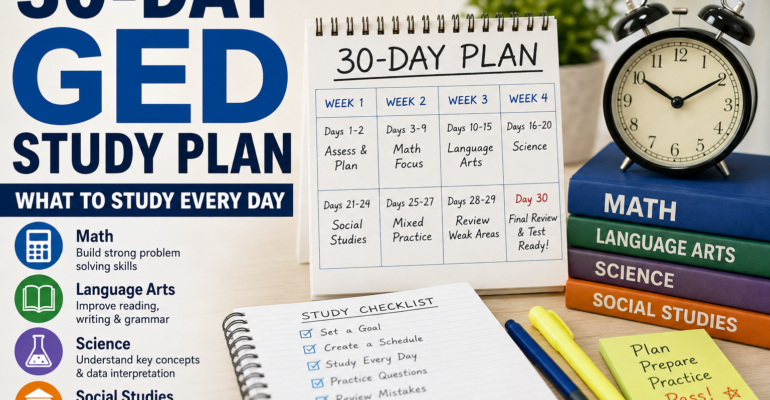

30-Day GED Study Plan: What to Study Every Day
Preparing for the GED in one month becomes much easier when you know exactly what to study every day.
Instead of switching randomly between Math, Reasoning Through Language Arts, Science, and Social Studies, this 30-Day GED Study Plan gives you a structured daily schedule that moves from diagnostic testing and foundation building to subject-specific practice, timed assessments, weak-area review, and final test preparation.
The GED consists of four separate subject tests:
- Mathematical Reasoning
- Reasoning Through Language Arts
- Science
- Social Studies
Candidates need a score of at least 145 on each subject test to meet the GED passing standard. You can take the four subjects separately, which means your study plan can also focus on one area at a time.
For the official examination structure and current subject information, review the GED Testing Service test subjects guide.
If you are just beginning your preparation, first read the 2026 GED Study Guide for a complete overview of the exam format, subjects, scoring, and preparation strategies.
30-Day GED Study Plan at a Glance
The following schedule provides a simple overview of what you will study during the next 30 days.
| Days | Main Focus |
|---|---|
| Days 1–2 | Diagnostic assessment and preparation |
| Days 3–9 | GED Mathematical Reasoning |
| Days 10–15 | Reasoning Through Language Arts |
| Days 16–20 | GED Science |
| Days 21–24 | GED Social Studies |
| Days 25–27 | Mixed GED practice |
| Days 28–29 | Weak areas and final review |
| Day 30 | Light review and test readiness |
The schedule gives Mathematics slightly more time because many candidates need additional practice with arithmetic, percentages, algebra, geometry, graphs, functions, and word problems.
However, this schedule should be adjusted according to your own diagnostic results.
Can You Prepare for the GED in 30 Days?
It is possible for some candidates to make substantial GED preparation progress in 30 days.
However, there is no guarantee that every candidate will be ready after exactly one month.
Your preparation time depends on factors such as:
- Your current academic level
- Mathematics foundation
- Reading comprehension
- Writing ability
- Scientific reasoning skills
- Social Studies knowledge
- Time since you last attended school
- Number of hours available for study
- Diagnostic-test performance
- Practice-test performance
Candidates who already perform near the passing level may need relatively little preparation.
Someone rebuilding basic arithmetic, algebra, reading, or writing skills may need considerably longer.
Treat this 30-day GED study schedule as a framework, not as a deadline that forces you to take the examination before you are ready.
How Many Hours a Day Should You Study for the GED?
For this 30-day schedule, aim for approximately:
60–120 minutes of focused study each day.
You might divide that time into:
- 45–60 minutes of learning and review
- 30–45 minutes of practice questions
- 10–15 minutes reviewing mistakes
Consistency matters more than extremely long study sessions.
If you work full-time, attend school, care for children, or have other responsibilities, two focused 30-minute sessions may be more realistic than trying to study continuously for several hours.
What You Need Before Starting Your GED Study Plan
Before beginning Day 1, organize your preparation resources.
You should ideally have:
- GED study notes
- Practice questions
- Notebook
- Calculator
- Math formula references
- Reading passages
- Practice tests
- Reliable internet access
- Error log
AIProctoredExams provides dedicated preparation materials for all four GED subject areas:
- GED Mathematical Reasoning Preparation
- GED Reasoning Through Language Arts Preparation
- GED Science Preparation
- GED Social Studies Preparation
You can also browse the AIProctoredExams Study Guides for additional exam-focused preparation resources.
Week 1: Diagnose Your Skills and Build Your GED Math Foundation
Your first week focuses on understanding your current skill level and building the Mathematical Reasoning foundation you will need throughout GED Math.
Day 1: Understand the GED and Take a Diagnostic Assessment
Your first day should focus on determining exactly where you are starting.
Study Today
Review:
- The four GED subjects
- Test structure
- Passing score
- Question types
- Your strongest subject
- Your weakest subject
GED Testing Service confirms that the GED consists of four separate subject tests that can be taken separately.
You can review the current structure through the official GED test subjects page.
Practice Today
Complete a short diagnostic set covering:
- Math
- Language Arts
- Science
- Social Studies
Do not worry about achieving a perfect score.
Your purpose today is to identify weaknesses.
Create Your GED Error Log
Use a table like this:
| Subject | Topic | Why I Missed It | What to Review |
|---|---|---|---|
| Math | Fractions | Different denominators | Adding fractions |
| RLA | Inference | Guessed rather than using evidence | Reading comprehension |
| Science | Graph | Misread scale | Data interpretation |
| Social Studies | Civics | Confused branches | Government structure |
Keep updating this error log throughout the 30 days.
Day 2: Review Basic Math Skills
Begin your focused GED Mathematical Reasoning preparation.
Study Today
Review:
- Whole numbers
- Integers
- Negative numbers
- Order of operations
- Fractions
- Decimals
Practice converting between fractions and decimals.
Examples:
1/2 = 0.50
3/4 = 0.75
1/4 = 0.25
Practice Today
Complete approximately 20–30 questions involving:
- Addition
- Subtraction
- Multiplication
- Division
- Fractions
- Decimals
Do not simply mark incorrect answers.
Determine why you made each mistake.
Day 3: Percentages, Ratios and Proportions
These skills commonly appear inside practical GED Math questions.
Study Today
Review:
- Percentage of a number
- Percentage increase
- Percentage decrease
- Discounts
- Sales tax
- Ratios
- Unit rates
- Proportions
Example:
Find 20% of 150.
0.20 × 150 = 30
Practice Today
Complete problems involving:
- Discounts
- Prices
- Wages
- Ratios
- Proportions
- Unit rates
Day 4: Introduction to GED Algebra
Algebra is an important component of GED Mathematical Reasoning.
Study Today
Review:
- Variables
- Expressions
- Combining like terms
- One-step equations
- Two-step equations
Example:
3x + 5 = 20
Subtract 5:
3x = 15
Divide by 3:
x = 5
Practice Today
Complete approximately:
- 10 expression questions
- 15 equation questions
If you need additional Mathematics instruction, Khan Academy’s Math resources provide free practice in arithmetic, algebra, geometry, equations, graphs, and functions.
Day 5: Equations, Inequalities and Word Problems
Today moves into applied algebra.
Study Today
Review:
- Multi-step equations
- Variables on both sides
- Inequalities
- Translating words into equations
Practice Today
Work through word problems involving:
- Money
- Distance
- Wages
- Age
- Monthly charges
- Business costs
Before calculating, identify:
- What information is given?
- What is unknown?
- What equation represents the situation?
Day 6: Geometry and GED Math Formulas
Today focuses on measurement and formula application.
Study Today
Review:
- Perimeter
- Area
- Circumference
- Volume
- Triangles
- Rectangles
- Circles
- Pythagorean theorem
Important formulas include:
Rectangle Area: A = lw
Triangle Area: A = ½bh
Circle Area: A = πr²
Circumference: C = πd
Pythagorean Theorem: a² + b² = c²
GED candidates have access to formula references during Mathematical Reasoning, so you should concentrate on understanding which formula to use and how to apply it correctly.
For a more detailed review, read the GED Math Study Guide 2026.
Day 7: Graphs, Slope and Functions
Complete the first week by strengthening your graph and function skills.
Study Today
Review:
- Coordinate plane
- X-axis
- Y-axis
- Slope
- Tables
- Linear equations
- Functions
Understand the basic linear form:
y = mx + b
where:
- m = slope
- b = y-intercept
Practice Today
Complete questions involving:
- Reading graphs
- Calculating slope
- Interpreting tables
- Evaluating functions
Week 2: Complete GED Math and Focus on Language Arts
Week 2 begins by finishing Mathematics review and then shifts to Reasoning Through Language Arts.
Day 8: Statistics, Probability and Data
Study Today
Review:
- Mean
- Median
- Mode
- Range
- Probability
- Graph interpretation
- Data tables
Example:
Find the mean of:
8, 10, 12, 14
Add the values:
8 + 10 + 12 + 14 = 44
Divide by four:
44 ÷ 4 = 11
Practice Today
Complete approximately 20 questions involving statistics, probability, graphs, and data.
Day 9: GED Math Review and Timed Practice
Today is your first major Mathematics checkpoint.
Review Today
Revisit:
- Fractions
- Percentages
- Algebra
- Geometry
- Graphs
- Functions
- Statistics
- Word problems
Practice Today
Complete a timed set of GED-style Math questions.
Then categorize every error:
- Knowledge error
- Arithmetic error
- Formula error
- Calculator error
- Reading error
- Time-management error
Your results should guide any additional Math review later in the schedule.
Day 10: GED RLA Reading Comprehension
Today begins your Reasoning Through Language Arts preparation.
Study Today
Review:
- Main ideas
- Supporting details
- Author’s purpose
- Tone
- Vocabulary in context
- Inferences
Practice Today
Read several short passages.
After each passage, ask:
- What is the main idea?
- What evidence supports it?
- Why did the author write the passage?
- What conclusion can reasonably be inferred?
Day 11: Arguments, Claims and Evidence
GED RLA requires candidates to evaluate arguments as well as understand passages.
Study Today
Learn to identify:
- Claims
- Evidence
- Reasoning
- Conclusions
- Assumptions
- Counterarguments
Practice Today
Read argumentative passages and identify:
What is the author’s main claim?
What evidence supports that claim?
Is the evidence relevant and convincing?
Day 12: Grammar and Sentence Structure
Study Today
Review:
- Subject-verb agreement
- Pronouns
- Verb tense
- Sentence fragments
- Run-on sentences
- Punctuation
- Capitalization
- Word usage
Practice Today
Correct at least 20 sentences containing grammar or punctuation problems.
Use the GED Reasoning Through Language Arts preparation course for additional reading, grammar, argument-analysis, and writing practice.
Day 13: Comparing Texts and Viewpoints
Today focuses on comparing written information.
Study Today
Practice identifying:
- Similar arguments
- Different arguments
- Conflicting claims
- Stronger evidence
- Different author perspectives
Practice Today
Read two passages discussing the same issue.
Create a comparison table:
| Passage 1 | Passage 2 |
|---|---|
| Main claim | Main claim |
| Supporting evidence | Supporting evidence |
| Tone | Tone |
| Strength of argument | Strength of argument |
Day 14: GED Extended Response Practice
Today focuses on written argument.
Study Today
Use a clear response structure:
- Introduction
- Central claim
- Supporting evidence
- Explanation
- Additional evidence
- Conclusion
Avoid relying mainly on personal opinions when the task requires analysis of provided evidence.
Practice Today
Write one complete timed response.
Then review it for:
- Evidence
- Organization
- Grammar
- Sentence clarity
- Repetition
- Conclusion
Day 15: RLA Timed Practice and Review
Complete a timed Language Arts practice set.
Review Your Results
Identify:
- Reading errors
- Inference errors
- Evidence errors
- Grammar weaknesses
- Time-management problems
Do not simply record your percentage.
Determine why each error occurred.
Week 3: GED Science Preparation
GED Science rewards scientific reasoning and evidence interpretation as much as factual recall.
Day 16: Scientific Method and Experiments
Study Today
Review:
- Hypothesis
- Independent variable
- Dependent variable
- Control group
- Constants
- Experimental group
- Results
- Conclusions
Practice Today
For each experiment, identify:
- What was changed?
- What was measured?
- What remained constant?
- What conclusion does the evidence support?
Day 17: Life Science
Study Today
Review:
- Cells
- Genetics
- Heredity
- Human body systems
- Evolution
- Ecosystems
- Food chains
- Photosynthesis
Practice Today
Work with:
- Scientific passages
- Diagrams
- Experiments
- Graphs
- Data tables
Focus on reasoning rather than simply memorizing definitions.
Day 18: Physical Science
Study Today
Review:
- Matter
- Atoms
- Elements
- Chemical reactions
- Force
- Motion
- Energy
- Electricity
- Heat
- Waves
Practice Today
Complete questions that require you to apply scientific information to unfamiliar scenarios.
Day 19: Earth and Space Science
Study Today
Review:
- Earth’s structure
- Plate tectonics
- Weather
- Climate
- Natural resources
- Water cycle
- Solar system
- Stars and galaxies
Practice Today
Work with:
- Maps
- Weather data
- Graphs
- Scientific models
- Diagrams
Day 20: Science Data Interpretation and Timed Practice
Today concentrates on one of the most important GED Science skills: interpreting information.
Study Today
Practice reading:
- Tables
- Line graphs
- Bar graphs
- Scientific diagrams
- Experimental results
Before answering graph questions, check:
- Title
- X-axis
- Y-axis
- Scale
- Units
- Legend
Practice Today
Complete a timed GED Science practice set.
For additional preparation, use the GED Science preparation course.
Week 4: GED Social Studies and Full-Test Preparation
The final 10 days combine Social Studies with mixed-subject practice and final readiness work.
Day 21: Civics and Government
Study Today
Review:
- U.S. Constitution
- Bill of Rights
- Legislative branch
- Executive branch
- Judicial branch
- Separation of powers
- Checks and balances
- Citizens’ rights and responsibilities
Practice Today
Answer questions using:
- Constitutional passages
- Government scenarios
- Political cartoons
- Tables
- Charts
Day 22: U.S. History
Study Today
Focus on:
- Major historical developments
- Cause and effect
- Political change
- Social change
- Primary sources
- Historical arguments
Avoid trying to memorize every date.
Focus on understanding:
What happened?
Why did it happen?
What resulted from it?
Day 23: Economics and Geography
Economics Review
Study:
- Supply and demand
- Markets
- Incentives
- Employment
- Productivity
- Government and the economy
Geography Review
Study:
- Maps
- Population
- Migration
- Natural resources
- Geographic regions
- Human-environment relationships
Day 24: Social Studies Source Analysis and Timed Practice
Today brings your Social Studies skills together.
Study Today
Practice interpreting:
- Historical documents
- Political cartoons
- Maps
- Timelines
- Graphs
- Economic data
Five Questions to Ask About a Source
Ask:
- Who created the source?
- What is its main message?
- What evidence does it provide?
- What viewpoint does it represent?
- What conclusion is supported?
Practice Today
Complete a timed Social Studies practice set.
For additional practice, use the GED Social Studies preparation course.
Final GED Practice and Review: Days 25–30
Your final six days should focus less on learning large quantities of new material and more on applying, testing, and strengthening what you already know.
Day 25: Mixed Math and RLA Practice
GED Math Practice
Complete approximately 15–20 mixed questions covering:
- Algebra
- Percentages
- Geometry
- Functions
- Graphs
- Word problems
GED RLA Practice
Complete:
- Reading passages
- Argument questions
- Grammar questions
Review every incorrect answer.
Day 26: Mixed Science and Social Studies Practice
Complete a combined review involving:
- Scientific graphs
- Experiments
- Historical sources
- Maps
- Charts
- Data
- Arguments
Notice that Science and Social Studies share an important skill:
evidence interpretation.
Improving this skill can help you across several GED subjects.
Day 27: Take a Major GED Practice Assessment
Today is one of the most important days in the schedule.
Use a realistic timed assessment to determine whether your skills have improved.
GED Testing Service offers GED Ready, the official GED practice test. GED Ready is approximately half the length of the corresponding real subject test and provides information about areas that need more study.
You can also use the official free GED test previews to become familiar with question formats.
Evaluate Your Practice-Test Results
Divide your results into four categories.
Ready
Topics you answer correctly and consistently.
Almost Ready
Topics where you occasionally make errors.
Weak
Topics where you repeatedly make mistakes.
Careless Errors
Questions you understood but missed because you:
- Rushed
- Misread the question
- Entered information incorrectly
- Overlooked units
- Selected the wrong answer accidentally
Use these results to plan Days 28 and 29.
Day 28: Review Your Weakest GED Subject
Do not follow a predetermined topic today.
Your practice results should determine your study.
If Math Is Weakest
Review:
- Equations
- Fractions
- Percentages
- Geometry
- Graphs
- Word problems
If RLA Is Weakest
Review:
- Reading comprehension
- Inferences
- Arguments
- Evidence
- Grammar
If Science Is Weakest
Review:
- Experiments
- Variables
- Graphs
- Scientific reasoning
If Social Studies Is Weakest
Review:
- Civics
- Historical sources
- Economics
- Maps
- Data interpretation
Spend most of today’s study time on your weakest area.
Day 29: Final Mixed GED Review
Today should reinforce existing knowledge.
Review Today
Focus on:
- Math formulas
- Algebra rules
- Common grammar problems
- Reading strategies
- Scientific variables
- Graph interpretation
- Government structure
- Source analysis
Practice Today
Complete short mixed sets rather than another exhausting full-length session.
Review your error log.
Ask:
Which mistakes am I still repeating?
Spend your remaining review time addressing those problems.
Day 30: Light Review and GED Test Readiness
Day 30 should not become a marathon study session.
Avoid trying to learn several major new topics.
Light Review
Review:
- Key Math formulas
- Important algebra procedures
- Reading strategies
- Scientific reasoning
- Government structure
- Common mistakes from your error log
Prepare for Test Day
Confirm:
- Test date
- Test time
- Testing location
- Identification requirements
- Transportation
- Local testing requirements
- Online testing requirements, if applicable
Testing policies can vary by jurisdiction, so use the official GED Testing Service website to confirm current requirements.
If you plan to take an online GED exam, check the current GED online testing requirements before scheduling.
Then finish studying at a reasonable time and get adequate rest.
Daily GED Study Routine for the 30-Day Plan
You can make the schedule easier to follow by using the same general routine each day.
First 10–15 Minutes: Review Previous Mistakes
Review yesterday’s errors.
Ask:
- Why did I miss the question?
- Do I understand the correct approach now?
- Could I answer a similar question without help?
Next 30–45 Minutes: Learn the Main Topic
Study the day’s primary concept.
Focus on understanding rather than simply reading as much material as possible.
Next 30–45 Minutes: Complete Practice Questions
Immediately apply what you learned.
Practice helps determine whether you actually understand the concept.
Final 10–15 Minutes: Analyze Mistakes
Record:
- Topic
- Mistake
- Correct method
- What you should review later
Use this cycle:
Learn → Practice → Review → Correct → Retest
How to Adjust Your 30-Day GED Study Schedule
Not every candidate should follow the exact same schedule.
If GED Math Is Your Weakest Subject
Increase Math preparation by two or three days.
Spend additional time on:
- Fractions
- Percentages
- Algebra
- Geometry
- Functions
- Word problems
If Reading Is Your Weakest Skill
Increase daily reading practice.
Reading skills support:
- RLA
- Science
- Social Studies
Practice reading:
- Informational articles
- Arguments
- Scientific passages
- Historical documents
If You Already Passed Some GED Subjects
Concentrate your schedule on the remaining subjects.
There is little benefit in spending most of your available study time preparing again for a subject you have already successfully completed.
If You Have More Than 30 Days
Use the additional time.
You can divide difficult days into two separate sessions.
For example:
Instead of:
Day 4 — Algebra
Use:
Day 4 — Expressions and basic equations
Day 5 — Multi-step equations and inequalities
The 30-day schedule is a framework, not a requirement to test after exactly 30 days.
How to Know If You Are Ready for the GED
Do not judge readiness based only on how many days or hours you studied.
Your performance is more important.
Signs that you are improving include:
- Higher practice scores
- Fewer repeated mistakes
- Better pacing
- Greater Math accuracy
- Better reading comprehension
- Improved graph interpretation
- Stronger understanding of answer explanations
- Ability to complete timed practice
- More confidence with GED-style questions
Official GED sample tests can also help you become familiar with the test interface and question styles.
Use the GED Testing Service free test previews as one part of your final readiness assessment.
Common GED Study Schedule Mistakes to Avoid
Trying to Study All Four Subjects Every Day
Constant subject switching can make your preparation scattered.
Focused study blocks usually make it easier to concentrate on one skill set at a time.
Spending Too Much Time Making Notes
Notes are helpful.
However, writing pages of notes without practicing questions will not adequately prepare you for the examination.
Ignoring Incorrect Answers
Wrong answers reveal what needs improvement.
Use them as diagnostic tools.
Practicing Only Easy Topics
Repeating topics you already understand may feel productive, but it provides little improvement.
Spend sufficient time on difficult areas.
Taking Practice Tests Without Reviewing Them
A carefully reviewed practice assessment can provide more value than several tests completed without analysis.
Cramming During the Final Days
The final days should reinforce existing knowledge rather than introduce large amounts of new content.
Useful External GED Study Resources
A few external resources can complement your AIProctoredExams preparation.
Official GED Testing Service
Use the official GED website for:
- Registration
- Current policies
- State requirements
- Test scheduling
- Official scoring information
Official GED Test Previews
Use the free official GED test previews to experience sample question formats for Math, Language Arts, Science, and Social Studies.
GED Ready Official Practice Test
Use GED Ready when you want an official practice assessment designed by GED Testing Service.
Khan Academy Math
Khan Academy Math can provide additional free practice if you need extra support with:
- Arithmetic
- Pre-algebra
- Algebra
- Geometry
- Equations
- Graphs
- Functions
These external resources should supplement—not replace—a structured GED preparation plan.
Frequently Asked Questions About the 30-Day GED Study Plan
Can I Study for the GED in 30 Days?
Yes, some candidates can make substantial preparation progress in 30 days.
However, whether you are ready to take the test should depend on your skills and practice performance rather than the calendar alone.
How Many Hours Should I Study for the GED Every Day?
Approximately one to two focused hours per day is a practical target for this schedule.
Your needs may differ based on your starting level.
Which GED Subject Should I Study First?
Start with a diagnostic assessment.
This plan begins with Math because it often requires substantial skill-building, but you should prioritize whichever subject is weakest for you.
Should I Study All Four GED Subjects at the Same Time?
You can prepare for each GED subject separately.
Focusing on one or two subjects at a time may make your study sessions more manageable.
What GED Score Do I Need to Pass?
The GED passing score is 145 or higher on each of the four subject tests.
Should I Take Practice Tests During the 30 Days?
Yes.
Use:
- Topic-based practice early in the schedule
- Timed subject practice during the middle weeks
- More comprehensive assessments near the end
What Should I Do If I Keep Getting the Same Type of Question Wrong?
Stop simply repeating similar questions.
Return to the underlying concept.
Use this sequence:
- Review the concept.
- Study a worked example.
- Complete an easier problem.
- Complete a moderate problem.
- Return to GED-style questions.
- Check whether the error occurs again.
What Is GED Ready?
GED Ready is the official GED practice test provided by GED Testing Service.
It is designed to provide a realistic practice experience and help identify areas that need additional preparation.
Should I Use Khan Academy for GED Preparation?
Khan Academy can be useful as a supplementary Mathematics resource, particularly for arithmetic, algebra, geometry, graphs, and functions.
However, it does not replace a complete GED-specific preparation program covering all four subjects.
What Should I Study the Day Before My GED?
Keep the review light.
Focus on:
- Important formulas
- Common mistakes
- Reading strategies
- Major concepts
- Test-day requirements
Avoid heavy cramming.
Start Your 30-Day GED Study Plan Today
The most important part of any GED study schedule is not simply creating the plan.
It is following the schedule consistently, practicing actively, and adjusting your preparation according to your results.
Start by identifying your strengths and weaknesses. Build your Mathematics foundation. Strengthen reading and writing skills. Practice scientific reasoning. Learn to interpret Social Studies sources. Then use timed practice and mistake analysis to determine whether you are ready.
Continue your preparation through AIProctoredExams:
- GED Mathematical Reasoning Preparation
- GED Reasoning Through Language Arts Preparation
- GED Science Preparation
- GED Social Studies Preparation
You can also explore the AIProctoredExams Study Guides for additional preparation resources.
If you are new to the platform, see How AIProctoredExams Works to learn how preparation resources and courses are organized.
Students needing assistance can visit the AIProctoredExams Help Center.
Thirty days of focused preparation can accomplish much more than thirty days of random studying. Follow the plan, practice consistently, review your mistakes, and improve one skill at a time.