Nevada Praxis Requirements | Tests, Scores & Licensure
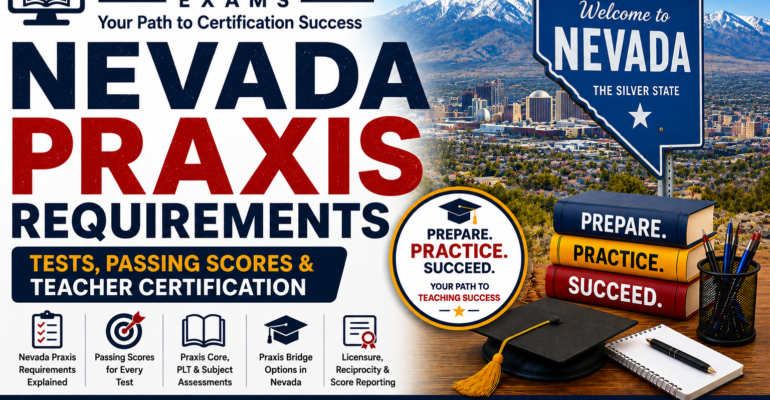

Teacher Certification in Nevada: Your Nevada Praxis Requirements Guide
Becoming a licensed teacher in Nevada can require completing academic preparation, student teaching, background checks, and competency testing. For many new applicants, understanding the Nevada Praxis requirements is therefore an important part of planning the licensure process.
Nevada currently uses Praxis examinations for basic academic skills, professional teaching knowledge, and numerous subject-area competencies. However, the exact test combination depends on the license or endorsement being pursued, and some applicants may qualify for testing exceptions or reciprocity.
This guide explains current Nevada Praxis requirements, Praxis Core, Principles of Learning and Teaching examinations, content tests, Praxis Bridge, score reporting, provisional licensure, reciprocity, and practical exam preparation.
Candidates who are ready to prepare can begin with AIProctoredExams or explore the complete Praxis exam preparation collection.
What Are the Nevada Praxis Requirements?
The Nevada Department of Education states that applicants for Nevada educator licensure must meet applicable competency-testing requirements under Nevada regulations. For most initial licenses, testing can include Praxis Core, a Principles of Learning and Teaching assessment, and an appropriate content-area examination.
Candidates should begin with the official Nevada Department of Education Competency Testing Requirements.
Nevada’s testing requirements can vary according to:
- Grade level
- Teaching subject
- Type of license
- Existing credentials
- Previous testing
- Academic qualifications
- Reciprocity eligibility
- Whether an approved testing exception applies
For this reason, candidates should determine their exact licensing category before registering for an examination.
ETS also maintains an official Nevada Praxis overview showing state-specific Praxis information, score reporting, and Praxis Bridge participation.
Nevada Teacher Licensure Requirements
Praxis testing is only one part of teacher licensure.
The Nevada Department of Education evaluates an applicant’s transcripts, academic preparation, student teaching, testing results, and other required documentation before issuing an educator license.
Candidates should review the official Nevada Educator Licensure portal before applying.
Depending on the pathway, applicants may need to submit:
- Official transcripts
- Evidence of an accredited degree
- Student-teaching documentation
- Competency-test scores
- Background-check information
- Fingerprints
- Existing educator licenses
- Foreign transcript evaluations, when applicable
- Additional documents for specialized endorsements
AIProctoredExams candidates can also explore the Teacher Certification preparation category for available teacher-focused preparation resources.
Praxis Core Requirements in Nevada
Praxis Core evaluates basic academic skills in reading, writing, and mathematics.
Nevada identifies the current Praxis Core tests as:
- Praxis Core Reading 5713
- Praxis Core Writing 5723
- Praxis Core Mathematics 5733
Nevada also continues to recognize qualifying scores from previous versions of the Core examinations.
Candidates preparing for these assessments can use the Praxis Core 5713, 5723, 5733 and 5752 preparation course.
Preparation should cover:
- Reading comprehension
- Main ideas and supporting details
- Inference
- Argument analysis
- Grammar
- Sentence structure
- Editing and revision
- Essay writing
- Numbers and operations
- Algebra
- Geometry
- Statistics
- Probability
- Data interpretation
A strong Nevada Praxis requirements study plan should first confirm whether the candidate must take all three Core tests or qualifies for an exception.
Nevada Praxis Core Testing Exceptions
Not every Nevada applicant is required to complete Praxis Core.
The Nevada Department of Education currently identifies several possible exceptions to the basic-skills testing requirement.
For example, an applicant may potentially satisfy the requirement through an approved equivalent basic-skills examination or through certain qualifying SAT, ACT, GRE, or academic alternatives. Current Nevada guidance lists an SAT score of at least 1100 and an ACT score of at least 21 among the possible testing exceptions, subject to the state’s conditions and time limits.
Nevada has also adopted an approved-course pathway for certain applicants who did not initially meet the required level on a basic reading, writing, or mathematics competency assessment.
Because these rules can change, verify eligibility directly with Nevada DOE instead of assuming that an old SAT, ACT, GRE, degree, or course automatically provides an exemption.
Principles of Learning and Teaching in Nevada
Principles of Learning and Teaching, commonly called PLT, evaluates pedagogical knowledge and the ability to apply educational principles in classroom situations.
Nevada indicates that PLT testing is required for many teaching licenses, with the test level matched to the grades the candidate intends to teach.
Common Praxis PLT assessments include:
- Praxis 5621 – Early Childhood
- Praxis 5622 – Grades K–6
- Praxis 5623 – Grades 5–9
- Praxis 5624 – Grades 7–12
Candidates preparing for elementary pedagogy can use the Praxis 5622 Principles of Learning and Teaching Grades K–6 course.
Middle-grade candidates can review the Praxis 5623 Principles of Learning and Teaching Grades 5–9 course.
Secondary candidates can prepare through the Praxis 5624 Principles of Learning and Teaching Grades 7–12 course.
AIProctoredExams also offers a Praxis 5621 Early Childhood preparation course for candidates whose certification pathway requires or accepts that assessment.
Always verify the exact test level required for your Nevada license before registering.
What Is Tested on Praxis PLT?
Although each grade-band examination differs, common PLT concepts include:
Students as Learners
Candidates should understand:
- Child and adolescent development
- Cognitive development
- Social and emotional development
- Learning theories
- Student motivation
- Individual differences
- Exceptional learners
- English learners
- Cultural influences on learning
Instructional Process
Study areas include:
- Lesson planning
- Learning objectives
- Instructional strategies
- Differentiated instruction
- Classroom management
- Student engagement
- Technology integration
- Questioning techniques
Assessment
Candidates should understand:
- Formative assessment
- Summative assessment
- Diagnostic assessment
- Formal and informal assessment
- Data interpretation
- Feedback
- Progress monitoring
Professional Responsibilities
Praxis PLT questions may also address:
- Professional ethics
- Family partnerships
- Collaboration
- Student safety
- Professional development
- Community relationships
Successful preparation requires more than memorizing educational theories. Candidates need to apply those theories to realistic teaching situations.
Nevada Praxis Content-Area Tests
Many Nevada licenses require subject-specific competency testing when an appropriate Praxis Subject Assessment is available.
The Nevada Department of Education directs applicants to ETS to determine the applicable content assessment for their certification area.
Candidates can use the official ETS Nevada required-tests directory when identifying their examination.
Possible subject areas include:
- English language arts
- Mathematics
- Science
- Social studies
- Special education
- Early childhood education
- World languages
- Physical education
- Art
- Music
- Other endorsement areas
Your test depends on the specific credential being pursued.
Therefore, one of the most important Nevada Praxis requirements rules is simple: confirm the test code before preparing for it.
Elementary Education Praxis Preparation
Candidates pursuing an elementary teaching pathway should pay particular attention to the content assessment required for their license.
Nevada currently participates in Praxis Bridge for Praxis 5001 Elementary Education: Multiple Subjects, along with its four individual subtests.
The four areas are:
- Reading and Language Arts – 5002
- Mathematics – 5003
- Social Studies – 5004
- Science – 5005
Candidates can prepare through the Praxis 5001 Elementary Education Multiple Subjects course.
Nevada also maintains separate official information for Elementary School Licenses. The state advises applicants to use its competency-testing information and the Praxis website when determining required testing.
Special Education Praxis Preparation
Special education candidates may need a subject assessment depending on the particular license sought.
A notable current development is Nevada’s participation in Praxis Bridge for Praxis 5355 Special Education: Foundational Knowledge, with eligibility beginning October 1, 2025 for qualifying candidates. ETS also identifies retroactive eligibility provisions for certain earlier test-takers who meet the program’s requirements.
Candidates can strengthen their preparation through the Praxis 5355 Special Education Foundational Knowledge course.
Important preparation areas include:
- Human development
- Individual learning differences
- Disability characteristics
- Inclusive education
- Instructional planning
- Accommodations
- Modifications
- Assessment
- IEP development
- Progress monitoring
- Behavior support
- Collaboration
- Professional responsibilities
What Is Praxis Bridge in Nevada?
Praxis Bridge is one of the most important newer elements of Nevada Praxis requirements.
Nevada participates in the Praxis Bridge program for several examinations. The program can provide an alternative pathway for qualifying candidates whose test performance falls within an eligible range.
Current ETS information identifies Nevada Bridge participation for tests including:
- Elementary Education Multiple Subjects 5001
- Reading and Language Arts 5002
- Mathematics 5003
- Social Studies 5004
- Science 5005
- Early Childhood Education 5025
- Special Education: Foundational Knowledge 5355
- Praxis Core Reading 5713
- Praxis Core Writing 5723
- Praxis Core Mathematics 5733
- PLT Grades K–6 5622
- PLT Grades 7–12 5624
- Mathematics 5165
- Middle School English Language Arts 5047
- Middle School Mathematics 5164
- Middle School Science 5442
- Social Studies 5581
- Other participating assessments
Different tests entered the Nevada Bridge program on different dates, including February, October, and November 2025.
Because eligibility rules are specific, candidates should check the current ETS Nevada page before assuming they qualify.
Nevada Middle School Teacher Testing
Middle-school candidates should first identify the endorsement they intend to pursue.
Nevada’s Middle School or Junior High School license covers specific subjects in grades 7–9. The Nevada DOE directs applicants to its competency-testing information and ETS for the exact required examinations.
Use the official Nevada Middle School or Junior High School License page when reviewing the licensure pathway.
Candidates preparing for pedagogical knowledge can also use the Praxis 5623 resource linked earlier, while content preparation should be based on the exact subject assessment identified for the endorsement.
Nevada Secondary Teacher Testing
Secondary teachers normally pursue subject-specific licenses or endorsements.
Nevada maintains separate requirements for areas such as:
- English
- Mathematics
- Science
- Social studies
- Physical education
- Music
- Other secondary subjects
The Nevada Secondary or High School License page provides the state’s licensing information and directs candidates to competency-testing requirements.
Secondary candidates who need professional pedagogy preparation can use the Praxis 5624 course linked above.
Nevada Praxis Passing Scores
There is no single passing score for every Nevada Praxis examination.
Each test has its own qualifying score, and certification requirements are established by the licensing authority rather than by ETS alone. ETS explains that states and certifying agencies set their own Praxis qualifying scores.
Candidates should therefore use the official Praxis qualifying-score comparison tool before registration.
When reviewing a required score, confirm:
- State
- Test name
- Test code
- Current qualifying score
- Whether an alternative or Bridge pathway applies
Avoid relying on an old blog table or social-media post because scores and approved assessments can change.
How Are Praxis Scores Sent to Nevada?
Score reporting is another important part of the Nevada Praxis requirements.
ETS currently states that if you test in Nevada and your Praxis profile address is in Nevada, your score report is normally sent automatically to the Nevada Department of Education.
However, if you test outside Nevada or your Praxis profile address is not in Nevada, your scores are not automatically sent to the state.
In that situation, ETS instructs candidates to select:
Nevada Department of Education – State Code 8670
as a score recipient.
ETS also states that code 8670 should be used when requesting additional reports for Nevada DOE.
Candidates may also be able to submit a PDF copy of test results through Nevada’s licensing process according to current state guidance.
Can You Get a Nevada Provisional License Before Passing Praxis?
Some applicants may be able to receive a provisional license before completing all required competency tests.
Nevada DOE states that an applicant for initial licensure who has not completed required competency testing may potentially receive a non-renewable provisional license valid for three years, giving the applicant time to complete outstanding testing requirements.
This does not mean every applicant automatically receives a provisional license.
Candidates should have their individual application evaluated by Nevada DOE.
Out-of-State Teachers Moving to Nevada
Nevada has an important reciprocity provision for experienced educators.
Applicants holding a valid, non-conditional, non-provisional, and unexpired educator license from another U.S. jurisdiction may qualify for reciprocal licensure.
Nevada DOE states that reciprocal licensing will, in many cases, waive Nevada testing requirements while the Department evaluates the applicant’s existing credentials.
Candidates should review the official Nevada new-teacher and reciprocity guidance before paying for additional Praxis tests.
Do not assume that an out-of-state teacher must automatically retake Praxis.
Background Checks and Fingerprinting
Teacher licensure in Nevada also requires a criminal background check.
Nevada DOE states that applicants must complete the Department’s required background-check process before a license will be issued. Employer background checks and Nevada DOE licensing checks are separate processes in many cases.
Candidates should factor fingerprinting and documentation timelines into their overall teacher-certification plan rather than focusing only on the Praxis examination.
How to Prepare for the Nevada Praxis Exam
1. Confirm Your Exact License
Start with the license or endorsement you want.
Do not begin by searching for a generic “Nevada teacher test.”
Identify the specific credential first.
2. Find the Required Praxis Code
Use Nevada DOE and ETS to confirm:
- Test name
- Test number
- Required score
- Grade band
- Content area
- Whether Praxis Bridge applies
3. Take a Diagnostic Test
Complete practice questions before starting intensive study.
Your goal is to identify:
- Strong content areas
- Weak content areas
- Timing problems
- Question-reading errors
- Knowledge gaps
4. Build a Focused Study Schedule
A four-week plan might look like:
Week 1: Diagnostic test and content review
Week 2: Weak-area study and targeted practice
Week 3: Praxis-style questions and answer explanations
Week 4: Timed practice and final review
Effective Nevada Praxis requirements preparation should be structured rather than based on random study sessions.
5. Use High-Quality Study Resources
Candidates can use the AIProctoredExams Study Guides alongside relevant Praxis preparation courses.
Focus on resources that provide:
- Content review
- Practice questions
- Detailed explanations
- Timed practice
- Weak-area analysis
- Exam strategy
6. Practice Under Timed Conditions
Timed practice improves pacing.
It also helps candidates determine how much time they can reasonably spend on difficult questions.
Do not wait until the official test to discover that your normal study pace is too slow.
7. Review Every Wrong Answer
For each incorrect question, determine:
- What was being tested?
- Why is the correct answer correct?
- Why was your answer weaker?
- What concept should you review?
- How will you avoid the same mistake?
This method converts practice questions into active learning.
Building Your AIProctoredExams Nevada Praxis Study Path
Candidates who are new to the platform can review How AIProctoredExams Works to understand how course materials and practice resources are organized.
You can also browse the main AIProctoredExams Courses directory to locate preparation resources by examination.
If you experience difficulty accessing materials or selecting a resource, visit the AIProctoredExams Help Center.
For common questions about courses, access, and preparation resources, see the AIProctoredExams FAQs.
Nevada Praxis Test-Day Tips
Before the examination:
- Confirm your appointment.
- Check identification requirements.
- Verify your test code.
- Confirm your score recipient.
- Review current ETS testing policies.
- Complete timed practice.
- Get enough rest.
During the exam:
- Read the full question.
- Identify key words.
- Eliminate weak answer choices.
- Avoid spending too much time on one question.
- Use evidence from the question.
- Monitor remaining time.
- Review uncertain answers if time allows.
Good preparation should make both the content and the testing process feel familiar.
Why Nevada Candidates Should Prepare Early
Teacher licensing involves several moving parts.
Applicants may need to coordinate:
- University transcripts
- Test registration
- Score reporting
- Background checks
- Student-teaching documentation
- License applications
- Reciprocity information
- Additional endorsement requirements
Starting your Nevada Praxis requirements preparation early gives you time to identify the correct tests and address weak areas before licensing deadlines become urgent.
Start Preparing for Nevada Teacher Certification
The most effective approach begins with accurate information.
First, identify your Nevada license or endorsement. Next, confirm the required Praxis tests through Nevada DOE and ETS. Determine whether an exemption, reciprocity provision, provisional license, or Praxis Bridge pathway could affect your requirements.
Then build a focused preparation plan using content review, practice questions, detailed answer explanations, and timed examinations.
The Nevada Praxis requirements differ according to the applicant and certification area, so a test-specific study plan is much more effective than generic teacher-exam preparation.
Prepare carefully, verify your official requirements, and approach each required assessment with a clear plan.
Frequently Asked Questions About Nevada Praxis Requirements
Does Nevada require Praxis?
Nevada requires competency testing for initial educator licensure, with Praxis used for many of the applicable basic-skills, pedagogy, and content assessments. Exceptions and reciprocity provisions can apply.
Does Nevada require Praxis Core?
Praxis Core is part of Nevada’s basic-skills testing structure for many initial applicants. However, Nevada recognizes several possible exceptions, so candidates should review their individual eligibility before registering.
Does Nevada require a PLT exam?
Nevada identifies Principles of Learning and Teaching testing as a requirement for many teaching licenses, with the test selected according to the relevant grade level.
Does Nevada use Praxis 5001?
Praxis 5001 Elementary Education: Multiple Subjects is included in Nevada’s current Praxis Bridge program. Candidates should confirm the test required for their particular elementary license before registering.
Is Praxis 5355 part of Praxis Bridge in Nevada?
Yes. ETS currently lists Special Education: Foundational Knowledge 5355 as a Nevada Praxis Bridge title, effective October 1, 2025, with specified retroactive eligibility provisions.
What is Nevada’s Praxis score recipient code?
The Nevada Department of Education Praxis score recipient code is 8670. It is especially important for candidates testing outside Nevada or using a Praxis profile address outside the state.
Can out-of-state teachers avoid Nevada Praxis testing?
Potentially. Nevada states that applicants with qualifying valid out-of-state educator licenses may be eligible for reciprocity, which in many cases waives testing requirements. Eligibility is determined through the Nevada licensing evaluation process.
Can I receive a provisional license before passing all Praxis tests?
Nevada regulations allow some initial applicants who have not completed required competency testing to potentially receive a three-year non-renewable provisional license. Individual eligibility must be determined by Nevada DOE.
Where should I verify Nevada Praxis requirements?
Always verify current information through the Nevada Department of Education’s competency-testing pages and the official ETS Nevada Praxis requirements pages before registering.
Disclaimer: AIProctoredExams is an independent exam-preparation provider and is not affiliated with, endorsed by, or sponsored by ETS or the Nevada Department of Education. Praxis is a trademark of ETS. Testing requirements, qualifying scores, Bridge eligibility, fees, and educator-licensure regulations may change. Candidates should verify current requirements through official sources before registering.