
Praxis 5001 Practice Test: Free Questions & Answers
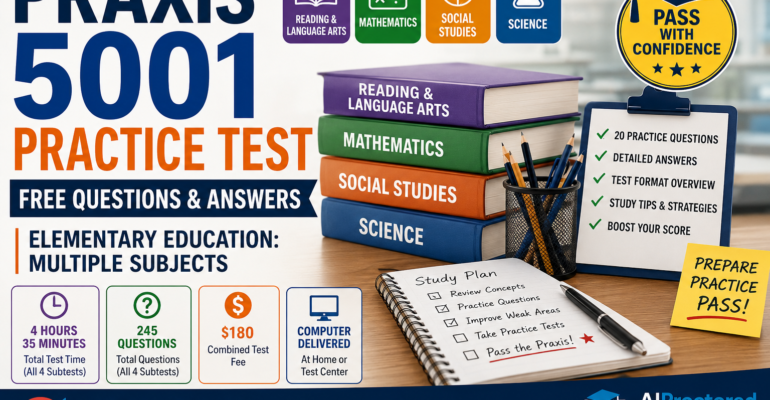

Praxis 5001 Practice Test: Free Questions, Answers & Study Guide
Preparing for the Praxis 5001 Elementary Education: Multiple Subjects exam can feel overwhelming because you are not preparing for just one subject. The assessment covers Reading and Language Arts, Mathematics, Social Studies, and Science across four separately timed subtests.
This Praxis 5001 practice test and study guide is designed to help you understand the exam structure, identify important content areas, answer realistic practice questions, and determine which subjects need additional review before test day.
You will find 20 free Praxis-style practice questions covering all four Praxis 5001 subtests, followed by correct answers and detailed explanations.
If you need more extensive preparation, AIProctoredExams also provides a complete Praxis 5001 Elementary Education: Multiple Subjects Exam Preparation course with structured study materials, topic-based quizzes, practice questions, detailed explanations, full-length practice tests, and study strategies.
What Is the Praxis 5001?
Praxis 5001 is officially known as Elementary Education: Multiple Subjects.
The assessment is designed for prospective elementary teachers and measures the content knowledge expected of an entry-level generalist elementary educator.
The combined Praxis 5001 examination consists of four subtests:
- Praxis 5002 — Reading and Language Arts
- Praxis 5003 — Mathematics
- Praxis 5004 — Social Studies
- Praxis 5005 — Science
Candidates can take the four subjects together as Praxis 5001 or, depending on their certification requirements, schedule individual subtests separately.
ETS currently describes the combined assessment as a computer-delivered examination consisting primarily of selected-response and numeric-entry questions.
Candidates should always confirm that Praxis 5001 is accepted for the teaching license they are pursuing because individual states and licensing agencies determine which Praxis tests they require.
Praxis 5001 Test Format
Understanding the test structure is one of the first steps toward effective preparation.
| Subtest | Test Code | Approx. Questions | Time |
|---|---|---|---|
| Reading and Language Arts | 5002 | 80 | 90 minutes |
| Mathematics | 5003 | 50 | 65 minutes |
| Social Studies | 5004 | 60 | 60 minutes |
| Science | 5005 | 55 | 60 minutes |
| Complete Praxis 5001 | 5001 | 245 | 4 hours 35 minutes |
ETS currently lists the combined Praxis 5001 fee at $180 and the individual 5002, 5003, 5004, and 5005 subtests at $64 each. Fees can change, so candidates should verify current pricing before registering.
What Is Tested on Praxis 5001?
The Praxis 5001 covers a broad range of elementary-level academic knowledge.
Praxis 5002 Reading and Language Arts
You should be prepared for questions involving:
- Reading comprehension
- Literature
- Informational texts
- Main ideas
- Supporting details
- Vocabulary
- Phonics
- Word analysis
- Grammar
- Sentence structure
- Writing
- Language conventions
- Speaking
- Listening
Praxis 5003 Mathematics
Major areas include:
- Numbers and operations
- Fractions
- Decimals
- Percentages
- Ratios
- Algebraic thinking
- Equations
- Geometry
- Measurement
- Probability
- Statistics
- Data interpretation
- Mathematical reasoning
Praxis 5004 Social Studies
Important areas include:
- United States history
- World history
- Government
- Civics
- Geography
- Economics
- Citizenship
- Historical documents
- Maps
- Charts
- Social studies reasoning
Praxis 5005 Science
Candidates should review:
- Life science
- Physical science
- Earth science
- Space science
- Scientific inquiry
- Experiments
- Variables
- Data interpretation
- Scientific evidence
- Scientific reasoning
These four areas reflect the content knowledge expected of an elementary generalist teacher.
How to Use This Free Praxis 5001 Practice Test
Try answering the questions before looking at the explanations.
For this short diagnostic practice test:
- Questions 1–5 cover Reading and Language Arts.
- Questions 6–10 cover Mathematics.
- Questions 11–15 cover Social Studies.
- Questions 16–20 cover Science.
Write down your answers.
After completing all 20 questions, compare your responses with the answer explanations later in this guide.
Do not treat your percentage on this short practice quiz as an official Praxis score. The official Praxis uses its own scoring procedures, and qualifying scores are established by individual states and licensing agencies.
Use this quiz primarily to determine which topics need more study.
Praxis 5001 Practice Questions
Praxis 5002 Reading and Language Arts Practice Questions
Question 1
Read the sentence:
Because the storm had damaged several power lines, many residents remained without electricity until the following afternoon.
Which relationship is primarily expressed in the sentence?
A. Comparison
B. Cause and effect
C. Sequence only
D. Problem and solution
Question 2
A teacher wants first-grade students to identify the individual sounds in the word ship.
Which sequence correctly represents the phonemes?
A. /s/ /h/ /i/ /p/
B. /sh/ /i/ /p/
C. /sh/ /ip/
D. /s/ /hi/ /p/
Question 3
Which sentence demonstrates correct subject-verb agreement?
A. The group of students are preparing for the presentation.
B. Each of the books contain several illustrations.
C. The teacher and the principal are attending the meeting.
D. Neither of the students know the correct answer.
Question 4
Read the passage:
Lena originally believed that planting vegetables would be simple. After several weeks, she discovered that successful gardening required careful watering, soil preparation, pest control, and patience. By the end of summer, however, she was proud to harvest tomatoes and peppers from her first garden.
Which statement best expresses the main idea?
A. Tomatoes require more water than peppers.
B. Gardening can require effort but can also be rewarding.
C. Lena should have planted flowers instead.
D. Pest control is the most important part of gardening.
Question 5
A student encounters the unfamiliar word preview.
Which strategy best demonstrates knowledge of morphology?
A. Counting the number of letters in the word
B. Recognizing that pre- means “before” and connecting it with view
C. Looking only at the final letter
D. Replacing the word with another word of the same length
Praxis 5003 Mathematics Practice Questions
Question 6
A classroom has 24 students. Three-eighths of the students bring lunch from home.
How many students bring lunch from home?
A. 6
B. 8
C. 9
D. 12
Question 7
Solve:
3x + 7 = 25
A. 4
B. 6
C. 8
D. 10
Question 8
A rectangular classroom rug is 9 feet long and 6 feet wide.
What is its area?
A. 15 square feet
B. 30 square feet
C. 54 square feet
D. 60 square feet
Question 9
The following scores were recorded on a five-question quiz:
3, 5, 4, 5, 3
What is the mean score?
A. 3
B. 4
C. 4.5
D. 5
Question 10
A bookstore reduces the price of a $40 teaching resource by 25%.
What is the sale price?
A. $10
B. $20
C. $30
D. $35
Praxis 5004 Social Studies Practice Questions
Question 11
Which branch of the U.S. federal government is primarily responsible for interpreting laws?
A. Executive
B. Legislative
C. Judicial
D. Administrative
Question 12
Which document begins with the words “We the People” and established the framework of the United States federal government?
A. Declaration of Independence
B. U.S. Constitution
C. Bill of Rights
D. Articles of Confederation
Question 13
If demand for a product increases while supply remains unchanged, what will generally happen to the price?
A. The price will tend to increase.
B. The price will always decrease.
C. The price will remain permanently unchanged.
D. The product will immediately disappear.
Question 14
Which geographic feature most directly encouraged the growth of many early civilizations?
A. Large deserts
B. River valleys
C. Mountain peaks
D. Polar regions
Question 15
Which of the following is an example of a primary source for a historian studying the American Civil War?
A. A modern textbook describing the war
B. A documentary produced recently
C. A soldier’s diary written during the war
D. A modern encyclopedia article
Praxis 5005 Science Practice Questions
Question 16
Plants use sunlight to produce glucose during which process?
A. Respiration
B. Photosynthesis
C. Digestion
D. Fermentation
Question 17
A student investigates whether the amount of sunlight affects plant growth.
The student gives identical plants different amounts of sunlight but provides each plant with the same amount of water and the same type of soil.
What is the independent variable?
A. Plant growth
B. Amount of water
C. Amount of sunlight
D. Type of soil
Question 18
Which statement best describes a physical change?
A. Iron reacts with oxygen to form rust.
B. Wood burns and produces ash.
C. Ice melts into liquid water.
D. Vinegar reacts with baking soda.
Question 19
What primarily causes Earth’s seasons?
A. Earth becomes dramatically closer to the Sun every summer.
B. The Moon changes Earth’s temperature.
C. Earth’s axis is tilted as Earth revolves around the Sun.
D. The Sun produces different amounts of energy every three months.
Question 20
A scientist repeats an experiment several times and obtains similar results.
Why is repetition important?
A. It guarantees the scientist’s hypothesis is correct.
B. It helps determine whether the results are consistent and reliable.
C. It eliminates the need for evidence.
D. It changes the independent variable automatically.
Praxis 5001 Practice Test Answers and Explanations
Reading and Language Arts Answers
Question 1: B — Cause and effect
The damaged power lines are the cause, while residents remaining without electricity is the effect.
Words such as because, therefore, as a result, and consequently frequently signal cause-and-effect relationships.
Question 2: B — /sh/ /i/ /p/
The word ship contains three phonemes.
Although sh contains two letters, together those letters represent one sound or phoneme.
This distinction between letters and sounds is important in phonemic-awareness and phonics questions.
Question 3: C — The teacher and the principal are attending the meeting.
The compound subject teacher and principal requires the plural verb are.
In the other examples:
- group is singular in the given construction;
- each requires a singular verb;
- neither conventionally takes a singular verb in this construction.
Question 4: B — Gardening can require effort but can also be rewarding.
The passage explains that Lena initially underestimated the work involved but eventually experienced the satisfaction of harvesting vegetables.
A main idea should represent the passage as a whole rather than one small detail.
Question 5: B — Recognizing that pre- means “before” and connecting it with view
Morphology involves understanding meaningful units of language such as:
- Roots
- Prefixes
- Suffixes
Knowing that pre- means before helps a reader determine that preview means to view something beforehand.
Mathematics Answers
Question 6: C — 9
Calculate:
3/8 × 24
First:
24 ÷ 8 = 3
Then:
3 × 3 = 9
Therefore, 9 students bring lunch from home.
Question 7: B — 6
Start with:
3x + 7 = 25
Subtract 7 from both sides:
3x = 18
Divide both sides by 3:
x = 6
Question 8: C — 54 square feet
The area of a rectangle is:
Area = length × width
Therefore:
9 × 6 = 54 square feet
Be careful not to confuse area with perimeter.
Question 9: B — 4
Add the values:
3 + 5 + 4 + 5 + 3 = 20
There are five scores:
20 ÷ 5 = 4
Therefore, the mean is 4.
Question 10: C — $30
First calculate 25% of $40:
0.25 × 40 = $10
Subtract the discount:
$40 − $10 = $30
The sale price is $30.
Social Studies Answers
Question 11: C — Judicial
The judicial branch interprets laws.
The three federal branches have different primary functions:
- Legislative — makes laws.
- Executive — carries out/enforces laws.
- Judicial — interprets laws.
Understanding separation of powers is an important civics concept.
Question 12: B — U.S. Constitution
The phrase “We the People” begins the Preamble to the U.S. Constitution.
The Constitution established the framework of the federal government and its branches.
Question 13: A — The price will tend to increase.
When demand rises and supply remains constant, buyers compete for the available quantity.
This tends to place upward pressure on price.
This is a basic principle of supply and demand.
Question 14: B — River valleys
Many early civilizations developed around major rivers.
Rivers provided benefits such as:
- Water.
- Fertile agricultural land.
- Transportation.
- Trade.
- Food resources.
Examples include civilizations associated with the Nile, Tigris and Euphrates, Indus, and Yellow River systems.
Question 15: C — A soldier’s diary written during the war
A primary source comes directly from the period being studied.
Examples include:
- Diaries.
- Letters.
- Government records.
- Photographs.
- Speeches.
- Original newspaper accounts.
- Artifacts.
A modern textbook or documentary is generally a secondary source.
Science Answers
Question 16: B — Photosynthesis
During photosynthesis, plants use light energy to help produce glucose from carbon dioxide and water.
Oxygen is released as part of the process.
Question 17: C — Amount of sunlight
The independent variable is the factor intentionally changed by the researcher.
The student changes the amount of sunlight.
Plant growth is the dependent variable because it is the outcome being measured.
Water and soil are controlled variables because they are kept consistent.
Question 18: C — Ice melts into liquid water
Melting is a physical change because the chemical identity of the substance remains water.
Rusting, burning, and the reaction between vinegar and baking soda involve chemical changes because new substances form.
Question 19: C — Earth’s axis is tilted as Earth revolves around the Sun.
Earth’s axial tilt causes different parts of the planet to receive different angles and durations of sunlight during Earth’s orbit.
The seasons are not primarily caused by Earth’s distance from the Sun.
Question 20: B — It helps determine whether the results are consistent and reliable.
Repeating experiments helps scientists determine whether results can be reproduced.
Repetition strengthens confidence in the evidence but does not automatically prove that a hypothesis is correct.
How Did You Do?
Use this simple diagnostic guide:
| Correct Answers | Suggested Interpretation |
|---|---|
| 18–20 | Strong performance on this short diagnostic |
| 15–17 | Good foundation; review weaker topics |
| 11–14 | Additional targeted preparation recommended |
| 0–10 | Consider a structured review of all four subjects |
This table is not an official Praxis score conversion.
A 20-question practice quiz cannot accurately predict your scaled Praxis score.
Instead, examine your performance by subject.
For example, someone who scores:
- RLA — 5/5
- Math — 2/5
- Social Studies — 4/5
- Science — 4/5
should spend considerably more preparation time on Mathematics.
That is more useful than focusing only on the overall score.
What Is a Passing Score on Praxis 5001?
There is no single Praxis 5001 passing score that applies to every candidate nationwide.
ETS develops and administers Praxis tests, but states and licensing agencies establish their own:
- Required examinations.
- Teacher-certification requirements.
- Qualifying scores.
ETS specifically states that Praxis passing scores are not set nationally by ETS and can vary by state or licensing organization.
Before registering, check the requirements for the state where you intend to become licensed.
Use the official Praxis state requirements directory to determine whether your state currently accepts Praxis 5001 and what scores are required for the applicable subtests.
Do You Have to Pass All Four Praxis 5001 Subtests?
If your state requires the complete Praxis 5001 assessment, you generally need to satisfy its qualifying requirements across the four component subjects:
- 5002 Reading and Language Arts
- 5003 Mathematics
- 5004 Social Studies
- 5005 Science
However, certification rules are established by individual states.
Some states may:
- Require the combined assessment.
- Allow individual subtests.
- Use different elementary education examinations.
- Transition to newer Praxis assessments.
- Require additional pedagogy or reading tests.
Always verify your state’s current requirements before paying for an exam.
How Hard Is Praxis 5001?
Praxis 5001 can be challenging because of its breadth.
You are expected to demonstrate competency across four major academic disciplines rather than concentrating on one specialized subject.
Candidates often find different portions difficult for different reasons.
Why Praxis 5002 Can Be Difficult
Reading and Language Arts requires more than basic reading comprehension.
Candidates may need to understand:
- Phonological awareness.
- Phonics.
- Vocabulary.
- Literary analysis.
- Informational texts.
- Grammar.
- Writing conventions.
- Language instruction.
Why Praxis 5003 Can Be Difficult
Candidates who have not studied mathematics recently may struggle with:
- Fractions.
- Ratios.
- Algebra.
- Geometry.
- Functions.
- Probability.
- Statistics.
Math often improves significantly with repeated problem-solving rather than passive reading.
Why Praxis 5004 Can Be Difficult
Social Studies covers a broad range of content.
Candidates may encounter:
- American history.
- World history.
- Government.
- Economics.
- Geography.
- Civics.
Instead of memorizing isolated facts, focus on relationships between events, institutions, concepts, and evidence.
Why Praxis 5005 Can Be Difficult
Science may involve unfamiliar terminology, but many questions also test reasoning.
Candidates should practice:
- Interpreting experiments.
- Identifying variables.
- Reading graphs.
- Evaluating evidence.
- Understanding major scientific concepts.
How to Study for Praxis 5001
A good Praxis 5001 study strategy should be based on your weaknesses rather than simply dividing time equally among all four subjects.
Step 1: Take a Diagnostic Practice Test
Begin by answering questions in all four subjects.
Record your results separately.
For example:
| Subject | Score | Priority |
|---|---|---|
| RLA | 82% | Medium |
| Math | 58% | High |
| Social Studies | 78% | Medium |
| Science | 90% | Low |
Your weakest subjects should receive more study time.
Step 2: Review the Official Test Blueprint
Before studying, understand what ETS says the examination covers.
The official Praxis 5001 Study Companion provides information about:
- Test structure.
- Content categories.
- Approximate question distribution.
- Question types.
- Sample questions.
- Preparation guidance.
Do not build your study plan around random internet questions that may have little relationship to the official content domains.
Step 3: Review One Content Area at a Time
Break large subjects into smaller sections.
For Praxis 5002
Study:
- Phonemic awareness.
- Phonics.
- Fluency.
- Vocabulary.
- Comprehension.
- Literature.
- Informational text.
- Grammar.
- Writing.
For Praxis 5003
Study:
- Numbers.
- Fractions.
- Percentages.
- Ratios.
- Algebra.
- Geometry.
- Measurement.
- Statistics.
- Probability.
For Praxis 5004
Study:
- U.S. history.
- Government.
- Civics.
- World history.
- Geography.
- Economics.
For Praxis 5005
Study:
- Life science.
- Physical science.
- Earth and space science.
- Scientific inquiry.
- Experiments.
- Data interpretation.
Step 4: Practice Questions Immediately After Studying
Do not wait until you have “finished studying” to start answering questions.
Use this cycle:
Learn → Practice → Review → Correct → Repeat
For example:
- Review fractions.
- Complete 10–20 fraction questions.
- Identify mistakes.
- Review weak concepts.
- Complete another set of questions.
This approach is usually more effective than repeatedly rereading notes.
Step 5: Keep an Error Log
Create a record of questions you answer incorrectly.
Include:
| Question | Topic | Why I Missed It | What I Need to Review |
|---|---|---|---|
| Math #12 | Fractions | Incorrect denominator | Adding unlike fractions |
| RLA #24 | Phonics | Confused phoneme and grapheme | Sound-symbol relationships |
| Science #17 | Experiments | Mixed up variables | Independent vs dependent variables |
Your error log becomes a personalized study guide.
Step 6: Practice Under Timed Conditions
Knowing the content is not enough if you cannot complete questions efficiently.
Practice timed sets such as:
- 20 RLA questions.
- 15 Math questions.
- 15 Social Studies questions.
- 15 Science questions.
Gradually increase the length until you can sustain concentration under realistic exam conditions.
Step 7: Complete Full-Length Practice Tests
Near your test date, complete longer simulations.
A useful practice test should help you develop:
- Pacing.
- Mental endurance.
- Question analysis.
- Elimination strategies.
- Confidence.
- Familiarity with switching between content areas.
AIProctoredExams’ Praxis 5001 exam preparation course includes practice across all four 5001 subtests, detailed explanations, topic-based quizzes, and full-length practice materials.
A Simple 4-Week Praxis 5001 Study Plan
Week 1: Diagnose and Build Foundations
Focus on:
- Diagnostic testing.
- RLA fundamentals.
- Number operations.
- Fractions.
- U.S. government.
- Basic life science.
Goal: identify your strongest and weakest subjects.
Week 2: Strengthen Weak Areas
Focus on:
- Reading comprehension.
- Grammar.
- Algebra.
- Geometry.
- U.S. history.
- Economics.
- Physical science.
Spend more time on areas where your diagnostic performance was weakest.
Week 3: Apply Knowledge
Increase the number of practice questions.
Complete:
- Timed RLA sets.
- Timed Math sets.
- Timed Social Studies sets.
- Timed Science sets.
Review every incorrect answer.
Week 4: Simulate Test Conditions
Complete longer mixed practice tests.
During the final week:
- Review your error log.
- Revisit difficult formulas.
- Review major government concepts.
- Strengthen science reasoning.
- Practice pacing.
- Avoid trying to learn enormous amounts of completely new material immediately before the test.
Praxis 5001 Test-Taking Strategies
Read the Entire Question
Praxis questions may include distractors that appear correct if you read too quickly.
Identify exactly what the question asks.
Watch for words such as:
- BEST
- MOST
- FIRST
- PRIMARY
- EXCEPT
- NOT
Eliminate Clearly Incorrect Answers
If you do not immediately know the answer, eliminate options you know are wrong.
Turning a four-choice question into a two-choice decision significantly improves your chances of reasoning toward the correct response.
Do Not Spend Too Long on One Question
A difficult question can consume time needed for several easier questions.
Make your best decision, continue, and return when permitted if time remains.
Look for Evidence in Reading Questions
Do not choose an answer simply because it sounds reasonable.
Select the answer best supported by the passage.
Estimate Before Calculating
In Mathematics, estimation can help identify impossible answer choices.
If your exact calculation produces a result dramatically different from your estimate, recheck the work.
Identify Variables in Science Experiments
For experiment questions, ask:
- What is being changed?
- What is being measured?
- What is being held constant?
This often reveals the answer quickly.
Interpret Social Studies Sources Carefully
When you encounter:
- Maps.
- Graphs.
- Timelines.
- Political cartoons.
- Historical documents.
use the evidence provided rather than relying only on memorized facts.
Can You Take Praxis 5001 at Home?
ETS currently lists Praxis 5001 as available at home through online testing or at a test center, subject to applicable eligibility, technical, and scheduling requirements.
Candidates planning to test at home should verify:
- Computer requirements.
- Webcam requirements.
- Internet connection.
- Testing-room rules.
- Identification requirements.
- Proctoring requirements.
Your state must also accept the exam you are taking for your certification pathway.
How Much Does Praxis 5001 Cost?
ETS currently lists:
Praxis 5001 combined test: $180
The individual subtests are currently listed at:
Praxis 5002: $64
Praxis 5003: $64
Praxis 5004: $64
Praxis 5005: $64
Taking all four separately at current standard pricing would therefore cost more than taking the combined 5001 examination.
However, candidates should not select an exam solely based on price.
Check:
- Which test your state requires.
- Whether you need all four subtests.
- Whether your state permits separate subtest attempts.
- Current ETS pricing at registration.
Is Praxis 5001 Being Replaced?
This is an important development for candidates planning future testing.
ETS has introduced new Elementary Education Fundamentals assessments and the Praxis Steps approach.
ETS states that these newer assessments are designed to replace several existing elementary assessments, including Praxis 5001 and its 5002–5005 subtests, with the current target for retirement of those older assessments being August 2028.
However, states control adoption and transition timing, so candidates should not assume Praxis 5001 has already disappeared from their certification pathway.
What Should Current Candidates Do?
If your state currently requires Praxis 5001:
Prepare for the test your state currently accepts.
Do not switch to a newer assessment simply because it exists.
Always check your current state requirements before registering.
This section should also be reviewed periodically because state adoption schedules can change.
Frequently Asked Questions About Praxis 5001
What is Praxis 5001?
Praxis 5001 is the Elementary Education: Multiple Subjects assessment used in certain elementary teacher-licensure pathways. It combines Reading and Language Arts, Mathematics, Social Studies, and Science.
How many questions are on Praxis 5001?
The combined assessment currently contains approximately 245 questions across its four subtests.
How long is Praxis 5001?
The complete assessment takes approximately 4 hours and 35 minutes, with each subject separately timed.
What are the four Praxis 5001 subtests?
They are:
- 5002 Reading and Language Arts
- 5003 Mathematics
- 5004 Social Studies
- 5005 Science
How much does Praxis 5001 cost?
ETS currently lists the combined Praxis 5001 test at $180. Verify current pricing when registering.
What score do you need to pass Praxis 5001?
There is no universal nationwide passing score. States and licensing agencies establish their own qualifying-score requirements.
Is Praxis 5001 difficult?
Difficulty depends on your academic strengths. Many candidates find the breadth challenging because the exam covers four different subject areas.
Can I take the Praxis 5001 subtests separately?
ETS offers the four individual subtests separately as 5002, 5003, 5004, and 5005. Whether taking them individually satisfies your licensing requirements depends on your state or agency.
Can you take Praxis 5001 online?
ETS currently lists the exam as available either at home or at a test center.
Should I take Praxis 5001 practice tests?
Yes. Practice testing can help identify weak content areas, improve pacing, and familiarize you with the types of reasoning required.
Are these official ETS practice questions?
No.
The practice questions in this AIProctoredExams article are original preparation questions created for study purposes. They are not copied from ETS examinations and should not be interpreted as actual or recalled Praxis test questions.
Where can I find official Praxis 5001 information?
Candidates should review the official Praxis 5001 test page and ETS Study Companion for the current test blueprint, registration information, and preparation guidance.
Take Your Praxis 5001 Preparation Further
A short Praxis 5001 practice test is useful for identifying weak areas, but passing a comprehensive elementary education assessment requires consistent preparation across all four subjects.
AIProctoredExams provides a complete Praxis 5001 Elementary Education: Multiple Subjects preparation course covering:
- Praxis 5002 Reading and Language Arts.
- Praxis 5003 Mathematics.
- Praxis 5004 Social Studies.
- Praxis 5005 Science.
- Topic-based review.
- Practice questions.
- Correct-answer explanations.
- Full-length practice tests.
- Worked solutions.
- Study planning.
- Test-taking strategies.
- Time-management techniques.
Candidates can also explore the broader AIProctoredExams Praxis preparation collection for additional teacher-certification exam preparation.
The goal is not simply to memorize practice-test answers. Effective Praxis preparation means understanding the underlying concepts well enough to apply them to unfamiliar questions on test day.
Official Praxis Resources
Candidates should verify current exam information through official ETS Praxis resources.
Use the official Praxis 5001 test page to confirm current pricing, testing options, and examination details. Review the official Praxis Study Companion for the current blueprint and content categories, and check your state’s Praxis requirements before registering.
Exam fees, state certification rules, accepted test codes, qualifying scores, and transition timelines can change.
AIProctoredExams is an independent exam-preparation provider and is not affiliated with, sponsored by, or endorsed by ETS. Praxis® is a registered trademark of Educational Testing Service (ETS). All practice questions in this guide are independently created for educational preparation and are not actual ETS examination questions.