2026 NCLEX-RN Study Guide: Test Plan, NGN & Practice Questions
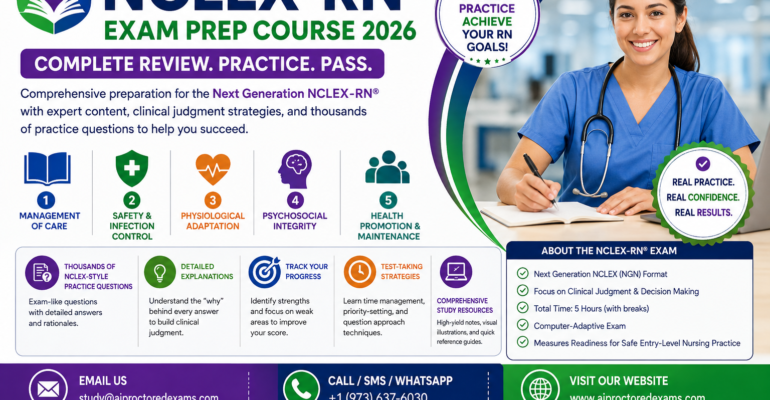

2026 NCLEX-RN Study Guide: Exam Format, Test Plan, NGN Questions, Study Plan & Practice Questions
Preparing for the NCLEX-RN in 2026 requires more than memorizing medications, laboratory values, diseases, and nursing procedures. The examination is designed to evaluate whether a nursing graduate can apply knowledge, recognize important patient information, make safe decisions, prioritize care, and demonstrate the clinical judgment expected of an entry-level registered nurse.
This 2026 NCLEX-RN Study Guide provides a comprehensive overview of the current exam format, the 2026 NCLEX-RN Test Plan, Next Generation NCLEX (NGN), clinical judgment, major content categories, study strategies, priority-setting techniques, practice questions, and realistic 30-day and 60-day study plans.
The official 2026 NCLEX-RN Test Plan is effective from April 1, 2026 through March 31, 2029. The test plan is used both to guide examination development and to help candidates understand the content and competencies assessed on the NCLEX-RN.
If you want structured preparation beyond this guide, explore the 2026 NCLEX-RN Exam Prep Course – Complete Review, Practice Questions & Rationales from AIProctoredExams. The course includes nursing content review, NGN clinical-judgment preparation, practice questions, rationales, prioritization, pharmacology, safety, delegation, major body systems, and exam strategies.
What Is the NCLEX-RN?
The National Council Licensure Examination for Registered Nurses, commonly called the NCLEX-RN, is a nursing licensure examination designed to determine whether a candidate demonstrates the knowledge, skills, abilities, and clinical judgment needed for safe and effective entry-level nursing practice.
Unlike many traditional academic examinations, the NCLEX-RN is not primarily a test of how many facts you can remember. Nursing knowledge remains essential, but candidates must frequently apply that knowledge to clinical situations.
For example, instead of simply asking for the definition of hypoxemia, an NCLEX-style question may provide a patient scenario containing assessment findings and ask which patient requires immediate attention, which finding is most concerning, or which nursing intervention should be performed first.
Successful NCLEX preparation therefore needs to combine:
- Nursing content review
- Clinical judgment
- Patient-safety principles
- Prioritization
- Delegation and assignment
- Pharmacology
- Interpretation of clinical findings
- Communication
- Infection prevention
- Practice questions
- Review of detailed rationales
Candidates looking for organized review materials can also visit the AIProctoredExams Study Guides section or browse the dedicated NCLEX-RN preparation category. AIProctoredExams currently organizes its nursing preparation resources around structured content review, exam-style questions, rationales, and clinical-judgment preparation.
2026 NCLEX-RN Exam Format at a Glance
Understanding how the examination works should be one of the first steps in your NCLEX preparation.
The 2026 NCLEX-RN continues to use computerized adaptive testing (CAT). According to the official test plan, every RN candidate answers a minimum of 85 items and may receive up to 150 items. Candidates have a maximum of five hours, and that five-hour period includes breaks.
Key 2026 NCLEX-RN Exam Facts
| Feature | 2026 NCLEX-RN |
|---|---|
| Exam delivery | Computerized Adaptive Testing (CAT) |
| Minimum number of items | 85 |
| Maximum number of items | 150 |
| Maximum testing time | 5 hours |
| Clinical judgment case studies | 3 case-study sets |
| Items in each case study | 6 |
| Case-study items at minimum length | 18 |
| Unscored pretest items | 15 |
| Ability to return to previous questions | No, after moving to the next item |
| Current test-plan period | April 1, 2026–March 31, 2029 |
At the minimum 85-item examination length, the official test plan specifies that 52 items come from the eight content areas, 18 items comprise three clinical-judgment case studies, and 15 are unscored pretest items.
Does Getting 85 Questions Mean You Passed the NCLEX?
No.
The number of questions you receive does not by itself tell you whether you passed or failed. A candidate can pass or fail at different examination lengths.
The adaptive system continues selecting questions until the scoring process has enough information to make a pass/fail decision under the applicable stopping rule or until the maximum examination length or time condition is reached.
Do not spend examination day trying to determine whether the computer is giving you “good” or “bad” questions. Concentrate on the patient scenario immediately in front of you.
How Computerized Adaptive Testing Works on the NCLEX-RN
Computerized adaptive testing means that your examination is assembled dynamically as you take it.
After you answer an item, the CAT system updates its estimate of your nursing ability. It then selects another appropriate item while also maintaining the content requirements established in the NCLEX-RN Test Plan. The process continues as additional responses make the estimate of your ability more precise.
This has several important implications for candidates.
Every Question Deserves Your Attention
You cannot assume a question is unimportant because it appears easy.
You also should not panic because several questions feel difficult. An adaptive examination is designed to challenge candidates around their estimated ability level.
You Cannot Go Back After Submitting an Item
Candidates may reconsider an answer while still on the current question. However, once an answer is confirmed and the candidate advances to the next item, the previous question cannot be revisited.
Read carefully, make the safest evidence-based decision you can, submit the answer, and mentally move forward.
You Must Answer the Current Question
Do not become paralyzed by an unfamiliar question. Eliminate unsafe or clearly inappropriate answers, identify what the question is actually testing, choose the strongest remaining response, and continue.
Understanding the 2026 NCLEX-RN Test Plan
The NCLEX-RN Test Plan organizes examination content around Client Needs.
There are four major Client Needs categories, two of which contain multiple subcategories. Together, these create the eight major areas commonly used when planning NCLEX review.
The official 2026 distribution is:
| NCLEX-RN Client Needs Category | 2026 Percentage Range |
|---|---|
| Management of Care | 15–21% |
| Safety and Infection Prevention and Control | 10–16% |
| Health Promotion and Maintenance | 6–12% |
| Psychosocial Integrity | 6–12% |
| Basic Care and Comfort | 6–12% |
| Pharmacological and Parenteral Therapies | 13–19% |
| Reduction of Risk Potential | 9–15% |
| Physiological Adaptation | 11–17% |
Because the examination is adaptive and variable in length, an individual candidate’s exact content distribution can vary within the framework established by the test plan. The official plan notes that category distributions on individual examinations may vary by up to ±3%.
The implication for your study strategy is simple: do not completely ignore any Client Needs category.
You can spend additional time on heavily weighted categories and on your personal areas of weakness, but your preparation should still cover all eight.
Safe and Effective Care Environment
Safe and Effective Care Environment addresses the nurse’s responsibility to organize, coordinate, and provide care in a way that protects clients and health care personnel.
It includes two major subcategories.
Management of Care: 15–21%
Management of Care is one of the largest areas of the 2026 NCLEX-RN blueprint.
Candidates should be comfortable applying concepts involving:
- Prioritization of nursing care
- Delegation and supervision
- Assignments
- Client rights
- Informed consent
- Confidentiality and privacy
- Ethical nursing practice
- Legal responsibilities
- Interdisciplinary collaboration
- Continuity of care
- Handoffs
- Advance directives
- Quality improvement
- Discharge planning
- Referrals
- Time management
The official 2026 activity statements specifically include delegating and supervising care, prioritizing care according to acuity, advocating for client rights, collaborating with multidisciplinary team members, receiving and implementing provider orders, managing confidentiality, and practicing within legal scope.
How to Study Management of Care
Do not study delegation as a collection of isolated rules.
Instead, practice scenario-based questions.
Ask:
What does this patient require?
Which team member has the appropriate scope and competence?
Is the patient stable or unstable?
Does the task require assessment, teaching, evaluation, or nursing judgment?
What action protects the patient most effectively?
Prioritization and delegation should appear repeatedly throughout your NCLEX study schedule rather than being reviewed only once.
Safety and Infection Prevention and Control: 10–16%
The 2026 Test Plan uses the category name Safety and Infection Prevention and Control.
This area evaluates whether the candidate can protect patients and health care personnel from environmental and health-related hazards.
Important review topics include:
- Hand hygiene
- Standard precautions
- Transmission-based precautions
- Aseptic technique
- Sterile technique
- Personal protective equipment
- Patient identification
- Fall prevention
- Restraint safety
- Equipment safety
- Allergies
- Emergency response
- Biohazardous materials
- Medication and treatment errors
- Workplace safety
- Reporting unsafe practice
The official test plan includes infection-prevention principles, protection from injury, safe handling of hazardous materials, appropriate patient identification, equipment safety, restraints, allergies, emergency response, and escalation of unsafe practice.
High-Yield Safety Strategy
When two answers both sound clinically reasonable, ask which choice:
- Prevents immediate harm;
- Addresses the greatest risk;
- Is within the nurse’s role;
- Uses the least restrictive safe intervention; and
- Protects the patient before a complication occurs.
Safety is not confined to one test category. It influences pharmacology, maternity, pediatrics, mental health, medical-surgical nursing, delegation, and virtually every clinical scenario.
Health Promotion and Maintenance: 6–12%
Health Promotion and Maintenance focuses on normal growth and development, prevention, early detection of health problems, education, and helping clients achieve optimal health.
The 2026 test plan includes areas such as prenatal and postpartum education, screening, health assessments, prevention, lifespan care, readiness to learn, newborn through older-adult care, and planning for care in the home environment.
Topics to Review
Candidates should review:
- Growth and development
- Developmental milestones
- Prenatal nursing
- Postpartum care
- Newborn care
- Pediatric development
- Adolescent health
- Adult preventive care
- Older-adult care
- Screening
- Health education
- Lifestyle modification
- Community health
- Patient readiness to learn
- Home-care planning
A common mistake is to treat health promotion as less important because its percentage range is smaller than Management of Care or Pharmacological and Parenteral Therapies.
That is not a reason to skip it.
You still need to recognize normal versus abnormal development, appropriate patient education, prevention priorities, and age-appropriate nursing care.
Psychosocial Integrity: 6–12%
Psychosocial Integrity assesses nursing care related to emotional, behavioral, social, and mental-health needs.
Preparation should include:
- Therapeutic communication
- Mental health disorders
- Crisis intervention
- Grief and loss
- Coping
- Stress management
- Substance-related concerns
- Abuse and neglect
- Family dynamics
- Behavioral interventions
- Patient support
- End-of-life psychosocial care
Therapeutic Communication Strategy
NCLEX communication questions are rarely solved by choosing the longest or most compassionate-sounding option.
Look for responses that:
- Encourage the patient to communicate;
- Avoid false reassurance;
- Avoid judgment;
- Do not unnecessarily change the subject;
- Respect autonomy;
- Clarify concerns;
- Address immediate safety risks appropriately.
When preparing, read the answer rationales carefully. Understanding why a response is therapeutic is more valuable than memorizing individual phrases.
Physiological Integrity
Physiological Integrity contains four subcategories and collectively accounts for a substantial portion of NCLEX-RN content.
The four areas are:
Basic Care and Comfort: 6–12%
Review fundamental nursing care including:
- Mobility
- Nutrition
- Hydration
- Elimination
- Hygiene
- Sleep
- Positioning
- Pain
- Nonpharmacological comfort measures
- Assistive devices
- Skin integrity
- Activities of daily living
Questions may integrate basic care with patient safety and clinical judgment.
A positioning question, for example, may really be testing aspiration prevention, airway protection, pressure-injury prevention, postoperative safety, or improved ventilation.
Pharmacological and Parenteral Therapies: 13–19%
Pharmacology is one of the largest individual content areas in the 2026 Test Plan.
The official activity statements include evaluating medication orders, preparing and administering medications safely, performing medication calculations, reviewing contraindications and laboratory data, monitoring intravenous therapy, administering blood products, maintaining central venous access devices, educating patients about medications, evaluating medication responses, medication reconciliation, and safe handling of high-risk medications.
How to Study Pharmacology for NCLEX
Avoid attempting to memorize every medication ever mentioned in nursing school.
Organize medications by class.
For each important class, know:
- Why the medication is given;
- The major nursing assessments;
- Important adverse effects;
- Significant contraindications or precautions;
- Relevant laboratory monitoring;
- Essential patient teaching;
- What finding would require urgent nursing action.
Focus heavily on medication safety.
When a medication question includes laboratory values, vital signs, allergies, assessment findings, or another medication, assume those details may be important.
Reduction of Risk Potential: 9–15%
Reduction of Risk Potential focuses on preventing complications related to existing conditions, procedures, and treatments.
The official 2026 activity statements include monitoring changes in vital signs, focused assessments, recognizing changes in condition, evaluating diagnostic findings, preoperative and postoperative care, monitoring procedures and treatments, obtaining specimens, and preventing procedure-related complications.
High-Yield Reduction of Risk Topics
Study:
- Laboratory trends
- Diagnostic tests
- Preoperative care
- Postoperative complications
- Changes in vital signs
- Focused assessments
- Electrolyte abnormalities
- Acid-base disorders
- Blood glucose abnormalities
- Bleeding
- Infection
- Aspiration
- Falls
- Treatment complications
The most important skill is recognizing deterioration before a patient becomes critically unstable.
Physiological Adaptation: 11–17%
Physiological Adaptation covers the care of patients experiencing acute, chronic, complex, or life-threatening physical health problems.
The official test plan includes emergency care, mechanical ventilation, wound care, postoperative care, dialysis, pulmonary hygiene, telemetry, impaired oxygenation, pacing devices, fluid and electrolyte disorders, hemodynamics, tissue perfusion, and recognition of complications.
High-Yield Physiological Adaptation Topics
Prioritize review of:
- Respiratory failure
- Shock
- Sepsis
- Acute coronary syndromes
- Dysrhythmias
- Stroke
- Increased intracranial pressure
- Acute kidney injury
- Fluid overload
- Severe electrolyte disorders
- Diabetic emergencies
- Gastrointestinal bleeding
- Hemorrhage
- Burns
- Postoperative complications
- Mechanical ventilation
- Chest tubes
- Dialysis
- Emergency nursing care
You do not need to become a critical-care specialist to pass the NCLEX. You do need to identify dangerous findings and select safe entry-level nursing actions.
Next Generation NCLEX: What You Need to Know in 2026
The Next Generation NCLEX (NGN) launched on April 1, 2023 to improve assessment of candidates’ clinical judgment and decision-making abilities. NGN remains an important component of NCLEX preparation in 2026.
The central idea is straightforward:
Can you take information from a realistic patient situation and use it to make safe nursing decisions?
Memorizing isolated facts is not enough.
The Six Clinical Judgment Steps
The 2026 NCLEX-RN Test Plan describes six clinical-judgment steps:
1. Recognize Cues
Identify relevant information.
Potential cues may include:
- Vital signs
- Symptoms
- Medical history
- Laboratory results
- Medication history
- Physical assessment findings
- Patient statements
- Changes from baseline
The challenge is deciding which information matters.
2. Analyze Cues
Connect the relevant findings.
Ask yourself:
What could explain these findings?
Which findings belong together?
What clinical problem may be developing?
Do not treat every cue independently.
3. Prioritize Hypotheses
Determine which potential problem requires the greatest attention.
Consider:
- Urgency
- Severity
- Risk
- Probability
- Potential for deterioration
A patient can have multiple legitimate problems. NCLEX often asks you to determine which one is most urgent.
4. Generate Solutions
Identify interventions that could address the priority problem and produce the desired outcome.
At this stage, think beyond simply naming the diagnosis.
Ask what the nurse can safely do.
5. Take Action
Select or implement the highest-priority intervention.
This step demands understanding of patient safety, nursing scope, urgency, and prioritization.
6. Evaluate Outcomes
Determine whether the intervention worked.
Look for:
- Improved findings;
- Worsening findings;
- New complications;
- Need for additional intervention.
NGN case studies use an unfolding clinical scenario, meaning new patient information may appear as you move through the case.
How Many NGN Case Studies Are on the NCLEX-RN?
Clinical judgment is explicitly measured in the 2026 plan.
The official blueprint states that clinical judgment processes are explicitly assessed with 18 case-study items, consisting of three sets, plus approximately 10% stand-alone clinical-judgment items, depending on examination length. Each case study contains six items associated with the same evolving client presentation.
This is why NGN practice should be incorporated throughout your study program instead of being saved for the final week.
NCLEX Question Types and Partial Credit
NCLEX items may appear in multiple formats, including stand-alone items and case studies. Items can also contain multimedia such as tables, charts, and graphics.
Some items that contain more than one keyed response can receive partial-credit scoring. The official NCLEX information identifies three partial-credit scoring approaches: plus/minus, zero/one, and rationale scoring.
Do not make your preparation strategy overly dependent on memorizing scoring formulas.
Your primary objective is still to:
- Understand what the question asks;
- Identify relevant patient information;
- Apply nursing knowledge;
- Eliminate unsafe responses;
- Select every response that is clinically supported.
How to Answer NCLEX Priority Questions
Priority questions are among the most important question types to master because prioritization applies across virtually every nursing content area.
Start With Immediate Threats
A useful starting framework is:
Airway → Breathing → Circulation → immediate safety threats.
However, do not apply ABC mechanically.
A stable patient with a chronic airway-related condition may be lower priority than another patient experiencing an immediate life-threatening emergency.
Always consider the entire clinical picture.
Acute Usually Takes Priority Over Chronic
A newly developed change often requires more immediate assessment than an expected chronic finding.
Look for language such as:
- New
- Sudden
- Increasing
- Decreasing
- Unexpected
- Restless
- Confused
- Unresponsive
- Severe
- Rapidly worsening
These words may signal deterioration.
Unstable Usually Takes Priority Over Stable
Ask whether the finding is expected or unexpected.
Patients experiencing major changes in neurological status, breathing, perfusion, consciousness, bleeding, or other critical functions frequently require rapid assessment.
Actual Problems Often Take Priority Over Potential Problems
A current threat generally outranks a theoretical future risk, although prevention may become the priority when the potential problem is immediate and serious.
The safest approach is to analyze the scenario rather than memorize an absolute rule.
How to Approach NCLEX Delegation Questions
Delegation questions combine scope of practice, patient stability, task complexity, and nursing judgment.
Before selecting an answer, ask:
Is the Patient Stable?
Stable patients with predictable needs may be appropriate for delegated tasks when the task falls within the team member’s permitted role.
Unstable or newly changing patients generally require greater RN involvement.
Does the Task Require Assessment?
Initial nursing assessment requires professional nursing judgment.
Be cautious about delegating responsibilities that involve making nursing judgments about what patient findings mean.
Does the Task Require Teaching?
Initial education and evaluation of patient understanding frequently require the RN’s professional judgment.
Routine reinforcement may be different from initial teaching.
Does the Task Require Evaluation?
Determining whether a nursing intervention achieved the intended outcome requires nursing judgment.
The NCLEX-RN preparation materials available through the AIProctoredExams NCLEX-RN course specifically include management of care, delegation, assignment, prioritization, leadership, clinical judgment, and exam-style question practice.
High-Yield NCLEX-RN Topics to Review in 2026
A comprehensive NCLEX review should cover the complete test plan, but certain concepts repeatedly connect multiple Client Needs categories.
Cardiovascular Nursing
Review:
- Heart failure
- Acute coronary syndromes
- Dysrhythmias
- Hypertension
- Shock
- Perfusion
- Anticoagulation concepts
- Cardiac medications
- Post-cardiac procedure care
- Priority cardiovascular assessment findings
Respiratory Nursing
Study:
- Asthma
- COPD
- Pneumonia
- Pulmonary embolism
- Respiratory failure
- Oxygen therapy principles
- Mechanical ventilation
- Chest tubes
- Airway emergencies
- Arterial blood gas interpretation concepts
Neurological Nursing
Review:
- Stroke
- Seizures
- Increased intracranial pressure
- Spinal cord injury
- Changes in level of consciousness
- Neurological assessment
- Safety precautions
- Emergency neurological findings
Endocrine Nursing
Concentrate on:
- Diabetes mellitus
- Hypoglycemia
- Hyperglycemia
- Diabetic emergencies
- Thyroid disorders
- Adrenal disorders
- Medication and patient-teaching principles
Renal Nursing
Review:
- Acute kidney injury
- Chronic kidney disease
- Dialysis
- Fluid balance
- Electrolyte changes
- Urinary disorders
- Intake and output
- Renal medication considerations
Gastrointestinal Nursing
Study:
- GI bleeding
- Liver disease
- Pancreatitis
- Bowel obstruction
- Ostomy care
- Enteral feeding
- Nutrition
- Postoperative abdominal complications
Maternal-Newborn Nursing
Include:
- Prenatal care
- Pregnancy complications
- Labor
- Fetal monitoring concepts
- Postpartum care
- Postpartum complications
- Newborn assessment
- Newborn safety
- Maternal patient education
Pediatric Nursing
Review:
- Growth and development
- Pediatric safety
- Respiratory emergencies
- Dehydration
- Medication safety
- Family-centered care
- Congenital conditions
- Childhood infections
- Developmentally appropriate communication
Mental Health Nursing
Focus on:
- Therapeutic communication
- Suicide and self-harm risk assessment concepts
- Anxiety
- Depression
- Psychosis
- Mania
- Substance-related disorders
- Crisis intervention
- Patient safety
- Medication considerations
How to Study Pharmacology Without Becoming Overwhelmed
Pharmacology becomes difficult when candidates attempt to memorize medications as unrelated facts.
A better approach is to create medication-class templates.
For every major drug class, answer five questions:
- What is the medication class used for?
- What should the nurse assess before administering it?
- What important adverse effect could harm the patient?
- What laboratory value, vital sign, or clinical finding may need monitoring?
- What should the patient know?
Then complete practice questions immediately after reviewing the class.
The purpose is not just to remember a fact. It is to recognize how medication information affects a nursing decision.
Laboratory Values and Diagnostic Findings
Laboratory questions should be studied in context.
Instead of memorizing a long sheet of numbers and stopping there, practice asking:
- Is the result high or low?
- Is it expected for this condition?
- Could it indicate an emergency?
- Could a medication have contributed?
- Does the patient have symptoms?
- Is the value trending in the wrong direction?
- What assessment should the nurse perform?
- What nursing action may be required?
Reference ranges may differ slightly among laboratories and sources, so understand the clinical meaning of common abnormalities rather than depending exclusively on memorized cutoffs.
60-Day NCLEX-RN Study Plan
Candidates who have approximately two months can combine gradual content review with repeated practice and remediation.
Weeks 1–2: Build the Foundation
Review:
- NCLEX format
- Clinical judgment
- Management of Care
- Safety and Infection Prevention and Control
- Basic Care and Comfort
- Pharmacology foundations
Complete practice questions every study day.
Do not wait until you have “finished studying” before answering questions.
Weeks 3–4: Major Body Systems
Review:
- Cardiovascular
- Respiratory
- Neurological
- Renal
- Endocrine
- Gastrointestinal
- Musculoskeletal
- Hematology and oncology
After each system, complete targeted practice questions and document the concepts behind every significant error.
Week 5: Lifespan Nursing
Concentrate on:
- Maternal-newborn
- Pediatrics
- Growth and development
- Health promotion
- Older-adult nursing
- Community concepts
Week 6: Psychosocial Care and Integrated Processes
Review:
- Mental health
- Therapeutic communication
- Ethics
- Legal concepts
- Delegation
- Prioritization
- Patient education
Week 7: NGN and Mixed Practice
Complete:
- Unfolding case studies
- Clinical-judgment questions
- Mixed-system quizzes
- Prioritization questions
- Delegation questions
- Pharmacology questions
Spend significant time reviewing explanations.
Week 8: Final Consolidation
Focus on weak topics rather than trying to reread every nursing-school note.
Complete realistic mixed practice, review recurring mistakes, revisit high-yield clinical situations, and protect your sleep schedule as the examination approaches.
Candidates who prefer a structured digital course can follow their study schedule alongside the AIProctoredExams 2026 NCLEX-RN Exam Prep Course.
If you are new to the platform, review How AIProctoredExams Works for information on choosing a course, accessing materials, completing practice questions, taking mock examinations where available, reviewing weak areas, and preparing independently for examination day.
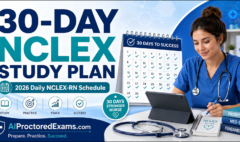
30-Day NCLEX-RN Study Plan
If you have one month, preparation needs to be more focused.
Days 1–5: Safety, Management and Fundamentals
Study:
- Prioritization
- Delegation
- Infection prevention
- Patient safety
- Basic care
- Ethics
- Legal nursing concepts
Complete daily practice questions.
Days 6–12: Adult Health Systems
Review:
- Cardiovascular
- Respiratory
- Neurological
- Endocrine
- Renal
- Gastrointestinal
Prioritize clinical deterioration and emergency findings.
Days 13–17: Pharmacology
Organize pharmacology by medication class.
Review major:
- Cardiovascular medications
- Respiratory medications
- Endocrine medications
- Neurological and psychiatric medications
- Anti-infective medications
- Analgesics
- Anticoagulation concepts
- High-risk medication safety
Days 18–21: Maternal-Newborn and Pediatrics
Review normal findings, complications, patient education, safety, and age-specific nursing care.
Days 22–24: Mental Health
Practice therapeutic communication and patient-safety scenarios.
Days 25–27: NGN Clinical Judgment
Complete case studies.
Practice:
Recognize cues → Analyze cues → Prioritize hypotheses → Generate solutions → Take action → Evaluate outcomes.
Days 28–29: Mixed Practice
Use comprehensive mixed questions.
Review every significant mistake.
Day 30: Light Review
Avoid an exhausting last-minute cram session.
Review concise notes, priority concepts, common errors, and examination logistics.
How Many NCLEX Questions Should You Practice Per Day?
There is no universal number of questions that guarantees success.
The quality of your review matters more than chasing a large daily total.
For example, completing 60 questions and carefully studying why you missed 15 of them can be more valuable than completing 200 questions and barely reading the explanations.
A productive cycle is:
Question → Answer → Rationale → Identify knowledge gap → Review concept → Attempt similar question later.
Practice questions are diagnostic tools.
Use them to discover what you do not yet understand.
10 NCLEX-RN Practice Questions With Rationales
The following are original educational practice questions designed to reinforce NCLEX-style reasoning. They are not live, recalled, or confidential NCLEX examination items.
Practice Question 1: Prioritization
A nurse receives report on four patients. Which patient should the nurse assess first?
A. A patient with chronic COPD whose oxygen saturation is at the patient’s documented baseline
B. A postoperative patient reporting incisional pain of 6/10
C. A patient who suddenly develops difficulty speaking and weakness of one arm
D. A patient awaiting discharge instructions after an uncomplicated procedure
Correct answer: C
Rationale: Sudden speech difficulty and unilateral weakness may indicate an acute neurological emergency. A new potentially time-sensitive change in neurological function takes priority over expected chronic findings, pain in an otherwise stable postoperative patient, and routine discharge teaching.
Practice Question 2: Infection Prevention
Which action by a nurse is most fundamental to reducing transmission of microorganisms between patient-care activities?
A. Performing appropriate hand hygiene
B. Wearing sterile gloves for every patient interaction
C. Administering prophylactic antibiotics to all patients
D. Placing every hospitalized patient in isolation
Correct answer: A
Rationale: Appropriate hand hygiene is a foundational infection-prevention measure. Sterile gloves are not required for every interaction, prophylactic antibiotics are not appropriate for every patient, and isolation is based on the applicable precautions rather than used universally.
Practice Question 3: Clinical Judgment
A patient who was previously alert becomes restless and increasingly confused. What should the nurse do first?
A. Document the behavior and reassess at the end of the shift
B. Perform an immediate focused assessment
C. Ask the family to calm the patient
D. Apply restraints immediately
Correct answer: B
Rationale: A new change in mental status may represent clinical deterioration. The nurse should promptly assess the patient to identify possible causes and determine whether urgent intervention is required.
Practice Question 4: Medication Safety
Before administering a newly prescribed medication, which action best demonstrates safe nursing practice?
A. Administer the medication because the provider prescribed it
B. Review relevant patient data, allergies, and medication information
C. Ask another patient whether the medication caused side effects
D. Delay all first doses until the following shift
Correct answer: B
Rationale: Safe medication administration includes evaluating relevant clinical information before giving the drug. The official 2026 test plan specifically incorporates review of pertinent data such as contraindications, laboratory results, allergies, and potential interactions into medication administration responsibilities.
Practice Question 5: Delegation
Which task is most appropriate for the RN to delegate to trained assistive personnel for a stable patient?
A. Perform the initial nursing assessment
B. Develop the nursing care plan
C. Obtain routine vital signs
D. Evaluate the patient’s response to a new medication
Correct answer: C
Rationale: Obtaining routine vital signs from a stable patient is generally a predictable task that may be delegated according to applicable policy and scope. Initial assessment, care planning, and evaluation require nursing judgment.
Practice Question 6: Therapeutic Communication
A patient says, “I am terrified about what the doctor might find.” Which response by the nurse is most therapeutic?
A. “There is nothing to worry about.”
B. “You should try not to think about it.”
C. “Tell me what concerns you most about the results.”
D. “Other patients have much more serious problems.”
Correct answer: C
Rationale: The response encourages the patient to express specific concerns without minimizing feelings, offering false reassurance, or comparing the patient with others.
Practice Question 7: NGN Clinical Judgment
A nurse notices that a patient’s respiratory rate is increasing, oxygen saturation is decreasing, and the patient has become restless. Which clinical-judgment process is occurring when the nurse identifies these findings as important information?
A. Recognizing cues
B. Generating solutions
C. Taking action
D. Evaluating outcomes
Correct answer: A
Rationale: Recognizing cues involves identifying relevant and important information from available patient data. The later clinical-judgment steps involve connecting those cues, prioritizing problems, planning interventions, acting, and evaluating the response.
Practice Question 8: Patient Safety
A hospitalized patient is at high risk for falls. Which nursing action is most appropriate?
A. Leave frequently used items within the patient’s reach
B. Encourage the patient to walk independently regardless of condition
C. Keep the bed elevated to make standing easier
D. Remove the call device to discourage unnecessary assistance
Correct answer: A
Rationale: Keeping necessary items within reach can reduce unsafe attempts by the patient to retrieve them. Fall-prevention strategies should reduce hazards and support safe assistance according to the patient’s individual condition.
Practice Question 9: Prioritization
Which patient finding requires the most immediate follow-up?
A. A patient requesting information about a low-sodium diet
B. A patient with a sudden decrease in level of consciousness
C. A patient asking when discharge paperwork will be completed
D. A stable patient reporting that breakfast arrived late
Correct answer: B
Rationale: A sudden decline in level of consciousness may represent serious neurological, respiratory, metabolic, or circulatory deterioration and requires immediate assessment.
Practice Question 10: Evaluation
A nurse administers an intervention for a patient’s breathing difficulty. Which action best demonstrates the evaluate outcomes step of clinical judgment?
A. Reviewing the patient’s initial symptoms
B. Identifying possible causes of the problem
C. Comparing the patient’s current respiratory status with the expected response
D. Choosing which intervention should be performed
Correct answer: C
Rationale: Evaluation requires comparing the observed patient response with the expected outcome to determine whether the intervention was effective.
How to Learn From NCLEX Practice Questions
Answer explanations are where much of the learning happens.
When you miss a question, do not simply record the correct answer.
Ask:
Why did I choose the wrong option?
Was it because:
- I did not know the content?
- I missed an important cue?
- I failed to recognize deterioration?
- I misunderstood the question?
- I selected an intervention before assessing?
- I confused RN responsibilities with delegated tasks?
- I overlooked a patient-safety issue?
- I changed a correct answer without a good reason?
Keep an error log.
After several hundred practice questions, patterns will become visible. Those patterns tell you what to review next.
AIProctoredExams’ 2026 NCLEX-RN preparation course emphasizes practice questions together with detailed rationales specifically to help learners identify gaps rather than simply memorize answer choices.
NCLEX Exam-Day Strategies
Your study program prepares your knowledge. Your exam-day strategy helps you use that knowledge effectively.
Read the Entire Question
Do not select an answer merely because you recognize a familiar keyword.
Determine what the question is actually asking.
Look for words such as:
- First
- Priority
- Immediate
- Best
- Most important
- Requires intervention
- Needs follow-up
- Expected
- Unexpected
Identify the Patient’s Immediate Problem
Before examining the options, summarize the clinical problem in your own words.
For example:
“This patient may be deteriorating respiratory-wise.”
Then compare the options against that problem.
Eliminate Unsafe Answers
NCLEX is fundamentally concerned with safe entry-level nursing practice.
If an option creates an unnecessary risk, exceeds appropriate nursing responsibility, delays urgent assessment, or ignores significant deterioration, examine it critically.
Avoid Adding Information
Use the information given.
Do not invent extra assessment findings, provider orders, diagnoses, or assumptions that are absent from the scenario.
Maintain a Reasonable Pace
The official NCLEX Test Plan advises candidates to maintain a reasonable pace and carefully read and consider each item before answering. The total five-hour examination period includes breaks.
Common NCLEX Study Mistakes
Studying Only Content and Ignoring Questions
You need knowledge, but you also need practice applying it.
Combine review and questions throughout your preparation.
Completing Questions Without Reviewing Rationales
A practice question is only partially useful if you never investigate why you missed it.
Memorizing Questions
Memorizing answers to a question bank does not create clinical judgment.
Learn the concept behind each question.
Ignoring Weak Subjects
Students naturally prefer topics they already understand.
Your score improves when you spend meaningful time on the areas that repeatedly cause errors.
Saving NGN Practice Until the End
Clinical judgment is explicitly integrated into the examination. Start NGN practice early.
Using Too Many Resources
Five partially completed courses may be less effective than one structured course, a clear review plan, and consistent question practice.
Choose your core resources and use them thoroughly.
Official NCLEX Resources You Should Use
Independent preparation resources can help you study, but candidates should also review official NCLEX information.
The official NCLEX preparation site currently provides the 2026 Candidate Bulletin, test plans, a candidate tutorial, an exam preview, and an official sample pack containing RN case studies and additional examples.
Use official resources to confirm current exam rules and formats, while using structured study materials to build nursing knowledge and practice application.
Frequently Asked Questions About the 2026 NCLEX-RN
Is the NCLEX-RN Different in 2026?
Candidates testing from April 1, 2026 are covered by the 2026 NCLEX-RN Test Plan, which remains effective through March 31, 2029.
Students should therefore prepare using materials aligned with the 2026 blueprint rather than relying exclusively on outdated summaries.
How Many Questions Are on the 2026 NCLEX-RN?
The NCLEX-RN can range from 85 to 150 items.
How Long Is the NCLEX-RN?
Candidates have up to five hours, including breaks.
Is the NCLEX-RN Computer Adaptive?
Yes. The NCLEX-RN uses computerized adaptive testing. The examination selects items as testing progresses and repeatedly updates the candidate’s estimated ability.
Is NGN Still on the NCLEX in 2026?
Yes. Clinical judgment and NGN-style assessment remain central to the examination. The NGN was launched in 2023, and the 2026 test plan explicitly incorporates clinical-judgment case studies and stand-alone clinical-judgment items.
How Many Clinical Judgment Case Studies Should I Expect?
The 2026 test plan specifies three clinical-judgment case-study sets, totaling 18 case-study items, along with approximately 10% stand-alone clinical-judgment items depending on examination length.
What Is the Largest NCLEX-RN Content Area?
Several areas receive substantial weighting. Under the 2026 ranges, Management of Care is 15–21%, Pharmacological and Parenteral Therapies is 13–19%, and Physiological Adaptation is 11–17%.
This does not mean smaller categories should be ignored.
Should I Memorize Thousands of NCLEX Questions?
No.
Use practice questions to develop knowledge application and clinical reasoning rather than memorizing answer patterns.
When Should I Start Practicing NGN Questions?
From the beginning of your preparation.
Clinical judgment should become part of the way you think through all patient scenarios rather than a separate topic studied just before the examination.
Can AIProctoredExams Help Me Prepare for the NCLEX-RN?
AIProctoredExams offers a dedicated 2026 NCLEX-RN Exam Prep Course covering NGN clinical judgment, nursing systems, pharmacology, patient safety, Management of Care, prioritization, delegation, practice questions, rationales, and exam strategies.
You can also browse the NCLEX-RN preparation section, review additional online study guides, or learn how AIProctoredExams works before beginning.
Final 2026 NCLEX-RN Preparation Checklist
Before your examination, make sure you can confidently:
- Explain the major NCLEX-RN Client Needs categories;
- Apply prioritization principles;
- Recognize unstable patients;
- Identify significant changes from baseline;
- Apply delegation principles;
- Use therapeutic communication;
- Apply infection-prevention and patient-safety principles;
- Recognize major medication risks;
- Interpret important clinical and laboratory trends;
- Work through NGN case studies;
- Recognize, analyze, and prioritize clinical cues;
- Generate safe nursing solutions;
- Select appropriate nursing actions;
- Evaluate patient outcomes;
- Complete mixed NCLEX-style practice questions;
- Learn from rationales and recurring mistakes;
- Manage your study time effectively;
- Approach unfamiliar questions systematically.
Start Preparing for the 2026 NCLEX-RN Today
Passing the NCLEX-RN requires more than memorizing nursing facts. Strong candidates learn to connect assessment findings, identify priority problems, make safe nursing decisions, recognize deterioration, apply nursing knowledge, and evaluate patient outcomes.
The 2026 NCLEX-RN Test Plan provides the blueprint. Your job is to turn that blueprint into a structured preparation strategy.
Review each Client Needs category. Practice clinical judgment. Strengthen weak content areas. Complete NCLEX-style and NGN questions consistently. Study the explanations behind your answers. Revisit the concepts you repeatedly miss.
If you want your study materials, content review, practice questions, rationales, clinical-judgment preparation, and exam strategies organized in one learning program, explore the 2026 NCLEX-RN Exam Prep Course – Complete Review, Practice Questions & Rationales.
You can also:
- Explore NCLEX-RN Preparation
- Browse AIProctoredExams Study Guides
- View All Exam Prep Courses
- Learn How AIProctoredExams Works
- Visit the AIProctoredExams Help Center
Study the content. Practice the questions. Understand the rationales. Strengthen your clinical judgment. Prepare with purpose.
Educational Disclaimer: AIProctoredExams is an independent exam-preparation platform and is not affiliated with or endorsed by NCSBN, NCLEX, Pearson VUE, or any nursing regulatory body. NCLEX® and NCLEX-RN® are registered trademarks of the National Council of State Boards of Nursing, Inc. Practice questions in this article are original educational materials and are not actual, recalled, or confidential examination questions. Candidates should verify current examination policies and requirements with the official NCLEX and their nursing regulatory body.