30-Day NCLEX Study Plan
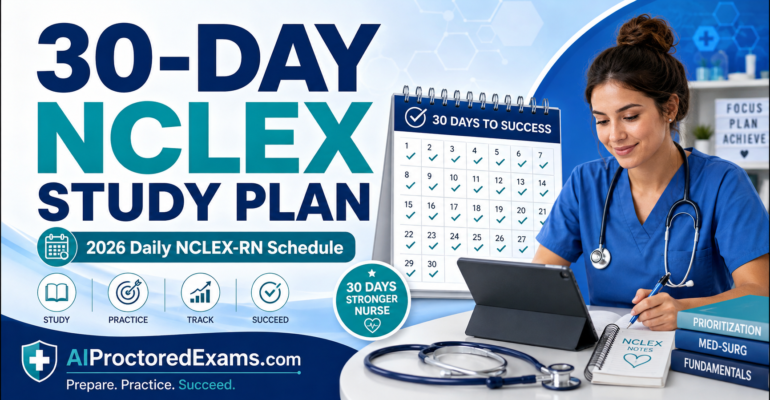

30-Day NCLEX Study Plan 2026: Complete Day-by-Day NCLEX-RN Schedule
Preparing for the NCLEX-RN in one month can feel overwhelming, especially when you consider how much nursing content you covered during nursing school. The key is not trying to relearn everything. Instead, you need a structured plan that combines high-yield content review, NCLEX-style practice questions, clinical judgment, Next Generation NCLEX (NGN) case studies, prioritization, delegation, pharmacology, and consistent review of your weak areas.
This 30-Day NCLEX Study Plan gives you a practical day-by-day schedule for preparing for the NCLEX-RN in 2026.
The plan is aligned with the current 2026 NCLEX-RN Test Plan and is designed to help you move from content review into application, clinical judgment, mixed practice, and final exam readiness.
If you have not already reviewed the complete exam structure, start with the AIProctoredExams 2026 NCLEX-RN Study Guide for a detailed explanation of the exam format, Client Needs categories, NGN questions, clinical judgment, test-taking strategies, and practice questions.
You can also prepare using the 2026 NCLEX-RN Exam Prep Course – Complete Review, Practice Questions & Rationales for structured content review and exam-style question practice.
Can You Prepare for the NCLEX in 30 Days?
Yes, a 30-day NCLEX study schedule can provide a useful preparation framework, particularly for candidates who recently completed nursing school and still have a strong foundation in nursing content.
However, thirty days should not be viewed as a guarantee of passing.
Your readiness depends on factors such as:
- How recently you graduated from nursing school
- Your current nursing knowledge
- Your clinical judgment skills
- Your performance on practice questions
- How much time you can study each day
- Whether you are taking the NCLEX for the first time or retaking it
- Your strongest and weakest content areas
If you are significantly weak in several major areas or have been away from nursing education for an extended period, you may benefit from extending the plan beyond 30 days.
The purpose of this plan is therefore not to cram every nursing textbook into one month. It is to help you use the next 30 days efficiently.
Understanding the 2026 NCLEX-RN Before You Start
Before beginning your study calendar, understand what you are preparing for.
The current NCLEX-RN uses computerized adaptive testing. Candidates receive between 85 and 150 items and have up to five hours to complete the examination, including breaks.
The 2026 NCLEX-RN Test Plan became effective April 1, 2026 and remains effective through March 31, 2029.
The exam is organized around eight Client Needs areas:
| Client Needs Area | 2026 Test Plan Range |
|---|---|
| Management of Care | 15–21% |
| Safety and Infection Prevention and Control | 10–16% |
| Health Promotion and Maintenance | 6–12% |
| Psychosocial Integrity | 6–12% |
| Basic Care and Comfort | 6–12% |
| Pharmacological and Parenteral Therapies | 13–19% |
| Reduction of Risk Potential | 9–15% |
| Physiological Adaptation | 11–17% |
This means your study schedule should not consist entirely of medical-surgical nursing.
You also need meaningful preparation in pharmacology, management of care, safety, infection prevention, health promotion, mental health, fundamental nursing care, risk reduction, and clinical judgment.
For a deeper breakdown of these categories, read the 2026 NCLEX-RN Study Guide.
How to Use This 30-Day NCLEX Study Plan
This schedule works best when each study day includes four activities:
Content Review
Spend time reviewing the day’s major nursing concepts.
Do not try to reread complete textbooks.
Concentrate on high-yield concepts, common conditions, nursing interventions, complications, patient teaching, medication safety, and priority findings.
Practice Questions
Complete NCLEX-style questions related to the material you studied.
For most days, approximately 50–100 carefully reviewed questions can provide substantial practice, although the exact number should depend on your available time and ability to thoroughly review the rationales.
Quality matters more than simply accumulating a large question count.
Rationale Review
Study the explanation for every question you answered incorrectly and any question you answered correctly for the wrong reason.
Ask yourself:
Why is the correct answer correct?
Why are the other options incorrect?
What clue did I miss?
What nursing concept was being tested?
Would I recognize the same concept if the patient scenario were different?
Weak-Area Tracking
Keep a simple NCLEX error log.
Record recurring weaknesses such as:
- Pharmacology
- Delegation
- Prioritization
- Fluid and electrolytes
- Maternal nursing
- Pediatrics
- Therapeutic communication
- Infection control
- Lab interpretation
- NGN case studies
Your error log becomes increasingly important during the final 10 days because it tells you exactly what deserves additional study.
Suggested Daily NCLEX Study Routine
A candidate with approximately three to five hours available could use a routine similar to this:
| Study Activity | Suggested Time |
|---|---|
| Content review | 60–90 minutes |
| Practice questions | 60–90 minutes |
| Rationales and remediation | 60–90 minutes |
| Quick review/error log | 20–30 minutes |
If you have less time because of work, family, or other responsibilities, reduce the question volume rather than skipping rationale review.
Twenty-five thoroughly reviewed questions are more educational than 100 questions completed without understanding your errors.
Week 1: Build Your NCLEX Foundation
The first seven days establish the nursing concepts that affect almost every section of the NCLEX.
The emphasis is on exam strategy, safety, prioritization, delegation, fundamentals, infection prevention, laboratory interpretation, fluids, electrolytes, and pharmacology foundations.
Day 1: Understand the NCLEX and Take a Baseline Assessment
Your first day should establish where you are starting.
Day 1 Content Review
Review:
- NCLEX-RN format
- Computerized adaptive testing
- Client Needs categories
- NGN structure
- Clinical judgment
- Prioritization principles
- Question-reading strategies
Read the complete 2026 NCLEX-RN Study Guide before beginning heavy content review.
Day 1 Practice
Complete a mixed baseline assessment or a substantial mixed set of NCLEX-style questions.
Do not worry if the score is lower than expected.
The goal is diagnosis, not validation.
Day 1 Goal
Identify your three weakest content areas.
Write them at the top of your study tracker because you will revisit them throughout the month.
Day 2: Prioritization and Management of Care
Management of Care is one of the largest components of the 2026 NCLEX-RN Test Plan.
Day 2 Content Review
Study:
- ABC prioritization
- Stable versus unstable patients
- Acute versus chronic conditions
- Expected versus unexpected findings
- Maslow’s hierarchy as a supporting framework
- Patient acuity
- Time-sensitive conditions
- Client rights
- Informed consent
- Continuity of care
- Interdisciplinary collaboration
Day 2 Practice
Complete prioritization and management-of-care questions.
For every question, ask:
Which patient can safely wait?
Which finding represents deterioration?
Which action prevents the greatest immediate harm?
Day 3: Delegation, Assignment and Scope of Practice
Delegation questions can become much easier once you stop memorizing isolated rules and start analyzing the patient and the task.
Day 3 Content Review
Review:
- RN responsibilities
- Practical/vocational nurse responsibilities where applicable
- Assistive personnel responsibilities
- Stable versus unstable patients
- Initial assessment
- Patient teaching
- Evaluation
- Routine predictable tasks
- Supervision
- Assignment principles
Day 3 Practice
Complete delegation and assignment questions.
Before answering, determine:
Does the task require assessment?
Does it require nursing judgment?
Does it involve initial teaching?
Does it involve evaluating a patient’s response?
Is the patient stable?
Day 4: Safety and Infection Prevention
Patient safety influences almost every NCLEX content area.
Day 4 Content Review
Study:
- Standard precautions
- Contact precautions
- Droplet precautions
- Airborne precautions
- PPE
- Hand hygiene
- Sterile technique
- Fall prevention
- Restraints
- Patient identification
- Seizure precautions
- Aspiration precautions
- Medication safety
- Equipment safety
Day 4 Practice
Complete safety and infection-prevention questions.
Pay particular attention to the order in which PPE is used and removed, isolation requirements, hand hygiene situations, fall risks, and preventing treatment-related harm.
Day 5: Fundamentals, Basic Care and Comfort
Fundamental nursing concepts often appear inside complicated-looking scenarios.
Day 5 Content Review
Review:
- Positioning
- Mobility
- Activities of daily living
- Skin integrity
- Pressure injury prevention
- Nutrition
- Hydration
- Elimination
- Hygiene
- Pain management
- Sleep
- Assistive devices
- Enteral feeding principles
Day 5 Practice
Complete Basic Care and Comfort questions.
Do not dismiss fundamental nursing questions as easy. Many assess whether you can recognize aspiration risk, skin injury, fall risk, immobility complications, or unsafe positioning.
Day 6: Fluids, Electrolytes, Laboratory Values and ABGs
These concepts appear across medical-surgical nursing, critical care, renal care, endocrine nursing, pharmacology, and postoperative care.
Day 6 Content Review
Study:
- Sodium
- Potassium
- Calcium
- Magnesium
- Glucose
- Hemoglobin
- Hematocrit
- Platelets
- White blood cells
- Kidney-function concepts
- Fluid overload
- Dehydration
- Acid-base balance
- Basic ABG interpretation
Day 6 Practice
Complete questions requiring you to recognize abnormal findings and determine which result requires priority nursing action.
Do not memorize laboratory values without understanding what an abnormal result means clinically.
Day 7: Pharmacology Foundations
Pharmacological and Parenteral Therapies represents a major portion of the current NCLEX-RN blueprint.
Day 7 Content Review
Focus on medication safety before individual drug classes.
Review:
- Medication rights
- Allergies
- Contraindications
- Drug interactions
- Medication reconciliation
- High-alert medications
- IV therapy
- Blood administration principles
- Medication calculations
- Patient teaching
- Adverse-effect recognition
Day 7 Practice
Complete mixed pharmacology questions.
Create a medication notebook organized by drug class rather than by individual medication name.
Week 2: Master High-Yield Adult Health and Pharmacology
Week 2 focuses on the major body systems and medications commonly integrated into NCLEX clinical scenarios.
Day 8: Cardiovascular Nursing
Day 8 Content Review
Study:
- Heart failure
- Acute coronary syndromes
- Hypertension
- Dysrhythmia concepts
- Shock
- Perfusion
- Peripheral vascular conditions
- Cardiac procedures
- Anticoagulation safety
- Cardiovascular medications
Day 8 Priority Focus
Know which findings suggest:
- Reduced cardiac output
- Poor tissue perfusion
- Acute deterioration
- Bleeding
- Fluid overload
Day 8 Practice
Complete cardiovascular and cardiac pharmacology questions.
Day 9: Respiratory Nursing
Day 9 Content Review
Review:
- Asthma
- COPD
- Pneumonia
- Pulmonary embolism
- Respiratory failure
- Oxygen administration
- Airway management
- Mechanical ventilation concepts
- Chest tubes
- Tracheostomy care
- Pulmonary hygiene
Day 9 Priority Focus
Ask:
Is the airway open?
Is ventilation adequate?
Is oxygenation deteriorating?
Is this expected for the patient’s condition?
Day 9 Practice
Complete respiratory priority and clinical-judgment questions.
Day 10: Neurological Nursing
Day 10 Content Review
Study:
- Stroke
- Seizures
- Increased intracranial pressure
- Head injury
- Spinal cord injury
- Changes in level of consciousness
- Neurological assessments
- Safety precautions
- Relevant medications
Day 10 Priority Focus
Pay attention to sudden neurological changes.
A new change in consciousness, speech, movement, pupil response, or neurological status may require rapid intervention.
Day 11: Renal and Urinary Nursing
Day 11 Content Review
Review:
- Acute kidney injury
- Chronic kidney disease
- Hemodialysis
- Peritoneal dialysis
- Fluid balance
- Urinary tract disorders
- Intake and output
- Renal laboratory findings
- Electrolyte complications
Day 11 Practice
Combine renal questions with fluid, electrolyte, and medication questions.
Day 12: Endocrine Nursing
Day 12 Content Review
Study:
- Diabetes mellitus
- Hypoglycemia
- Hyperglycemia
- Diabetic ketoacidosis
- Hyperosmolar states
- Thyroid disorders
- Adrenal disorders
- Insulin concepts
- Steroid therapy considerations
Day 12 Practice
Focus on distinguishing routine endocrine management from acute endocrine emergencies.
Day 13: Gastrointestinal and Hepatic Nursing
Day 13 Content Review
Review:
- GI bleeding
- Peptic ulcer disease
- Bowel obstruction
- Pancreatitis
- Liver disease
- Ostomy care
- Enteral feeding
- Nutrition
- Abdominal surgery
- Postoperative GI complications
Day 13 Practice
Practice identifying bleeding, perforation, obstruction, aspiration, fluid imbalance, and postoperative deterioration.
Day 14: Pharmacology Intensive Review
Return to pharmacology after reviewing several body systems.
Day 14 Content Review
Organize medications into major classes:
- Cardiovascular medications
- Anticoagulants
- Diuretics
- Respiratory medications
- Insulin and endocrine drugs
- Anti-infective agents
- Analgesics
- Neurological medications
- Psychiatric medications
For each drug class, know:
- Why it is given.
- What you assess before administration.
- Major adverse effects.
- Important laboratory or clinical monitoring.
- Essential patient teaching.
Day 14 Practice
Complete a pharmacology-heavy mixed question set and review every rationale carefully.
Week 3: Maternal Nursing, Pediatrics, Mental Health and NGN
Week 3 expands beyond adult medical-surgical nursing and puts greater emphasis on clinical judgment.
Day 15: Maternal Nursing – Pregnancy and Antepartum Care
Day 15 Content Review
Study:
- Normal pregnancy changes
- Prenatal care
- Pregnancy warning signs
- Hypertensive disorders
- Gestational diabetes
- Bleeding during pregnancy
- Prenatal education
- Fetal assessment concepts
Day 15 Practice
Focus on recognizing expected versus dangerous pregnancy findings.
Day 16: Labor, Delivery, Postpartum and Newborn Care
Day 16 Content Review
Review:
- Stages of labor
- Fetal monitoring concepts
- Labor complications
- Postpartum hemorrhage
- Postpartum assessment
- Newborn assessment
- Newborn safety
- Breastfeeding concepts
- Maternal-newborn teaching
Day 16 Priority Focus
Know which maternal and newborn findings require immediate intervention.
Day 17: Pediatric Nursing
Day 17 Content Review
Study:
- Growth and development
- Developmental milestones
- Pediatric safety
- Respiratory problems
- Dehydration
- Congenital conditions
- Medication safety
- Family-centered care
- Childhood illness
- Age-appropriate communication
Day 17 Practice
Pay attention to differences between normal developmental findings and findings that indicate deterioration.
Day 18: Mental Health and Therapeutic Communication
Day 18 Content Review
Review:
- Depression
- Anxiety
- Psychosis
- Bipolar disorders
- Substance-related conditions
- Crisis intervention
- Grief
- Therapeutic communication
- Patient safety
- Psychiatric medications
Day 18 Communication Strategy
Look for answers that encourage communication without:
- Judging
- Giving false reassurance
- Changing the subject
- Asking unnecessary “why” questions
- Minimizing feelings
Patient safety remains the priority when there is an immediate risk of harm.
Day 19: Emergency and Critical-Care Concepts
Day 19 Content Review
Study:
- Shock
- Sepsis
- Hemorrhage
- Respiratory emergencies
- Cardiac emergencies
- Stroke
- Burns
- Trauma principles
- Acute changes in consciousness
- Emergency prioritization
Day 19 Practice
Complete multi-patient prioritization questions.
Ask which patient is unstable and whose condition could worsen rapidly without intervention.
Day 20: Next Generation NCLEX and Clinical Judgment
NGN preparation should now become a major focus.
Day 20 Review the Six Clinical Judgment Steps
Know how to:
- Recognize cues.
- Analyze cues.
- Prioritize hypotheses.
- Generate solutions.
- Take action.
- Evaluate outcomes.
Day 20 Practice
Complete unfolding NGN case studies rather than only stand-alone questions.
For each case study, track how the patient’s condition changes as new information becomes available.
Day 21: NGN Case Study Intensive
Today is primarily an application day.
Day 21 Practice
Complete several NGN-style case studies.
Slow down enough to identify:
- Relevant cues
- Irrelevant data
- Trends
- Changes from baseline
- Priority hypotheses
- Safe interventions
- Expected outcomes
Day 21 Remediation
Write down every cue you overlooked.
This is one of the best ways to improve clinical judgment because many NGN mistakes occur when the candidate fails to recognize the significance of available information.
Week 4: Mixed Practice, Weak Areas and Exam Readiness
The final portion of your 30-day NCLEX study plan should gradually shift away from learning large amounts of new content.
The priority becomes application, mixed practice, remediation, endurance, and correcting recurring weaknesses.
Day 22: Mixed NCLEX Practice Day
Complete mixed questions across all Client Needs areas.
Avoid selecting only your favorite subjects.
Day 22 Goal
Practice moving rapidly between topics.
One question may involve pharmacology.
The next may involve pediatrics.
The next may involve delegation.
The next may involve mental health.
That unpredictability better reflects the cognitive flexibility required during the examination.
Day 23: Weak Area #1
Return to the weakest subject identified in your error log.
Day 23 Strategy
Spend approximately half of your study session reviewing the content and the other half answering targeted questions.
Do not simply reread notes.
Force yourself to apply the material immediately.
Day 24: Weak Area #2
Repeat the same process with your second weakest category.
Day 24 Questions to Ask Yourself
What mistakes keep repeating?
Am I missing content?
Am I failing to recognize cues?
Am I changing correct answers unnecessarily?
Am I rushing?
Am I misunderstanding prioritization?
Am I weak in pharmacology related to this topic?
Fix the reason behind the error, not just the individual question.
Day 25: Weak Area #3
Address your third major weakness.
Then complete a smaller mixed set at the end of the session to ensure you can transition between subjects.
Day 26: Prioritization, Delegation and Safety Review
Return to three of the most transferable NCLEX skills:
Prioritization
Practice determining who requires immediate attention.
Delegation
Practice matching patient stability and task complexity with the appropriate member of the nursing team.
Safety
Practice identifying interventions that prevent immediate patient harm.
Complete a large targeted set combining these concepts.
Day 27: Comprehensive Mixed Practice
Today should resemble an examination-training day.
Complete a substantial mixed set containing:
- Adult health
- Pharmacology
- Maternal nursing
- Pediatrics
- Mental health
- Management of Care
- Safety
- NGN clinical judgment
Review all rationales afterward.
The AIProctoredExams NCLEX-RN preparation course can be used for additional structured content review and practice-question work.
Day 28: Final Content Remediation
Do not try to review the entire nursing curriculum again.
Use your error log.
Day 28 Review
Focus only on concepts you continue to miss, such as:
- Electrolytes
- Insulin
- Isolation precautions
- Delegation
- Maternity emergencies
- Pediatric development
- Psychiatric medications
- Anticoagulants
- Cardiac medications
- Priority assessment findings
Your final days should become increasingly personalized.
Day 29: Light Mixed Practice and Exam Strategy
Reduce the intensity slightly.
Day 29 Review
Review:
- Priority frameworks
- Delegation principles
- Infection prevention
- Major medication risks
- Critical laboratory trends
- Clinical judgment steps
- Common errors from your question bank
- NCLEX test-day procedures
Complete a moderate mixed question set.
Do not attempt to learn several brand-new systems at this stage.
Day 30: Final NCLEX Preparation Day
Your final day should not be a 12-hour cram session.
The goal is to arrive at the examination rested enough to think clearly.
Day 30 Study
Keep review light.
Read:
- Your error log
- High-yield medication notes
- Priority concepts
- Safety reminders
- Clinical judgment steps
- A small collection of concepts you frequently forget
Day 30 Practical Preparation
Confirm:
- Your examination appointment
- Required identification
- Testing-center location
- Travel arrangements
- Arrival requirements
- Current official NCLEX candidate instructions
Use official NCLEX information for examination-day rules and procedures.
Avoid depending on old social-media posts for testing-center requirements because exam procedures can change.
30-Day NCLEX Study Plan at a Glance
| Day | Main Study Focus |
|---|---|
| 1 | NCLEX format + baseline assessment |
| 2 | Prioritization + Management of Care |
| 3 | Delegation + assignment |
| 4 | Safety + infection prevention |
| 5 | Fundamentals + Basic Care and Comfort |
| 6 | Labs + fluids + electrolytes + ABGs |
| 7 | Pharmacology foundations |
| 8 | Cardiovascular |
| 9 | Respiratory |
| 10 | Neurological |
| 11 | Renal |
| 12 | Endocrine |
| 13 | GI + hepatic |
| 14 | Pharmacology intensive |
| 15 | Pregnancy + antepartum |
| 16 | Labor + postpartum + newborn |
| 17 | Pediatrics |
| 18 | Mental health |
| 19 | Emergency + critical care |
| 20 | NGN + clinical judgment |
| 21 | NGN case studies |
| 22 | Mixed NCLEX practice |
| 23 | Weak area #1 |
| 24 | Weak area #2 |
| 25 | Weak area #3 |
| 26 | Priority + delegation + safety |
| 27 | Comprehensive mixed practice |
| 28 | Final remediation |
| 29 | Light mixed practice + strategy |
| 30 | Final light review + exam preparation |
How Many NCLEX Questions Should You Answer During the 30 Days?
There is no official number of practice questions that guarantees NCLEX success.
A reasonable study program should emphasize both volume and remediation.
For example, if you average 50 questions on 20 study-intensive days, you would complete approximately 1,000 practice questions.
At 75 questions, you would complete approximately 1,500.
At 100 questions, you would complete approximately 2,000.
But question totals alone can be misleading.
The more important question is:
How many questions did you truly learn from?
After every session, analyze incorrect answers and uncertain correct answers.
A strong review method is:
Question → Answer → Rationale → Identify the knowledge gap → Review the concept → Practice it again later.
Should You Study Every Day for 30 Days?
You should study consistently, but recovery matters.
This plan deliberately varies intensity.
Some days involve heavier content and practice, while the final day is intentionally lighter.
If you become mentally exhausted, a shorter high-quality study session may be more productive than forcing yourself through hundreds of questions without concentrating.
Consistency is the goal.
Exhaustion is not.
How to Study for NCLEX While Working Full Time
If you are working while preparing for the NCLEX, modify the schedule rather than abandoning it.
On Workdays
Consider:
- 30–45 minutes of focused content review
- 25–50 questions
- Rationale review
- Brief error-log update
On Days Off
Use longer sessions for:
- Major content areas
- NGN case studies
- Comprehensive mixed quizzes
- Pharmacology
- Weak-area remediation
You do not need to follow the exact question volume of someone studying full time.
You need consistency and meaningful learning.
How to Use Practice Question Rationales Properly
Reading rationales is one of the most important parts of NCLEX preparation.
When You Answer Incorrectly
Determine why.
Was the problem:
- Lack of content knowledge?
- Failure to notice a cue?
- Poor prioritization?
- Medication knowledge?
- Scope-of-practice confusion?
- Reading the question too quickly?
- Changing your original answer?
- Applying an absolute rule incorrectly?
When You Answer Correctly
Ask whether you truly knew why.
A lucky guess should still be reviewed.
Review Incorrect Options
Understanding why distractors are wrong can make you less likely to choose similar distractors later.
How to Improve NCLEX Clinical Judgment in 30 Days
Clinical judgment cannot be developed by memorizing lists alone.
When you review a patient scenario, repeatedly ask:
What Matters?
Identify relevant assessment findings, laboratory results, medications, history, vital signs, and patient statements.
What Does It Mean?
Connect the cues.
Do several findings suggest the same clinical problem?
What Is Most Important?
Prioritize the potential problems according to urgency and risk.
What Can the Nurse Do?
Generate safe nursing interventions appropriate to the situation.
What Should Happen First?
Select the priority action.
Did It Work?
Determine what patient findings would demonstrate improvement or deterioration.
Repeating this process makes clinical judgment part of your normal question-solving method rather than something you use only on obvious NGN questions.
Common Mistakes During a 30-Day NCLEX Study Plan
Trying to Study Everything
You cannot reread all of nursing school in 30 days.
Prioritize the current NCLEX blueprint and your weak areas.
Using Too Many Resources
Switching constantly between multiple question banks, videos, books, apps, and study guides can create unnecessary confusion.
Choose a core study system and use it consistently.
AIProctoredExams provides a dedicated NCLEX-RN course containing structured nursing review and question practice.
You can also browse additional AIProctoredExams Study Guides and NCLEX-RN resources.
Ignoring Rationales
Question volume without remediation creates an illusion of studying.
Study the explanations.
Avoiding Difficult Topics
If pharmacology is your weakest subject, studying pediatrics repeatedly because you enjoy it will not fix the problem.
Your error log should determine part of your schedule.
Memorizing Practice Questions
NCLEX preparation should develop transferable reasoning.
Learn concepts rather than remembering that “option B was correct last time.”
Ignoring NGN Until the Final Week
Clinical judgment should be practiced throughout your preparation.
Start with smaller clinical-judgment exercises and increase NGN case-study practice during Weeks 3 and 4.
Studying Until Exhaustion
Longer is not automatically better.
Effective NCLEX preparation requires concentration.
How Do You Know Whether You Are Improving?
Do not judge progress from a single quiz.
Look for trends.
Signs of improvement include:
- Fewer repeated mistakes
- Better recognition of patient deterioration
- Stronger prioritization
- Improved delegation decisions
- Better medication safety reasoning
- More accurate identification of relevant cues
- Greater comfort with NGN case studies
- Better ability to explain why an answer is correct
- Improved performance across mixed topics
Your goal is not simply to feel more confident.
Your goal is to demonstrate increasingly consistent nursing judgment.
What Should You Do If You Fall Behind?
Do not try to squeeze three missed study days into one exhausting session.
Prioritize.
For example, if you miss Day 10, you can integrate neurological review into your weak-area days rather than destroying the entire schedule.
Protect the core elements of your preparation:
- Current NCLEX blueprint.
- High-yield content.
- Practice questions.
- Rationales.
- Clinical judgment.
- Weak-area remediation.
- Mixed practice.
The schedule should serve you.
You should not become a prisoner of the schedule.
Frequently Asked Questions About a 30-Day NCLEX Study Plan
Is 30 Days Enough to Study for the NCLEX-RN?
Thirty days can provide a focused preparation period for candidates who already possess a reasonable nursing knowledge foundation.
Candidates requiring substantial content remediation may need additional preparation time.
How Many Hours a Day Should I Study for NCLEX?
There is no single required number.
Many candidates can build a productive schedule around approximately three to five focused hours on intensive study days, while candidates working full time may need shorter sessions and more strategic use of days off.
Quality and consistency matter more than simply counting hours.
Should I Study Content or Do NCLEX Questions?
Do both.
Content review builds knowledge.
Practice questions teach you to apply that knowledge.
Rationale review connects the two.
Should I Do NCLEX Questions Every Day?
Most study days in a 30-day plan should contain some form of question practice.
However, the question count can vary based on the topic, available time, and need for remediation.
Should I Study Pharmacology Every Day?
You do not need a full pharmacology session every day, but repeated pharmacology exposure can be useful.
When studying cardiovascular nursing, review relevant cardiovascular medications.
When studying endocrine nursing, integrate insulin and endocrine drugs.
When studying mental health, review major psychiatric medication concepts.
This creates spaced exposure rather than trying to memorize pharmacology during a single session.
When Should I Start NGN Questions?
Start early.
NGN and clinical judgment are part of the current NCLEX-RN examination structure, so case-study reasoning should not be saved exclusively for your last few study days.
What Should I Study the Day Before the NCLEX?
Keep study relatively light.
Review concise notes, high-yield safety concepts, common mistakes, clinical judgment, and practical exam information.
Avoid trying to learn an entirely new nursing subject.
Can I Use AIProctoredExams for My 30-Day NCLEX Plan?
Yes. You can combine this schedule with the 2026 NCLEX-RN Exam Prep Course – Complete Review, Practice Questions & Rationales.
You can also explore the NCLEX-RN course category, browse Study Guides, or learn How AIProctoredExams Works.
Final 30-Day NCLEX Study Checklist
Before completing your 30-day preparation period, make sure you have reviewed:
- The current NCLEX-RN exam structure
- All eight Client Needs areas
- Prioritization
- Delegation
- Patient safety
- Infection prevention
- Pharmacology
- Major adult-health systems
- Fluids and electrolytes
- Laboratory interpretation
- Maternal-newborn nursing
- Pediatrics
- Mental health
- Emergency nursing concepts
- NGN clinical judgment
- Unfolding case studies
- Your three weakest areas
- Mixed NCLEX-style practice
- Question rationales
- Examination-day requirements
Start Your 30-Day NCLEX-RN Preparation Today
Thirty days can pass quickly.
The most productive way to use that time is to stop thinking of NCLEX preparation as an enormous list of facts that must be memorized.
Instead, work systematically.
Build your foundation.
Strengthen high-yield content.
Practice pharmacology.
Review the major body systems.
Develop prioritization and delegation skills.
Practice NGN clinical judgment.
Track your mistakes.
Correct recurring weaknesses.
Then transition into increasingly mixed practice as your examination approaches.
For a broader explanation of the current exam, continue with the 2026 NCLEX-RN Study Guide: Exam Format, Test Plan, NGN Questions, Study Plan & Practice Questions.
For structured review and additional question practice, explore the 2026 NCLEX-RN Exam Prep Course.
You can also browse all NCLEX-RN preparation resources or explore the wider AIProctoredExams Study Guides.
A successful 30-day NCLEX plan is not about studying everything.
It is about studying the right material consistently, applying what you learn, understanding your mistakes, and developing the clinical judgment needed to make safe entry-level nursing decisions.
Important Educational Disclaimer
AIProctoredExams is an independent exam-preparation platform and is not affiliated with or endorsed by NCSBN, NCLEX, Pearson VUE, or any nursing regulatory body. NCLEX® and NCLEX-RN® are registered trademarks of the National Council of State Boards of Nursing, Inc. Study schedules and practice materials are educational resources and do not guarantee a passing examination result. Candidates should verify current examination rules, eligibility requirements, scheduling information, and test-day procedures through official NCLEX and nursing regulatory body sources.