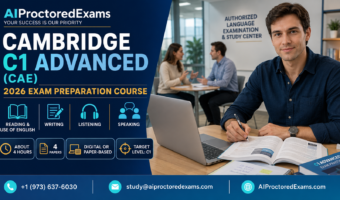
Cambridge C1 Advanced (CAE) 2026 Exam Preparation Course
About This Course
Prepare for Cambridge C1 Advanced with Confidence
The Cambridge C1 Advanced (CAE) 2026 Exam Preparation Course is an in-depth preparation program for learners who need to demonstrate advanced English proficiency for university study, professional development, employment or international opportunities.
Formerly known as Cambridge English: Advanced or CAE, C1 Advanced is targeted at Level C1 of the Common European Framework of Reference for Languages. It assesses whether candidates can understand demanding academic and professional texts, communicate complex ideas, write for different purposes and participate effectively in advanced spoken interactions.
This Cambridge C1 Advanced exam preparation course provides structured instruction for all four examination papers:
-
Reading and Use of English
-
Writing
-
Listening
-
Speaking
Students receive detailed instruction on every current task, advanced grammar and vocabulary development, guided response strategies, timed practice, writing support, paired-speaking activities and realistic mock examinations.
Candidates can explore related programs through the AIProctoredExams English Tests category or visit the dedicated Cambridge C1 Advanced course category.
About Cambridge C1 Advanced
Cambridge C1 Advanced is a high-level English qualification designed for candidates who can use English effectively in academic, professional and social settings.
A learner operating at C1 level should generally be able to:
-
Understand long and linguistically demanding texts
-
Recognize implied meaning, attitude and purpose
-
Communicate fluently without excessive searching for words
-
Use English flexibly in academic and professional environments
-
Produce clear and well-organized extended writing
-
Develop and support complex arguments
-
Adapt language to different audiences and purposes
-
Participate effectively in discussions and negotiations
The official Cambridge C1 Advanced overview states that the examination can be taken in either digital or paper-based form. Both formats lead to the same qualification and use the same examination structure.
The complete examination takes approximately four hours, although papers and the Speaking test may be scheduled separately by the authorized examination center.
Current C1 Advanced Exam Format
According to the official C1 Advanced exam-format guide, the examination contains four papers.
Reading and Use of English
-
Time allowed: 1 hour 30 minutes
-
Number of parts: 8
-
Number of questions: 56
-
Approximate reading volume: 3,000–3,500 words
Writing
-
Time allowed: 1 hour 30 minutes
-
Number of parts: 2
-
Required responses: 2
-
Recommended length: 220–260 words per response
Listening
-
Time allowed: Approximately 40 minutes
-
Number of parts: 4
-
Number of questions: 30
-
Recording policy: Each recording is played twice
Speaking
-
Time allowed: Approximately 15 minutes for a pair of candidates
-
Group-of-three timing: Approximately 23 minutes
-
Number of parts: 4
-
Format: Usually completed with another candidate and two examiners
The Cambridge C1 Advanced exam preparation course develops the language ability and examination techniques needed for each paper.
Reading and Use of English Preparation
The Reading and Use of English paper assesses advanced reading comprehension, grammatical control, vocabulary, collocation, word formation, textual organization and the interpretation of opinion and implied meaning.
Candidates must complete 56 questions within 90 minutes. Effective preparation therefore requires both language accuracy and careful time management.
Reading and Use of English Part 1: Multiple-Choice Cloze
Candidates read a passage containing eight numbered gaps. Four options are provided for each gap, and the candidate selects the word or phrase that best completes the text.
This part focuses heavily on:
-
Collocations
-
Fixed expressions
-
Phrasal verbs
-
Idiomatic language
-
Vocabulary distinctions
-
Dependent prepositions
-
Contextual meaning
-
Appropriate register
The course teaches students to analyze complete phrases instead of selecting a word solely because its general meaning appears appropriate.
Candidates practise recognizing differences between near-synonyms and identifying which option forms a natural English expression with the surrounding words.
Reading and Use of English Part 2: Open Cloze
Open Cloze presents a text with eight gaps. Candidates must supply one appropriate word for each gap without choosing from a list of options.
The task frequently assesses grammatical and structural words such as:
-
Articles
-
Auxiliary verbs
-
Conjunctions
-
Determiners
-
Modal verbs
-
Prepositions
-
Pronouns
-
Relative words
-
Quantifiers
-
Linking expressions
Students learn to read the complete sentence, determine the grammatical function of the missing word and check how the answer connects ideas across the passage.
Reading and Use of English Part 3: Word Formation
Candidates receive a passage with eight gaps and a base word beside each gap. They must change the base word into the correct form.
The Cambridge C1 Advanced exam preparation course develops knowledge of:
-
Prefixes and suffixes
-
Noun, verb, adjective and adverb forms
-
Negative word formation
-
Singular and plural forms
-
Changes in spelling
-
Compound words
-
Less common derivatives
-
Word-family relationships
Candidates also learn to check whether the required word must express a positive, negative or opposite meaning.
Reading and Use of English Part 4: Key Word Transformations
Key Word Transformations test advanced grammar, vocabulary and paraphrasing. Candidates rewrite a sentence using a given key word while preserving the original meaning.
The key word cannot be changed, and the completed section must contain between three and six words.
The course provides intensive practice with:
-
Passive structures
-
Reported speech
-
Inversion
-
Conditionals
-
Modal verbs
-
Causative structures
-
Comparative structures
-
Gerunds and infinitives
-
Phrasal verbs
-
Fixed expressions
-
Emphasis and cleft sentences
-
Wishes and regrets
-
Verb patterns
-
Advanced collocations
Students learn to identify the tested structure before attempting to complete the sentence. They also practise counting words carefully and checking whether the meaning remains unchanged.
Reading and Use of English Part 5: Multiple Choice
Candidates read a longer text and answer six four-option multiple-choice questions.
Questions may assess:
-
Main ideas
-
Supporting details
-
Purpose
-
Tone
-
Attitude
-
Opinion
-
Implication
-
Text organization
-
The meaning of words in context
The course teaches evidence-based answer selection. Students learn to locate the relevant section, interpret paraphrased information and eliminate options that distort or exaggerate the writer’s position.
Reading and Use of English Part 6: Cross-Text Multiple Matching
Candidates read four short texts connected by a common theme. They then compare the writers’ opinions, attitudes or conclusions.
This is not a simple information-location task. Candidates must understand how one writer’s position relates to another writer’s view.
Students practise identifying:
-
Agreement and disagreement
-
Qualified support
-
Criticism
-
Reservations
-
Contrasting explanations
-
Similar conclusions reached through different reasoning
-
Changes in tone or emphasis
The course develops careful comparative reading and teaches candidates to summarize each writer’s position before answering the questions.
Reading and Use of English Part 7: Gapped Text
A longer passage is presented with six missing paragraphs. Candidates select the paragraph that best fits each gap. One extra paragraph is provided.
Successful performance depends on understanding textual cohesion and development.
Students learn to analyze:
-
Pronoun references
-
Linking expressions
-
Repeated vocabulary
-
Chronological development
-
Cause-and-effect relationships
-
Contrast and concession
-
Topic progression
-
Examples and explanations
-
Paragraph openings and conclusions
Rather than relying only on matching vocabulary, candidates learn to examine how the ideas before and after each gap connect.
Reading and Use of English Part 8: Multiple Matching
Candidates match ten statements to sections of one text or several shorter texts.
This task assesses the ability to locate specific information, recognize opinion, interpret attitude and understand paraphrased details.
The course teaches efficient scanning, key-idea annotation and the identification of synonyms and paraphrases. Students also learn that the relevant text may be used more than once.
C1 Advanced Writing Preparation
The Writing paper lasts 90 minutes and requires candidates to produce two texts of 220–260 words each.
Responses are assessed according to criteria that include:
-
Content
-
Communicative achievement
-
Organization
-
Language
Candidates must answer every part of the task, use an appropriate style, organize the response logically and demonstrate a range of accurate C1-level vocabulary and grammatical structures.
Writing Part 1: Compulsory Essay
Part 1 requires every candidate to write an essay. The prompt provides several ideas connected to a topic. Candidates discuss two of the provided points, evaluate their importance and explain which one is more significant.
The course teaches students how to:
-
Analyze the exact essay question
-
Select the strongest points
-
Develop a clear position
-
Compare and evaluate ideas
-
Support arguments with explanations
-
Use relevant examples
-
Create logical paragraph progression
-
Maintain an appropriately formal style
-
Write an effective introduction and conclusion
-
Remain within the required word range
Students learn to avoid simply repeating the notes in the prompt. Instead, they develop each selected point using original reasoning and relevant support.
Writing Part 2: Choice of Task
Part 2 provides three questions, and candidates answer one. The possible text types include:
-
Letter or email
-
Proposal
-
Report
-
Review
Every task specifies the context, purpose and intended reader. Therefore, candidates must adapt their language, organization and level of formality.
Letters and Emails
Students learn appropriate openings, closings, paragraphing and register for formal, neutral and less formal communication. Practice tasks include requesting information, making recommendations, explaining a situation and responding to another person’s message.
Proposals
Proposal writing requires clear recommendations about future action. Candidates learn to use headings, evaluate alternatives, explain potential benefits and persuade the target reader.
Reports
Reports present and evaluate information in a clear, objective structure. Students practise using headings, summarizing findings, analyzing strengths and weaknesses and making practical recommendations.
Reviews
Reviews require description, evaluation and recommendation. Candidates learn how to engage the reader while maintaining clear organization and supporting judgments with specific reasons.
The course includes model texts, planning templates, editing checklists and assessment rubrics based on the official task requirements. Cambridge also provides a detailed official C1 Advanced writing guide.
C1 Advanced Listening Preparation
The Listening paper takes approximately 40 minutes and contains 30 questions across four parts. Each recording is played twice.
Candidates hear materials such as:
-
Interviews
-
Conversations
-
Discussions
-
Lectures
-
Radio broadcasts
-
Speeches
-
Presentations
-
Anecdotes
-
Informational talks
The Cambridge C1 Advanced exam preparation course develops the ability to understand gist, detailed information, attitude, opinion, purpose, agreement, feeling and implied meaning.
Listening Part 1: Multiple Choice
Candidates hear three short extracts involving interacting speakers. Two three-option questions accompany each extract.
Students practise identifying:
-
Speaker relationships
-
Attitudes and emotions
-
Reasons for speaking
-
Agreement and disagreement
-
Opinions and reactions
-
Intended future actions
-
The function of particular statements
The course emphasizes listening for meaning rather than selecting an answer simply because it repeats words from the recording.
Listening Part 2: Sentence Completion
Candidates listen to a monologue lasting approximately three minutes and complete eight sentences using information from the recording.
Students develop rapid note-taking, prediction and spelling accuracy. They also learn to use the wording around each gap to anticipate whether the missing answer should be a person, place, number, object, action or descriptive phrase.
Listening Part 3: Multiple Choice
Candidates listen to a conversation involving two or more speakers and answer six four-option multiple-choice questions.
The questions assess detailed understanding, attitude, agreement, purpose and implied meaning. Candidates learn to follow changes of opinion and distinguish one speaker’s view from another’s.
Listening Part 4: Multiple Matching
Candidates hear five short monologues connected by a common theme. Two matching tasks must be completed at the same time.
One task may focus on why each person is speaking, while another may assess opinions, feelings, experiences or outcomes.
The course teaches students how to preview both sets of options, create quick annotations and track two categories of information without confusing the speakers.
C1 Advanced Speaking Preparation
The Speaking test normally involves two candidates and two examiners. One examiner conducts the interaction, while the other listens and assesses the candidates.
Candidates are evaluated on areas such as:
-
Grammar and vocabulary
-
Discourse management
-
Pronunciation
-
Interactive communication
-
Overall performance
The objective is not to speak with one particular accent. Candidates need to communicate clearly, organize their ideas and respond appropriately to both the examiner and the other candidate.
Speaking Part 1: Interview
The examiner asks candidates questions about areas such as their studies, employment, interests, experiences and opinions.
The course helps students expand short answers naturally by adding a reason, example or relevant detail. Candidates also practise responding directly without delivering memorized speeches.
Speaking Part 2: Long Turn
Each candidate receives three photographs and speaks about two of them for approximately one minute. The task normally requires comparison, speculation or evaluation rather than simple description.
After the long turn, the other candidate gives a brief response lasting approximately 30 seconds.
Students learn to:
-
Select two photographs quickly
-
Address both questions in the prompt
-
Compare rather than describe separately
-
Speculate using appropriate language
-
Organize a one-minute response
-
Continue speaking without excessive hesitation
-
Listen carefully to the other candidate
-
Give a concise follow-up response
Speaking Part 3: Collaborative Task
Candidates receive written prompts and discuss them together for approximately two minutes. They then answer an additional question requiring them to reach a decision within approximately one minute.
The course teaches genuine interaction skills, including:
-
Inviting the other candidate to contribute
-
Responding to another person’s idea
-
Agreeing and disagreeing politely
-
Comparing alternatives
-
Speculating
-
Evaluating advantages and disadvantages
-
Negotiating
-
Reaching a joint decision
Students learn that dominating the conversation or delivering separate monologues does not demonstrate effective collaborative communication.
Speaking Part 4: Discussion
The examiner asks broader questions connected to the topic from Part 3. Candidates discuss these ideas with each other and the examiner.
Part 4 requires more developed opinions, justification, evaluation and speculation. Students practise introducing an argument, supporting it with examples, considering another perspective and responding thoughtfully to disagreement.
Understanding C1 Advanced Scores
C1 Advanced results are reported using the Cambridge English Scale. Candidates receive an overall score as well as individual scores for:
-
Reading
-
Use of English
-
Writing
-
Listening
-
Speaking
Each skill and Use of English is equally weighted. The overall score is calculated by adding the five individual scores and dividing the total by five.
Current score interpretation is:
| Cambridge English Scale score | Result | CEFR level |
|---|---|---|
| 200–210 | Grade A | C2 |
| 193–199 | Grade B | C1 |
| 180–192 | Grade C | C1 |
| 160–179 | Level B2 | B2 |
| 142–159 | Score reported without a certificate | Below the certifying range |
Candidates receiving Grade A are awarded a certificate showing demonstrated ability at Level C2. Grade B and Grade C candidates receive a C1 certificate. Candidates scoring between 160 and 179 receive a certificate showing achievement at Level B2.
The current result bands can be confirmed on the official Cambridge English Qualifications results page.
Digital and Paper-Based C1 Advanced
The examination format, task types and qualification are the same for digital and paper-based candidates.
Digital candidates complete Reading and Use of English, Writing and Listening using a computer. Paper-based candidates complete these papers using printed question and answer materials. The Speaking test remains an interactive examination involving other people.
This course prepares candidates for both delivery methods. Digital candidates practise typing, screen reading, answer navigation and on-screen editing. Paper-based candidates practise handwriting, answer transfer and accurate use of answer sheets.
Students can access official digital and paper sample materials through the Cambridge C1 Advanced preparation page.
Results and Certificate Validity
Cambridge states that digital examination results are normally available approximately 5–10 working days after the examination session. Paper-based results are generally available approximately 4–6 weeks after the session.
The Cambridge English result and certificate are valid indefinitely. However, an individual university, employer, government agency or professional organization may require evidence obtained within a specific period. Candidates should always confirm the receiving organization’s policy.
Current information is available through the official guidance on Cambridge English certificate validity.
Preparation Pathway
The Cambridge C1 Advanced exam preparation course follows a progressive study structure.
Diagnostic assessment: Candidates evaluate their current Reading, Use of English, Writing, Listening and Speaking performance.
Advanced language development: Students strengthen grammar, vocabulary, collocation, word formation, idiomatic language and register.
Task familiarization: Every examination part is introduced through clear instructions, examples and guided practice.
Skills development: Candidates build reading speed, listening accuracy, written organization and spoken interaction.
Timed practice: Students complete individual tasks and complete papers under official time limits.
Performance analysis: Errors are classified according to language weakness, task misunderstanding or time-management difficulty.
Mock examinations: Full simulations develop endurance, pacing and confidence for approximately four hours of assessment.
Final review: Candidates use personalized checklists and performance records to focus on weaker areas before examination day.
Common Mistakes Addressed
The course helps candidates correct mistakes such as:
-
Selecting vocabulary based only on general meaning instead of collocation
-
Supplying more than one word in an Open Cloze gap
-
Ignoring negative prefixes in Word Formation
-
Changing the given word during Key Word Transformations
-
Writing more or fewer than the required transformation words
-
Matching paragraphs through repeated vocabulary alone
-
Failing to answer every part of a Writing prompt
-
Using the wrong register for a report, proposal, review or email
-
Spending too much time on one Reading and Use of English section
-
Copying complete phrases from a listening recording without checking grammar
-
Describing photographs without comparing them
-
Giving memorized Speaking answers that do not address the question
-
Dominating or withdrawing from the collaborative speaking discussion
-
Reaching a Part 3 decision without evaluating the options
-
Failing to support opinions during the Part 4 discussion
Who Should Enrol?
This course is suitable for:
-
Students applying to universities that accept C1 Advanced
-
Professionals who need evidence of advanced English proficiency
-
Candidates preparing for digital or paper-based C1 Advanced
-
Learners progressing from Cambridge B2 First
-
Candidates retaking C1 Advanced to improve their result
-
Teachers and other professionals working in English-speaking environments
-
Advanced learners seeking structured C1-level language development
-
Candidates who need intensive writing and speaking practice
-
Students targeting Grade A, Grade B or Grade C
-
Learners who want an internationally recognized English qualification
Cambridge English qualifications are recognized by universities, employers and government organizations internationally. Candidates can use the official Cambridge recognition database to verify whether a particular organization accepts C1 Advanced and which score it requires.
Continue Preparing with AIProctoredExams
Browse the complete AIProctoredExams course catalogue to compare other English examinations and professional certifications.
Students can also access AIProctoredExams study guides, learn more about the study process through How It Works or read additional examination advice on the AIProctoredExams blog.
For course support, visit the Help Center, review the frequently asked questions or contact AIProctoredExams.
Build an individualized preparation plan, complete every guided lesson and use the timed practice examinations to develop the advanced language control needed for Cambridge C1 Advanced.
Important Disclaimer
AIProctoredExams is an independent examination-preparation provider. It is not affiliated with, endorsed by or sponsored by Cambridge University Press & Assessment or Cambridge English.
Cambridge, Cambridge English, C1 Advanced and CAE are trademarks or examination names belonging to their respective owner. Examination formats, dates, fees, result timelines and institutional requirements may change. Candidates should verify current information through the official Cambridge C1 Advanced website and their authorized examination center.
Learning Objectives
Material Includes
- * Complete C1 Advanced examination-format and Cambridge English Scale guide
- * Reading and Use of English practice covering all eight current parts
- * Advanced grammar, vocabulary, collocation and word-formation workbook
- * Key Word Transformation practice sets with detailed answer explanations
- * Essay, letter, email, proposal, report and review writing templates
- * Model writing responses with assessment criteria and editing checklists
- * Listening practice recordings, question sets, transcripts and answer explanations
- * Photograph-comparison cards and one-minute Speaking Part 2 activities
- * Collaborative speaking prompts, decision-making tasks and self-assessment rubrics
- * Digital and paper-based timed papers, progress tests and full mock examinations
Material Includes
- * Complete C1 Advanced examination-format and Cambridge English Scale guide
- * Reading and Use of English practice covering all eight current parts
- * Advanced grammar, vocabulary, collocation and word-formation workbook
- * Key Word Transformation practice sets with detailed answer explanations
- * Essay, letter, email, proposal, report and review writing templates
- * Model writing responses with assessment criteria and editing checklists
- * Listening practice recordings, question sets, transcripts and answer explanations
- * Photograph-comparison cards and one-minute Speaking Part 2 activities
- * Collaborative speaking prompts, decision-making tasks and self-assessment rubrics
- * Digital and paper-based timed papers, progress tests and full mock examinations