
Duolingo English Test (DET) 2026 Exam Preparation Course
About This Course
Prepare for the Duolingo English Test with Confidence
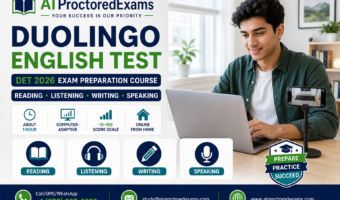
The Duolingo English Test (DET) 2026 Exam Preparation Course is a comprehensive online preparation program for students and professionals who need to demonstrate their English proficiency for university admission, international education or another academic application.
The course provides structured preparation for the four language skills assessed by the Duolingo English Test: Reading, Listening, Writing and Speaking. It covers the current computer-adaptive test format, individual question types, integrated language tasks, response strategies, time management and the technical requirements of taking the examination online.
Unlike a traditional English examination in which every candidate receives the same fixed set of questions, the Duolingo English Test uses an adaptive testing system. The difficulty of the questions changes according to the candidate’s performance. Correct answers can lead to more challenging questions, while incorrect answers help the system adjust the difficulty and collect additional evidence of the candidate’s proficiency.
This means that effective preparation requires more than memorizing model answers. Candidates must develop the vocabulary, grammar, comprehension, pronunciation and communication skills necessary to respond accurately to unfamiliar material.
Students can explore other available programs in the AIProctoredExams English Tests category or view the dedicated Duolingo English Test course category.
Understanding the Current Duolingo English Test
The Duolingo English Test is completed online using a compatible computer, a reliable internet connection and an approved smartphone positioned as a secondary camera. The examination normally takes approximately one hour, including the initial setup, adaptive assessment and ungraded samples shared with participating institutions.
According to the official Duolingo English Test structure guide, candidates complete an onboarding process before beginning the adaptive portion of the test. During onboarding, the system checks the candidate’s camera, microphone and speakers, verifies identification, reviews the test rules and provides instructions for positioning the smartphone camera.
The adaptive examination draws questions from a large item pool, so candidates should not expect to receive exactly the same sequence or number of questions as another test taker. The number of questions may also vary because the scoring engine continues collecting evidence until it has sufficient confidence in the candidate’s ability level.
This course prepares candidates for that uncertainty by teaching transferable language skills and repeatable response methods rather than relying on predictions about specific questions.
Current DET Question Types
The course provides focused instruction and practice for the question types currently listed in the official DET question guide, including:
-
Read and Select
-
Fill in the Blanks
-
Read and Complete
-
Listen and Type
-
Interactive Reading
-
Interactive Listening
-
Write About the Photo
-
Interactive Writing
-
Speak About the Photo
-
Read, Then Speak
-
Interactive Speaking
-
Writing Sample
-
Speaking Sample
Each lesson explains what the question measures, how the task is presented, how much time is available and which mistakes commonly reduce a candidate’s score.
Reading Preparation
The Reading section assesses vocabulary recognition, sentence-level comprehension, contextual understanding and the ability to analyze connected academic texts.
Read and Select
In Read and Select questions, candidates must identify which items are genuine English words. The challenge is distinguishing real vocabulary from invented words that may resemble English in spelling or pronunciation.
The course teaches students how to recognize common prefixes, suffixes, roots, spelling patterns and word families. Candidates also learn to avoid selecting an unfamiliar item simply because it appears sophisticated or resembles a word they already know.
Vocabulary practice is organized around academic, descriptive and everyday English so that students improve their overall lexical range instead of memorizing isolated word lists.
Fill in the Blanks
Fill in the Blanks questions require candidates to complete a partially missing word within a sentence. Success depends on understanding both the meaning of the sentence and the grammatical role of the missing word.
Students learn to use surrounding vocabulary, verb tense, subject–verb agreement, collocations and word formation to reconstruct the correct answer. The lessons also cover strategies for checking spelling before submitting a response.
Read and Complete
Read and Complete presents a passage in which letters have been removed from selected words. Candidates must restore the incomplete words while maintaining the meaning and grammatical accuracy of the passage.
The course develops contextual prediction, spelling accuracy and rapid passage comprehension. Students practise reading the entire passage before completing difficult words, using sentence structure to eliminate unlikely answers and checking whether each restored word fits the broader argument.
Interactive Reading
Interactive Reading uses a sequence of related activities based on the same passage. Tasks can involve completing sentences, inserting a missing sentence into a passage, highlighting an answer, identifying the main idea and selecting the most appropriate title.
Candidates learn how to:
-
Identify the subject, purpose and central argument of a passage
-
Distinguish a main idea from a supporting detail
-
Follow pronoun references and logical transitions
-
Recognize cause, contrast, comparison and sequence
-
Locate direct evidence without copying unrelated text
-
Select titles that represent the complete passage rather than one detail
-
Use completed questions to improve their understanding of later tasks
The course emphasizes active reading so candidates can understand how individual sentences contribute to the organization and meaning of an entire passage.
Listening Preparation
The Listening component evaluates the ability to understand spoken English, retain important information, recognize accurate wording and follow academic or everyday conversations.
Listen and Type
Listen and Type is a dictation-style task in which candidates hear a sentence and type exactly what was spoken. Accurate performance requires listening comprehension, working memory, spelling, grammar and punctuation.
Students practise capturing the sentence structure during the first playback, adding missing details during subsequent listening and proofreading the final transcription. Particular attention is given to articles, prepositions, verb endings, plural forms, contractions and words that sound similar.
Interactive Listening
Interactive Listening presents simulated conversations followed by several connected activities. Under the current format, candidates may complete missing parts of an introductory scenario, select appropriate responses during the conversation and write a summary of what occurred.
The official Interactive Listening update explains that the section includes two conversations. Candidates first complete Listen and Complete questions, continue through Listen and Respond activities and then summarize the interaction.
The course teaches students how to:
-
Identify the speakers, setting and purpose of the conversation
-
Recognize requests, suggestions, explanations and implied meaning
-
Follow changes in the conversation
-
Select a response that is both grammatically correct and contextually appropriate
-
Take effective mental notes without losing track of the dialogue
-
Summarize the situation, important information and final outcome
-
Paraphrase accurately instead of attempting to reproduce every sentence
Students complete guided and timed listening activities using different accents, speaking speeds and conversational situations.
Writing Preparation
The Writing component measures a candidate’s ability to communicate ideas clearly, accurately and logically under strict time limits. Written responses are assessed through features such as relevance, development, vocabulary, grammar, organization and overall clarity.
Write About the Photo
Candidates are shown an image and asked to write a detailed description. The official Write About the Photo guide provides one minute for the response.
The course teaches candidates to move beyond a basic list of visible objects. Students learn to establish the setting, identify the central action, describe relevant people or objects and add reasonable contextual detail without making unsupported claims.
Practice covers accurate use of:
-
Present continuous verbs for visible actions
-
Prepositions of place
-
Descriptive adjectives
-
Relative clauses
-
Linking expressions
-
Specific nouns and verbs
-
Cautious language when an interpretation is uncertain
Interactive Writing
Interactive Writing is a two-stage task. Candidates first respond to a written prompt and then receive a follow-up instruction based on the initial response. The official Interactive Writing guide provides five minutes for the first response and three minutes for the follow-up.
Students learn how to analyze the prompt, establish a clear position, develop supporting ideas and use the follow-up question to expand the response rather than repeat it. Lessons include planning techniques, paragraph development, examples, transitions and rapid proofreading.
The course also addresses common writing problems such as memorized introductions, excessive repetition, unsupported opinions, incomplete sentences and unnecessarily complicated vocabulary.
Writing Sample
The Writing Sample gives candidates five minutes to produce a longer response after a short preparation period. The response is shared with institutions that receive the candidate’s results, making clarity and presentation especially important. Current timing and delivery details are available in the official Writing Sample guide.
Candidates practise producing a focused opening, logically connected supporting points and a concise conclusion. They also learn how to leave enough time to correct spelling, punctuation and grammatical errors.
Speaking Preparation
The Speaking component evaluates intelligibility, fluency, pronunciation, vocabulary, grammatical control, relevance and the ability to develop a response in real time.
The objective is not to imitate a particular accent. Candidates need to speak clearly, maintain a natural pace and communicate ideas that directly address the prompt.
Speak About the Photo
Speak About the Photo requires candidates to describe an image orally. Candidates currently receive approximately 20 seconds to prepare before recording a response of up to 90 seconds, according to the official Speak About the Photo guide.
The course provides a flexible speaking framework covering the overall setting, main subject, visible actions, supporting details and a brief interpretation. Students learn how to continue speaking without repeating the same observation or inventing implausible details.
Read, Then Speak
Read, Then Speak presents a written topic and asks the candidate to deliver an extended oral response. The current task includes a short preparation period followed by approximately 90 seconds of speaking, as explained in the official Read, Then Speak guide.
Students practise organizing their response around a central answer, relevant reasons, examples and a short conclusion. The course also provides techniques for recovering from hesitation, correcting an error naturally and maintaining coherence when the candidate cannot immediately recall a word.
Interactive Speaking
Interactive Speaking simulates a conversation with an animated participant. The candidate responds to a sequence of questions, and later prompts may adapt according to earlier answers.
The official Interactive Speaking guide states that candidates receive between six and eight questions and have 35 seconds to answer each one.
This course prepares students to:
-
Answer immediately and directly
-
Add a relevant reason or example
-
Maintain continuity between responses
-
Respond appropriately to follow-up questions
-
Use conversational English without becoming overly informal
-
Avoid memorized statements that do not match the question
-
Maintain clear pronunciation and a steady speaking pace
Speaking Sample
The Speaking Sample includes a preparation period followed by an extended recorded response of up to three minutes. The video and prompt are shared with institutions receiving the candidate’s results. The format is explained in the official Speaking Sample guide.
Students practise planning quickly, sustaining a response, using examples and maintaining a professional on-camera presence.
DET Scores and Subscores
Duolingo English Test results are reported on a scale from 10 to 160. Candidates receive an overall score as well as Individual Subscores for Reading, Writing, Listening and Speaking.
The score report also includes Integrated Subscores:
-
Literacy combines Reading and Writing
-
Comprehension combines Reading and Listening
-
Production combines Writing and Speaking
-
Conversation combines Listening and Speaking
The overall result is calculated from the four Individual Subscores and rounded to the nearest five. Candidates can review the current scoring model and score comparisons on the official Duolingo English Test scores page.
The course helps students interpret diagnostic results, recognize their weakest language skills and develop a balanced preparation plan. Instead of concentrating only on a desired overall score, students learn how weaknesses in one skill can affect several individual and integrated subscores.
Test-Day Equipment and Security Requirements
Because the Duolingo English Test is completed remotely, compliance with the test rules is essential. Strong English performance does not guarantee a certified result if the testing environment or candidate behavior violates the examination requirements.
Candidates generally need:
-
A compatible computer with a camera, microphone and speakers
-
A reliable internet connection
-
A supported smartphone for the secondary camera
-
A valid government-issued identification document
-
A quiet, private and well-lit room
-
A clear desk and unobstructed view of the testing area
The smartphone must be positioned so that the secondary camera can monitor the computer screen, keyboard and surrounding area. Candidates may also be asked to complete a room scan and an ear scan.
Headphones, earbuds, notes, paper, additional people and unauthorized devices are not permitted. Students should confirm the most recent requirements through the official DET setup and secondary-camera guide before test day.
The course includes a practical setup checklist so candidates can identify technical or environmental problems before beginning the certified examination.
Your DET Preparation Pathway
The course follows a progressive study system:
Diagnostic assessment: Candidates begin by identifying their current level, target result and strongest and weakest skills.
Language development: Lessons strengthen vocabulary, grammar, reading comprehension, listening accuracy, written organization and spoken fluency.
Question-type training: Students learn how every current DET activity works before completing guided exercises.
Timed practice: Time limits are gradually introduced so candidates can maintain accuracy under realistic conditions.
Integrated practice: Reading, listening, writing and speaking skills are combined to reflect the demands of adaptive and interactive tasks.
Performance review: Students examine errors, classify their causes and create a focused improvement plan.
Test simulation: Full practice sessions develop concentration, timing, technical readiness and confidence.
Candidates are also encouraged to use the official free DET practice test to obtain an estimated score range and become familiar with the adaptive testing experience.
Common Mistakes Addressed in This Course
The course helps candidates recognize and correct mistakes that frequently limit performance, including:
-
Memorizing generic answers that do not address the prompt
-
Spending too much time on one adaptive question
-
Selecting invented words because they look familiar
-
Ignoring grammatical clues in incomplete-word questions
-
Giving image descriptions with insufficient detail
-
Repeating the prompt instead of developing an answer
-
Speaking rapidly at the expense of pronunciation
-
Using complex vocabulary inaccurately
-
Writing long sentences without clear punctuation
-
Forgetting to proofread typed responses
-
Summarizing a conversation without stating its outcome
-
Failing to test equipment or prepare the room in advance
-
Looking away from the screen excessively
-
Using headphones, paper or other prohibited materials
Who Should Enrol?
This Duolingo English Test preparation course is suitable for:
-
Students applying to universities or colleges that accept DET results
-
International applicants who need proof of English proficiency
-
Candidates taking the Duolingo English Test for the first time
-
Previous test takers seeking a stronger overall score
-
Candidates who need to improve one or more DET subscores
-
Learners who prefer structured preparation with guided practice
-
Busy candidates who need a flexible online study program
-
Students who want to understand the remote-testing rules before test day
Continue Your Preparation with AIProctoredExams
AIProctoredExams provides structured resources for candidates preparing for online and proctored examinations. Browse the complete course catalogue, review additional study guides or learn more about the study process on the How It Works page.
Candidates can also visit the AIProctoredExams blog for examination guidance, consult the frequently asked questions or contact the team through the Help Center.
Begin your preparation with a diagnostic assessment, follow the recommended study sequence and develop the language skills needed to approach the Duolingo English Test with greater accuracy, confidence and control.
Important Disclaimer
AIProctoredExams is an independent education and examination-preparation provider. It is not affiliated with, endorsed by or sponsored by Duolingo. Duolingo, the Duolingo English Test and DET are trademarks of their respective owner. Examination formats, security procedures, scoring policies and institutional requirements may change. Candidates should confirm current information on the official Duolingo English Test website before registering or taking the test.
Learning Objectives
Material Includes
- * Complete Duolingo English Test format and question-type guide
- * Reading, Listening, Writing and Speaking lesson modules
- * DET vocabulary development exercises and academic word lists
- * Interactive Reading practice passages with detailed explanations
- * Listen and Type dictation exercises with answer transcripts
- * Interactive Listening conversations and summary-writing activities
- * Timed writing prompts with model responses and evaluation checklists
- * Speaking prompts, response frameworks and self-assessment rubrics
- * Diagnostic assessments, progress checks and realistic practice tests
- * Test-day technology, room setup and secondary-camera checklist
Material Includes
- * Complete Duolingo English Test format and question-type guide
- * Reading, Listening, Writing and Speaking lesson modules
- * DET vocabulary development exercises and academic word lists
- * Interactive Reading practice passages with detailed explanations
- * Listen and Type dictation exercises with answer transcripts
- * Interactive Listening conversations and summary-writing activities
- * Timed writing prompts with model responses and evaluation checklists
- * Speaking prompts, response frameworks and self-assessment rubrics
- * Diagnostic assessments, progress checks and realistic practice tests
- * Test-day technology, room setup and secondary-camera checklist