
Praxis 5331 Study Guide: Complete SLP Review
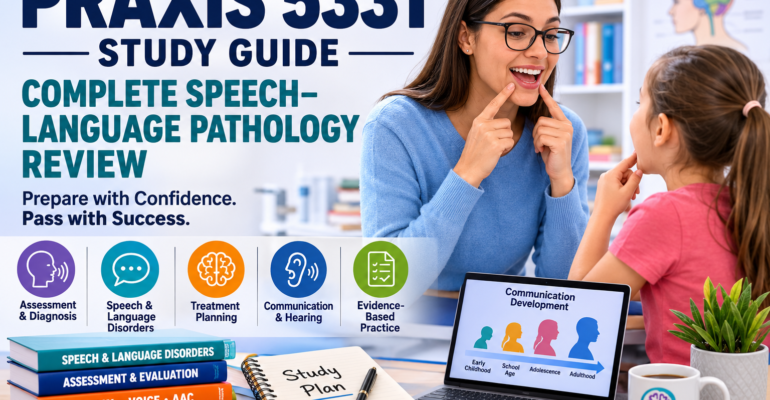

Praxis 5331 Study Guide: Complete Speech-Language Pathology Review
Preparing for the Speech-Language Pathology Praxis takes more than memorizing facts. You need to understand key ideas, recognize common disorders, read assessment results, choose suitable treatments, and apply sound clinical judgment.
This Praxis 5331 Study Guide gives you a clear review of the main areas tested on the exam. It covers professional practice, assessment, diagnosis, speech and language disorders, motor speech, fluency, voice, AAC, hearing, feeding and swallowing, treatment planning, and test-taking strategies.
According to ETS, the Speech-Language Pathology Praxis 5331 exam currently contains 132 selected-response questions and gives you 150 minutes to complete them. Therefore, good preparation should include both content review and timed practice.
For the latest testing details, visit the official ETS Praxis 5331 exam page. You can also review the official ASHA Praxis information for certification guidance.
For added practice, explore the Praxis 5331 Speech-Language Pathology Exam Preparation course from AIProctoredExams.
Praxis 5331 Study Guide: Exam Overview
Understanding the exam structure is an important first step. Once you know how the test is organized, you can divide your study time more wisely.
Praxis 5331 measures knowledge needed for entry-level work in speech-language pathology. The exam covers three broad areas:
- Foundations and Professional Practice
- Screening, Assessment, Evaluation, and Diagnosis
- Planning, Implementation, and Evaluation of Treatment
Each area is important. As a result, you should avoid spending too much time on only one topic.
In addition, many questions combine several skills. For example, a clinical scenario may ask you to recognize a disorder, choose an assessment, interpret the results, and then decide on a treatment plan.
That is why this Praxis 5331 Study Guide focuses on both knowledge and application.
You can also browse more Praxis and teacher exam preparation resources on AIProctoredExams.
What Is Tested on Praxis 5331?
Praxis 5331 covers many areas of speech-language pathology. Therefore, your study plan should be broad.
Important topics include:
- Speech sound production
- Articulation and phonology
- Fluency
- Voice and resonance
- Motor speech
- Receptive language
- Expressive language
- Pragmatics
- Cognitive communication
- Augmentative and Alternative Communication
- Hearing
- Feeding and swallowing
- Assessment and diagnosis
- Treatment planning
- Ethics
- Evidence-based practice
Although the list may look long, you can manage it by studying one section at a time.
Praxis 5331 Study Guide: Foundations and Professional Practice
Foundational knowledge supports almost every other part of the exam. Therefore, do not treat this section as background information only.
You should understand normal communication development, basic anatomy, neurological systems, professional duties, ethics, and evidence-based practice.
Typical Communication Development
First, review how speech and language normally develop.
Important areas include:
- Speech sound development
- Vocabulary growth
- Receptive language
- Expressive language
- Morphology
- Syntax
- Semantics
- Pragmatics
- Social communication
- Early literacy
- Feeding development
Knowing what is typical makes it easier to identify what may be delayed or disordered.
For example, if you understand normal speech sound development, you are more likely to recognize whether an error pattern is expected for a child’s age.
Anatomy and Physiology
You also need basic knowledge of the body systems used for speech, voice, hearing, and swallowing.
Focus on:
- Respiratory support
- Laryngeal function
- Oral structures
- Pharyngeal structures
- Cranial nerves
- Major brain areas
- Swallowing structures
However, avoid memorizing structures without learning what they do.
Instead, connect each structure to its function. This approach makes clinical questions easier to solve.
Neurological Foundations
Neurology is another important area.
Review:
- Brain areas linked to language
- Motor planning
- Motor control
- Cranial nerve function
- Stroke
- Traumatic brain injury
- Dementia
- Progressive neurological disease
For instance, a question may describe certain symptoms and ask which disorder is most likely. In that case, understanding the link between brain function and communication can help you choose the best answer.
Evidence-Based Practice
Evidence-based practice means using research, clinical skill, and client needs together when making decisions.
Therefore, treatment should not be chosen simply because it is familiar.
Instead, ask whether the approach:
- Fits the client’s needs
- Has research support
- Is within the SLP’s scope
- Matches the client’s goals
- Can be measured
- Can be adjusted if needed
In many Praxis questions, more than one option may seem reasonable. However, one answer will usually fit the client better than the others.
Cultural and Linguistic Considerations
Speech-language pathologists work with people from many language and cultural backgrounds.
For that reason, a language difference should not automatically be called a disorder.
When assessing multilingual or multidialectal clients, consider:
- Language history
- Exposure to each language
- Cultural background
- Dialect
- Family input
- Teacher input
- Dynamic assessment
- Language samples
- Performance in different settings
In addition, a standardized test score should not always be used alone.
A fuller evaluation often provides a better picture of the client’s communication skills.
Ethics and Professional Responsibilities
Ethics questions may cover:
- Confidentiality
- Consent
- Record keeping
- Scope of practice
- Referrals
- Professional competence
- Conflicts of interest
- Teamwork
When you are unsure, focus on client safety, professional rules, and proper practice.
Also, remember that an SLP should refer a client when another professional’s skills are needed.
Praxis 5331 Study Guide: Screening, Assessment, Evaluation and Diagnosis
Assessment is a major part of Praxis 5331. Therefore, it deserves a large share of your study time.
A good clinician does more than give a test. The clinician must know why the test is being used, whether it fits the client, and how the results should guide the next step.
Screening Versus Evaluation
Screening helps identify people who may need more testing.
However, screening usually does not provide enough information for a full diagnosis.
A complete evaluation, on the other hand, looks more closely at the client’s strengths, needs, and daily communication.
So, when reading a Praxis question, first ask whether the situation involves screening or full assessment.
Standardized Assessment
Standardized tests follow set rules for administration and scoring.
They may provide:
- Standard scores
- Percentile ranks
- Norm comparisons
- Age or grade comparisons
Even so, a standardized test must be suitable for the client.
For example, language background, age, disability, culture, and the test’s norm group may affect how results should be interpreted.
Informal and Functional Assessment
In addition to standardized testing, clinicians may use:
- Interviews
- Observations
- Language samples
- Speech samples
- Dynamic assessment
- Caregiver reports
- Teacher reports
- Functional communication tasks
These methods can provide useful information that a formal test may miss.
Therefore, strong assessment often uses more than one source of information.
Reliability, Validity, Sensitivity, and Specificity
These concepts are important because they help you judge the quality of an assessment.
Reliability
Reliability means consistency.
For example, if a test produces similar results under similar conditions, it has stronger reliability.
Validity
Validity asks whether the test actually measures what it is supposed to measure.
Therefore, a highly consistent test is not automatically useful if it measures the wrong skill.
Sensitivity
Sensitivity is the ability of a test to correctly identify people who have the target condition.
Specificity
Specificity is the ability of a test to correctly identify people who do not have the condition.
These ideas are easier to remember when you connect them to real examples.
Differential Diagnosis
Differential diagnosis means telling similar disorders apart.
Common comparisons include:
- Apraxia versus dysarthria
- Articulation disorder versus phonological disorder
- Language difference versus language disorder
- Aphasia versus cognitive-communication disorder
- Typical disfluency versus stuttering
- Voice disorder versus resonance disorder
When answering these questions, look at the full pattern of symptoms.
In other words, do not make a decision based on one clue alone.
Praxis 5331 Study Guide: Speech Sound Disorders
Speech sound disorders may involve articulation or phonology.
Articulation
Articulation refers to how individual sounds are produced.
Common errors include:
- Substitutions
- Omissions
- Distortions
- Additions
For example, a child may have trouble producing one or two sounds even though the overall sound system is mostly intact.
Phonological Disorders
Phonological disorders involve patterns in the way sounds are organized.
Examples include:
- Fronting
- Final consonant deletion
- Stopping
- Cluster reduction
- Gliding
- Weak syllable deletion
Therefore, it is important to know the difference between an isolated sound error and a broader sound pattern.
Fluency Disorders
Fluency questions may focus on stuttering, cluttering, assessment, counseling, and treatment.
Possible signs of stuttering include:
- Sound repetitions
- Syllable repetitions
- Prolongations
- Blocks
- Physical tension
- Secondary behaviors
- Avoidance
- Negative reactions
However, assessment should not focus only on the number of disfluencies.
Instead, consider how the problem affects communication, confidence, and daily life.
Voice and Resonance
Voice depends on breathing, sound production, and resonance.
Important topics include:
- Pitch
- Loudness
- Vocal quality
- Respiratory support
- Phonation
- Laryngeal function
Resonance topics include:
- Hypernasality
- Hyponasality
- Velopharyngeal function
- Structural problems
- Neurological causes
In some cases, the best answer may be a referral rather than direct treatment.
Therefore, always consider professional scope and client safety.
Praxis 5331 Study Guide: Motor Speech Disorders
Motor speech disorders are another high-value topic.
Dysarthria
Dysarthria results from problems with muscle control.
It may affect:
- Breathing
- Voice
- Resonance
- Articulation
- Prosody
Depending on the type, weakness, poor coordination, abnormal tone, or involuntary movement may be present.
Apraxia of Speech
Apraxia of speech mainly affects motor planning.
Possible signs include:
- Inconsistent errors
- Groping
- Difficulty starting speech
- Distorted substitutions
- Prosody problems
- Greater difficulty with longer words
Therefore, the key difference is that apraxia is not mainly caused by muscle weakness.
Receptive and Expressive Language
Language includes several connected areas.
Morphology
Morphology deals with meaningful parts of words.
Syntax
Syntax deals with how words are arranged into sentences.
Semantics
Semantics deals with word meaning and vocabulary.
Pragmatics
Pragmatics deals with the social use of language.
For children, language problems may affect school performance, reading, writing, and social skills.
For adults, language problems may occur after stroke or other neurological events.
If you are also preparing for literacy-related Praxis exams, explore the Praxis 5205 Teaching Reading: Elementary Exam Preparation course.
Social Communication and Pragmatics
Social communication includes the ability to use language properly in different situations.
Important skills include:
- Turn-taking
- Topic maintenance
- Conversation repair
- Understanding inference
- Reading nonverbal cues
- Adjusting language for the listener
- Understanding social context
Because communication changes across settings, assessment should include real-life situations when possible.
Cognitive-Communication Disorders
Cognitive-communication problems can affect daily communication.
Review:
- Attention
- Memory
- Planning
- Problem solving
- Reasoning
- Organization
- Self-monitoring
- Information processing
These problems may appear after traumatic brain injury, stroke, dementia, or other neurological conditions.
Therefore, Praxis questions may ask how a thinking problem affects communication or daily function.
Praxis 5331 Study Guide: Augmentative and Alternative Communication
AAC includes tools and methods that support people who cannot meet all of their communication needs through speech alone.
Examples include:
- Gestures
- Signs
- Picture boards
- Communication books
- Written communication
- Speech-generating devices
- Mobile devices
When choosing an AAC system, consider:
- Communication needs
- Motor access
- Vision
- Hearing
- Language level
- Literacy
- Environment
- Communication partners
Most importantly, the system should improve real-life communication.
Hearing and Aural Rehabilitation
Hearing affects both speech and language.
Therefore, SLPs need basic knowledge of:
- Hearing loss
- Hearing screening
- Audiograms
- Speech and language effects
- Referral
- Communication strategies
- Teamwork with audiologists
If hearing problems are suspected, an audiology referral may be the best next step.
Praxis 5331 Study Guide: Feeding and Swallowing
Feeding and swallowing require both anatomy knowledge and clinical judgment.
Review:
- Swallowing stages
- Oral control
- Pharyngeal function
- Airway protection
- Neurological causes
- Structural causes
- Medical factors
Dysphagia Assessment
Assessment may include:
- Medical history
- Patient interview
- Oral mechanism exam
- Clinical swallowing evaluation
- Meal observation
- Instrumental testing
However, not every swallowing problem can be fully understood from bedside signs alone.
Therefore, additional testing may sometimes be required.
Aspiration and Safety
Possible warning signs may raise concern for aspiration.
Even so, clinicians should avoid making unsupported assumptions.
Instead, they should use the available findings to decide whether more evaluation, referral, or treatment changes are needed.
Dysphagia Treatment
Treatment may depend on:
- Safety
- Nutrition
- Hydration
- Medical condition
- Client goals
- Caregiver needs
- Quality of life
As a result, there is rarely one treatment that fits every person.
Praxis 5331 Study Guide: Treatment Planning
Assessment results should guide treatment.
A good plan should match the client’s needs and include clear goals.
Writing Goals
Goals should be:
- Specific
- Useful
- Measurable
- Realistic
- Connected to daily needs
For example, a goal should clearly state what improvement will be measured.
Choosing Treatment
When several treatments seem possible, compare each option with the client’s diagnosis, age, severity, goals, and assessment results.
Then choose the option that best fits the case.
Measuring Progress
Treatment should include regular data collection.
That data can show whether:
- The client is improving
- A goal needs to change
- The treatment should be adjusted
- More assessment is needed
- Discharge may be appropriate
Therefore, progress monitoring is part of treatment, not an extra step.
How to Use This Praxis 5331 Study Guide Effectively
Reading alone is not enough.
Instead, use active study methods.
Step 1: Find Your Weak Areas
Start with practice questions or a self-check.
Then identify which areas need more work.
Possible weak areas may include:
- Assessment
- Speech sound disorders
- Language
- Motor speech
- Dysphagia
- AAC
- Ethics
- Treatment
After that, spend more time on weak topics while still reviewing stronger ones.
Step 2: Study One Topic at a Time
Large topics can feel overwhelming.
Therefore, divide them into smaller parts.
For example, instead of reviewing all neurological disorders at once, study aphasia first, then motor speech, then cognitive communication.
Step 3: Practice Recall
After reading a section, close your notes.
Next, explain the topic from memory.
Ask:
- What is this disorder?
- What are the main signs?
- How is it assessed?
- What can look similar?
- What treatment may help?
If you cannot explain the topic clearly, review it again.
Step 4: Answer Practice Questions
Practice questions help turn knowledge into exam skill.
For additional structured practice, use the Praxis 5331 Speech-Language Pathology Exam Preparation course.
Step 5: Review Mistakes
Do not simply mark a wrong answer and move on.
Instead, ask:
- Why was my answer wrong?
- Why was the correct answer stronger?
- What clue did I miss?
- What topic should I review?
- Could I answer a similar question next time?
This process can improve both knowledge and reasoning.
Four-Week Praxis 5331 Study Plan
Week 1: Foundations and Assessment
Review:
- Normal development
- Anatomy
- Neurology
- Ethics
- Evidence-based practice
- Screening
- Standardized testing
- Reliability
- Validity
- Differential diagnosis
In addition, complete short practice sets after each topic.
Week 2: Speech and Language
Study:
- Speech sound disorders
- Phonology
- Fluency
- Voice
- Resonance
- Language development
- Aphasia
- Pragmatics
Then review any missed questions before moving on.
Week 3: Complex Clinical Areas
Focus on:
- Dysarthria
- Apraxia
- Cognitive communication
- AAC
- Hearing
- Feeding and swallowing
At the same time, continue mixed practice so earlier topics stay fresh.
Week 4: Treatment and Final Review
Complete:
- Treatment planning
- Goal writing
- Timed practice
- Weak-area review
- Mixed questions
- Full-length practice
Finally, spend the last few days reviewing errors rather than learning large amounts of new material.
Praxis 5331 Practice Questions
Question 1
A preschool child consistently substitutes /t/ for /k/ and /d/ for /g/. Which phonological process best describes this pattern?
A. Gliding
B. Fronting
C. Stopping
D. Final consonant deletion
Correct Answer: B. Fronting
Fronting occurs when a sound made further back in the mouth is replaced with one made further forward.
Question 2
An adult shows inconsistent speech errors, visible groping, and trouble planning speech movements. Muscle strength is normal. Which condition best fits these signs?
A. Flaccid dysarthria
B. Apraxia of speech
C. Conductive hearing loss
D. Spasmodic dysphonia
Correct Answer: B. Apraxia of speech
Apraxia mainly affects speech planning rather than muscle strength.
Question 3
A test produces similar results when used more than once under similar conditions. Which feature does this show?
A. Sensitivity
B. Validity
C. Reliability
D. Specificity
Correct Answer: C. Reliability
Reliability refers to consistency.
Question 4
A multilingual child receives a low score on a standardized language test. What should the clinician do next?
A. Diagnose a disorder immediately
B. Start treatment based only on the score
C. Gather more culturally and linguistically suitable information
D. Ignore the child’s language background
Correct Answer: C.
More information is needed before making a diagnosis.
Question 5
A client shows little progress after a fair period of treatment. What should the SLP do?
A. Continue the same plan forever
B. Stop collecting data
C. Review the treatment plan and clinical information
D. Discharge the client immediately
Correct Answer: C.
Progress data should guide treatment decisions.
Praxis 5331 Test-Taking Strategies
Good exam technique can improve your performance.
Read the Whole Question
First, read every part of the question.
Some answer choices may sound correct but may not fully answer what is being asked.
Watch for Key Words
Look for words such as:
- BEST
- FIRST
- MOST likely
- MOST appropriate
- NEXT
- PRIMARY
These words can change the answer.
Use the Clinical Details
Pay attention to:
- Age
- Diagnosis
- Symptoms
- Medical history
- Language background
- Test results
- Setting
- Severity
These details often point toward the best response.
Remove Weak Answers
Eliminate choices that:
- Fall outside SLP scope
- Ignore important information
- Make unsafe assumptions
- Break ethical rules
- Do not address the main concern
As a result, even difficult questions can become easier.
Manage Your Time
Praxis 5331 gives you 150 minutes for 132 questions.
Therefore, you have a little more than one minute per question on average.
Do not spend too long on one item. Instead, make the best choice you can and continue.
Frequently Asked Questions About the Praxis 5331 Study Guide
What is Praxis 5331?
Praxis 5331 is the Speech-Language Pathology Praxis exam used for professional certification and licensing purposes.
However, requirements can vary by state or credentialing body.
How many questions are on Praxis 5331?
The current exam contains 132 selected-response questions and allows 150 minutes.
What should I study for Praxis 5331?
Review foundations, assessment, speech, language, fluency, voice, motor speech, AAC, hearing, swallowing, treatment, ethics, and clinical reasoning.
This Praxis 5331 Study Guide covers each of those major areas.
Is Praxis 5331 difficult?
It can be challenging because it covers many clinical topics.
However, a clear study plan and regular practice can make preparation much easier.
How long should I study?
There is no single answer.
For many test takers, a four- to six-week plan provides a useful structure. However, you may need more time if several content areas are weak.
Should I use practice tests?
Yes.
Practice tests can improve pacing, recall, and confidence. In addition, they help you identify weak areas before test day.
What is the best way to prepare?
Combine:
- Content review
- Active recall
- Practice questions
- Timed practice
- Clinical scenarios
- Review of mistakes
As a result, you build both knowledge and test-taking skill.
Related Praxis Preparation Resources
If you are preparing for another Praxis exam, explore the Praxis 5205 Teaching Reading: Elementary Exam Preparation course.
You can also browse the Teachers exam preparation category for more Praxis resources.
In addition, AIProctoredExams offers a growing collection of exam preparation courses designed to help learners review important topics, identify weak areas, and improve exam readiness.
Final Praxis 5331 Study Guide Tips
Successful preparation comes from regular practice.
Therefore, do not spend all your time rereading topics you already know well.
Instead, focus more attention on weaker areas and connect every topic to three questions:
How would I recognize it?
How would I assess it?
How would I treat or manage it?
This simple method helps connect knowledge with clinical reasoning.
In addition, review every missed practice question. Compare similar disorders side by side. Complete timed questions so pacing becomes easier.
Most importantly, stay systematic.
First, identify the client’s main concern. Next, review the details in the scenario. Then consider safety, scope of practice, and the client’s needs. Finally, choose the answer that best fits the evidence.
Start Your Praxis 5331 Preparation
This Praxis 5331 Study Guide gives you a clear framework for reviewing major Speech-Language Pathology topics. However, your preparation will be stronger when you combine review with regular practice.
The Praxis 5331 Speech-Language Pathology Exam Preparation course provides additional structured review, practice questions, clinical scenarios, and answer explanations.
You can also explore more Praxis and teacher exam preparation resources as you build your study plan.
Use this Praxis 5331 Study Guide consistently. Focus on weak areas, practice applying clinical knowledge, and review why each answer is correct or incorrect.
Prepare. Practice. Review. Improve.
AIProctoredExams is an independent exam-preparation provider and is not affiliated with, endorsed by, or sponsored by ETS or ASHA. Always confirm current testing, certification, and licensing requirements with the appropriate official organizations.